
We read your photo as:
What are the key characteristics and developmental focuses of middle childhood, early adulthood, adolescence, and middle adulthood?
ScanSolve AI Answer
here are the answers to your questions:
-
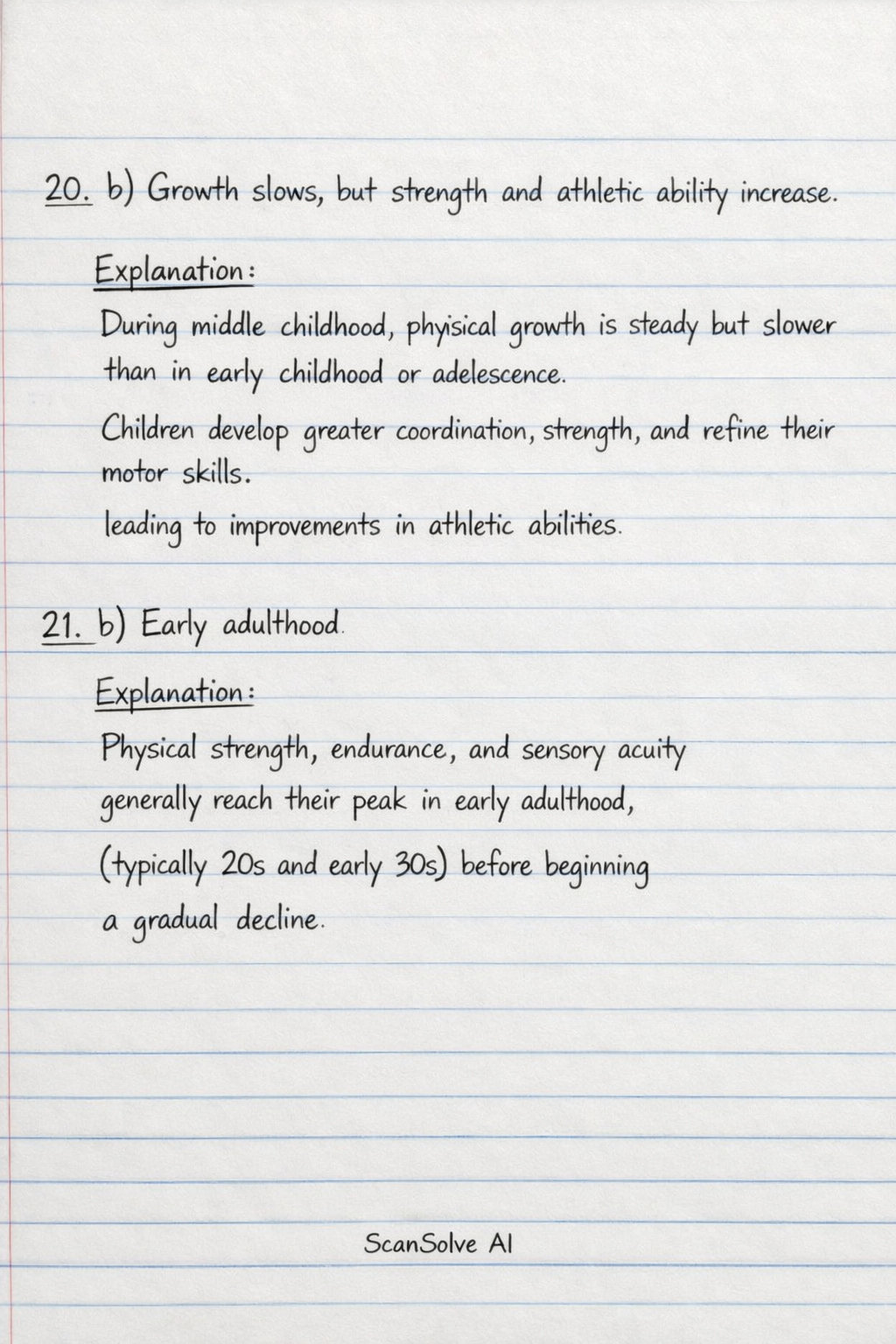
What is a key characteristic of the middle childhood stage (ages 6 to 11)? b) Growth slows, but strength and athletic ability increase. Explanation: During middle childhood, physical growth is steady but slower than in early childhood or adolescence. Children develop greater coordination, strength, and refine their motor skills, leading to improvements in athletic abilities.
-
At what life stage do most people experience physical peaks followed by slight declines? b) Early adulthood Explanation: Physical strength, endurance, and sensory acuity generally reach their peak in early adulthood (typically 20s and early 30s) before beginning a gradual decline.
-
Which of the following is a primary focus of adolescence (ages 11 to 18)? b) Discovering personal identity apart from parents Explanation: A central developmental task of adolescence is the formation of a coherent sense of self and identity, often involving exploration of values, beliefs, and roles independent of parental influence.
-
In which stage do people often notice changes in vision, hearing, and physical stamina? b) Middle adulthood Explanation: While individual variations exist, many people begin to notice subtle to moderate declines in sensory abilities (like vision and hearing) and physical stamina during middle adulthood (typically 40s to early 60s).
-
What is one of the main characteristics of late adulthood (65 years and beyond)? a) A decline in physical condition and reaction time Explanation: Late adulthood is characterized by a general decline in various physical functions, including muscle strength, bone density, sensory perception, and cognitive processing speed, which affects reaction time.
-
What is an important social change during late adulthood? c) Older adults adjust to retirement and personal losses. Explanation: Late adulthood often involves significant social transitions such as retirement from work, which changes daily routines and social networks, and coping with the loss of spouses, friends, and other loved ones.
-
During which stage do individuals typically adjust to and accept the loss of loved ones? b) Late adulthood Explanation: While loss can occur at any stage, the frequency and cumulative impact of losing spouses, siblings, and friends become a prominent and challenging adjustment task in late adulthood.
-
What are the two primary tasks of social psychology? b) Observation and testing Explanation: Social psychology, as a scientific discipline, primarily involves observing social phenomena and human behavior, and then testing hypotheses and theories through systematic research methods (like experiments and surveys) to understand and explain these phenomena.
Still stuck on this one?
Ask a follow-up, and the answer starts from this question.
More Psychology Questions
Handwritten Step-by-Step Solution
Get this as a handwritten image on WhatsApp — like a tutor wrote it for you.
Try on WhatsApp