
We read your photo as:
Explain three benefits of using mediation to resolve conflict in a family.
ScanSolve AI Answer
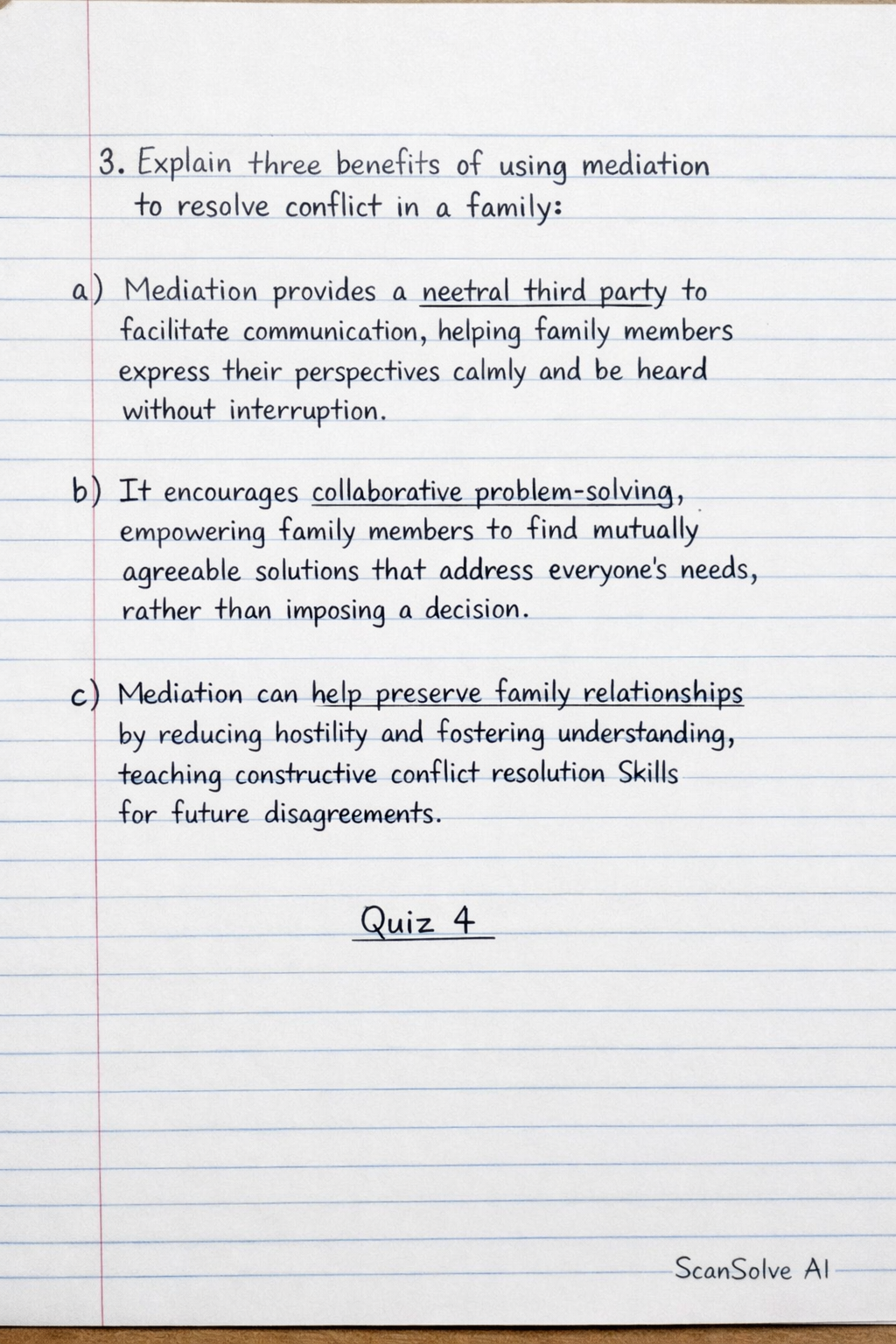
3. Explain three benefits of using mediation to resolve conflict in a family:
- a) Mediation provides a neutral third party to facilitate communication, helping family members express their perspectives calmly and be heard without interruption.
- b) It encourages collaborative problem-solving, empowering family members to find mutually agreeable solutions that address everyone's needs, rather than imposing a decision.
- c) Mediation can help preserve family relationships by reducing hostility and fostering understanding, teaching constructive conflict resolution skills for future disagreements.
Quiz 4
1. Describe three core components of a healthy family relationship that contribute to peace and stability:
- a) Open and Honest Communication: Family members can freely express thoughts, feelings, and needs without fear of judgment, leading to mutual understanding and trust.
- b) Mutual Respect and Support: Each member values the opinions and individuality of others, offering emotional and practical support during challenges and celebrating successes.
- c) Shared Values and Goals: The family has common principles and aspirations, which guide their decisions and actions, creating a sense of unity and purpose.
2. Imagine a sibling is feeling sad and isolated after a family disagreement. Explain two ways another family member can show empathy and support to help them feel understood:
- a) Active Listening and Validation: The family member can sit with the sibling, listen attentively to their feelings without interrupting, and validate their emotions by saying something like, "I can see why you'd feel sad and isolated right now; that sounds really tough."
- b) Offer Comfort and Presence: They can offer a hug or simply sit quietly with the sibling, letting them know they are not alone. They might say, "I'm here for you, whatever you need," showing unconditional support.
3. A group of learners is role-playing scenarios in the family where empathy is shown. Describe three actions or phrases that would effectively demonstrate empathy in their role-play:
- a) Active Listening with Body Language: The learner playing the empathetic family member would maintain eye contact, nod occasionally, and lean in slightly, showing they are fully engaged and paying attention to the other person's feelings.
- b) Validating Phrases: They would use phrases like, "It sounds like you're feeling really frustrated right now," or "I can understand why you'd be upset about that," to acknowledge and affirm the other person's emotions.
- c) Perspective-Taking Statements: They might say, "If I were in your shoes, I think I'd feel the same way," or "I can imagine how difficult that must be for you," to show they are trying to understand the situation from the other person's point of view.
Still stuck on this one?
Ask a follow-up, and the answer starts from this question.
More Psychology Questions
Handwritten Step-by-Step Solution
Get this as a handwritten image on WhatsApp — like a tutor wrote it for you.
Try on WhatsApp