

This biology question covers important biological concepts and processes. The step-by-step explanation below helps you understand the underlying mechanisms and reasoning.
ScanSolve AI Answer
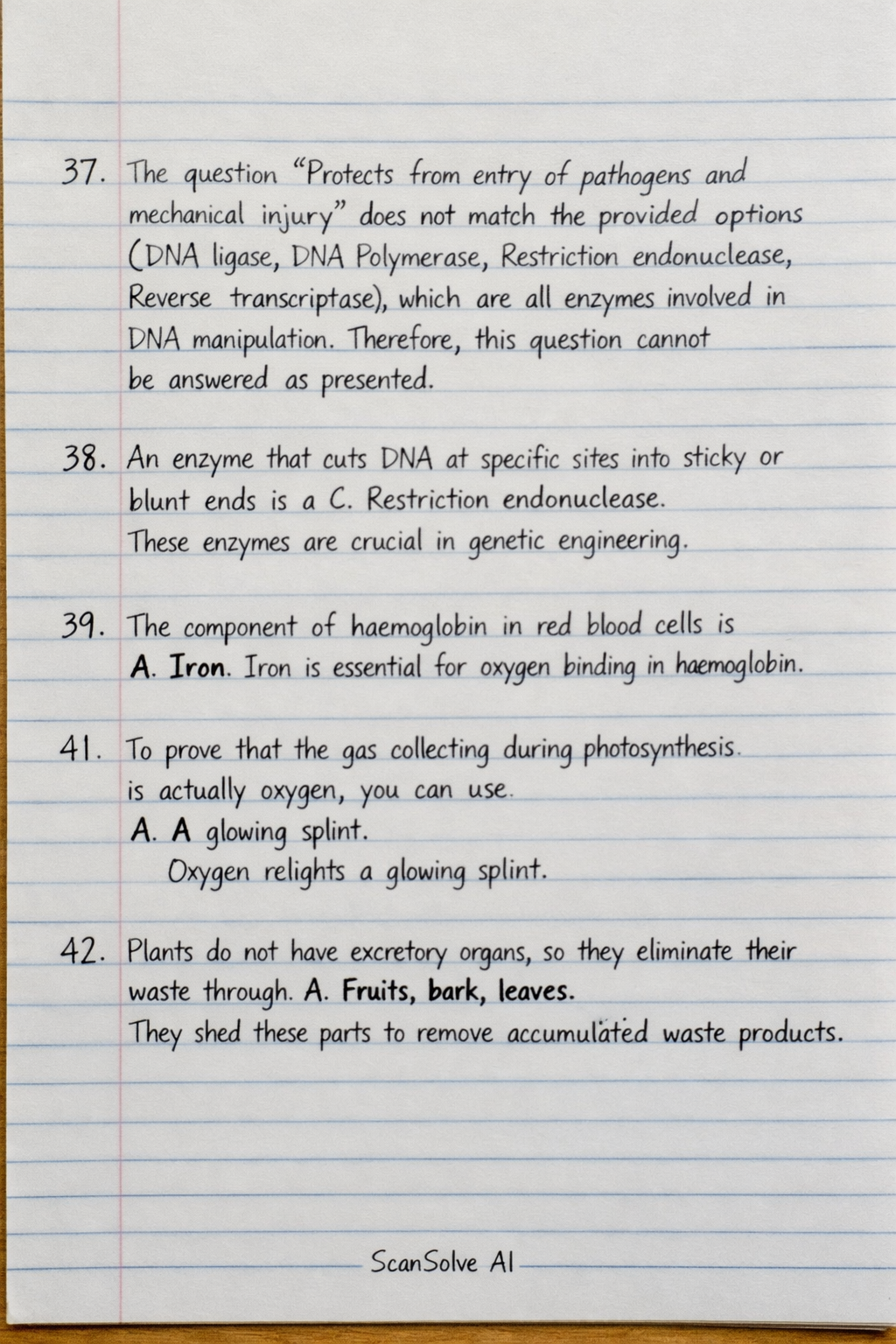
Here are the answers to the questions from the image: 37. The question "Protects from entry of pathogens and mechanical injury" does not match the provided options (DNA ligase, DNA Polymerase, Restriction endonuclease, Reverse transcriptase), which are all enzymes involved in DNA manipulation. Therefore, this question cannot be answered as presented. 38. An enzyme that cuts DNA at specific sites into sticky or blunt ends is a C. Restriction endonuclease. These enzymes are crucial in genetic engineering. 39. The component of haemoglobin in red blood cells is A. Iron. Iron is essential for oxygen binding in haemoglobin. 41. To prove that the gas collecting during photosynthesis is actually oxygen, you can use A. A glowing splint. Oxygen relights a glowing splint. 42. Plants do not have excretory organs, so they eliminate their waste through A. Fruits, bark, leaves. They shed these parts to remove accumulated waste products. 43. One major advantage of tissue culture in micropropagation is that it B. Produces large numbers of identical plants in disease-free conditions. This allows for rapid propagation of desirable traits. 44. If you choke when eating, it is likely caused by C. Entry of solid or liquid particles into the trachea. This happens when food or drink accidentally enters the windpipe instead of the esophagus. 45. The movement of water molecules from a region of high-water potential to that with lower-water potential through a selectively permeable membrane is D. Osmosis. This is the definition of osmosis. 46. If a marine Amoeba is placed in fresh water, B. Water enters the cell by osmosis but the contractile vacuole sends out excess water. Marine organisms are hypertonic to fresh water, so water will move in. If it has a contractile vacuole, it will pump out the excess water to prevent lysis. 47. The set of environmental conditions that favours the least rate of transpiration in plants is A. Cool, humid and still day. Low temperature, high humidity, and no wind reduce the rate of water evaporation from leaves. 48. Blood is red and lymph is colourless or pale-yellow because C. Blood has haemoglobin but lymph lacks haemoglobin. Haemoglobin in red blood cells gives blood its characteristic red color. 49. Given the blood sugar values after two hours (Person A: 190mg/dl, Person B: 100mg/dl, Person C: 90mg/dl), the persons with normal functioning pancreas and liver are B. Both persons B and C. Normal post-prandial blood sugar is typically below 140 mg/dl. 50. Humans experience rapid breathing after vigorous exercise because C. They are repaying the oxygen debt to oxidize the accumulated lactic acid. During intense exercise, anaerobic respiration produces lactic acid, and extra oxygen is needed to break it down. Last free one today — make it count tomorrow, or type /upgrade for unlimited.