

This physics problem tests your understanding of fundamental physical laws and their applications. The step-by-step solution below breaks down the problem using relevant equations and physical reasoning.
ScanSolve AI Answer
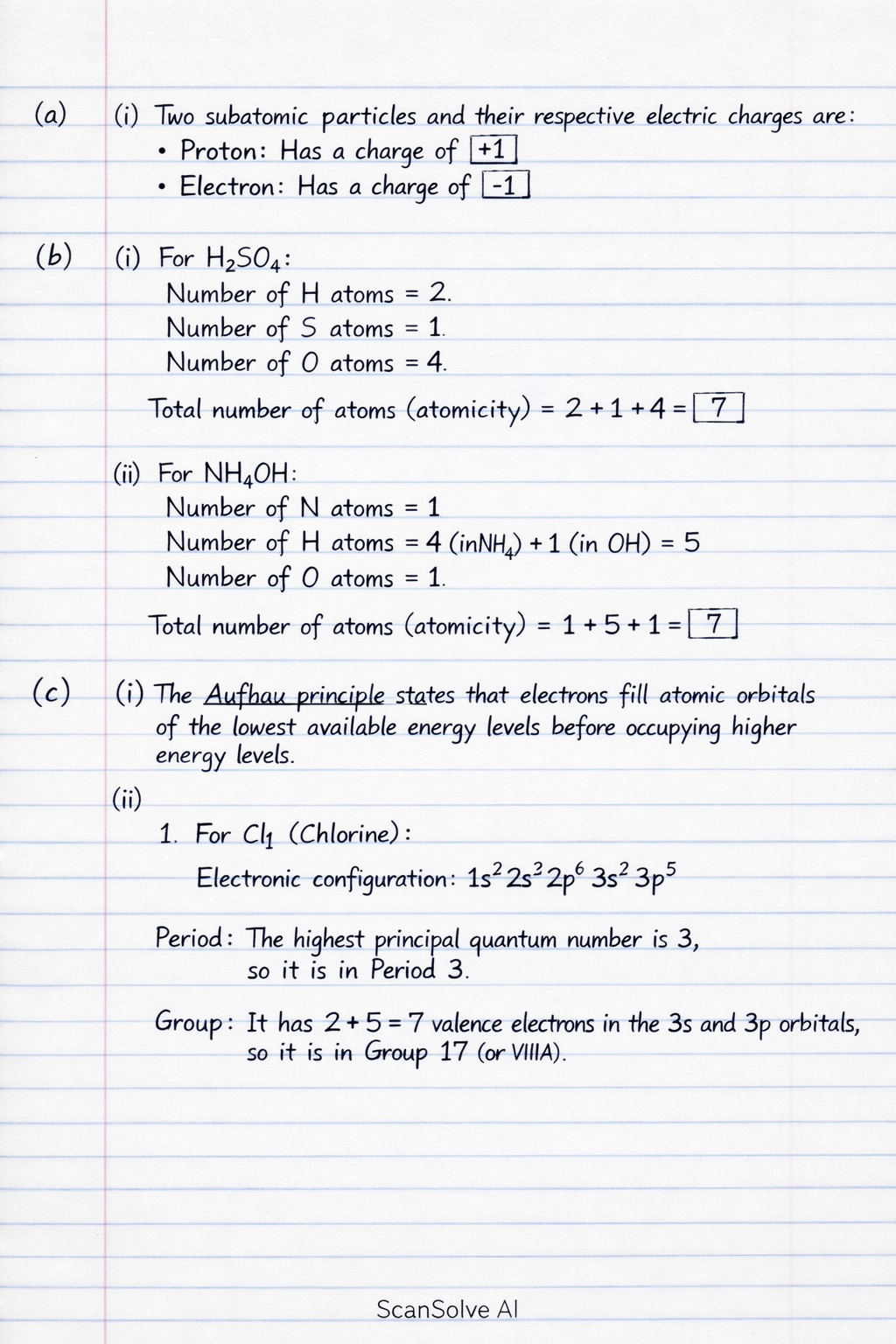
a) (i) Two subatomic particles and their respective electric charges are: • Proton: Has a charge of +1. • Electron: Has a charge of -1. b) (i) For H_2SO_4: Number of H atoms = 2 Number of S atoms = 1 Number of O atoms = 4 Total number of atoms (atomicity) = 2 + 1 + 4 = 7 (ii) For NH_4OH: Number of N atoms = 1 Number of H atoms = 4 (in NH_4) + 1 (in OH) = 5 Number of O atoms = 1 Total number of atoms (atomicity) = 1 + 5 + 1 = 7 c) (i) The Aufbau principle states that electrons fill atomic orbitals of the lowest available energy levels before occupying higher energy levels. (ii) 1. For Cl_17 (Chlorine): Electronic configuration: 1s^2 2s^2 2p^6 3s^2 3p^5 Period: The highest principal quantum number is 3, so it is in Period 3. Group: It has 2+5=7 valence electrons in the 3s and 3p orbitals, so it is in Group 17 (or VIIA). 2. For Mg_12 (Magnesium): Electronic configuration: 1s^2 2s^2 2p^6 3s^2 Period: The highest principal quantum number is 3, so it is in Period 3. Group: It has 2 valence electrons in the 3s orbital, so it is in Group 2 (or IIA). d) (i) 2Na + Cl_2 2NaCl This is a combination reaction (or synthesis reaction), where two or more reactants combine to form a single product. (ii) 2H_2O_2 2H_2O + O_2 This is a decomposition reaction, where a single compound breaks down into two or more simpler substances. That's 2 down. 3 left today — send the next one.