
We read your photo as:
Calculate the cost of goods sold (COGS) for scenarios a, b, and c.
ScanSolve AI Answer
Answers
5 partsStep-by-step solution
9 stepshere are the solutions to the short answer questions:
Part 11
To calculate the cost of goods sold (COGS), we use the formula:
Where Purchases = Cash Purchases + Credit Purchases.
Part a
Calculate total purchases.
Calculate Cost of Goods Sold.
The cost of goods sold for scenario a is .
Part b
Calculate total purchases.
Calculate Cost of Goods Sold.
The cost of goods sold for scenario b is .
Part c
Calculate total purchases.
(Refund Inward relates to sales, not purchases, so it is not included in COGS calculation here).
Calculate Cost of Goods Sold.
The cost of goods sold for scenario c is .
Part 12
The provided table lists transactions with "SUPPLIER OR TRADE CREDITOR," indicating these are purchases made by the business from its suppliers. The "AMOUNT (K)" column represents the value of these credit purchases. The table does not contain any information about sales to customers.
Therefore, the amount for credit sales cannot be determined from the given information.
The amount for credit sales is .
Part 13
A liability in the balance sheet represents amounts owed by the business. From the table, we need to calculate the total amount owed to suppliers (trade creditors).
Calculate total credit purchases (amounts from suppliers).
Identify total payments made to suppliers.
The "ACCOUNT PAID" column shows payments of K200.00 and K518.00, with a total of K718.00.
Calculate the amount still owed (liability).
The amount that will be shown as a liability in the balance sheet is .
Try one yourself
A new problem that tests the same skill.
Still stuck on this one?
Ask a follow-up, and the answer starts from this question.
More Accounting Questions
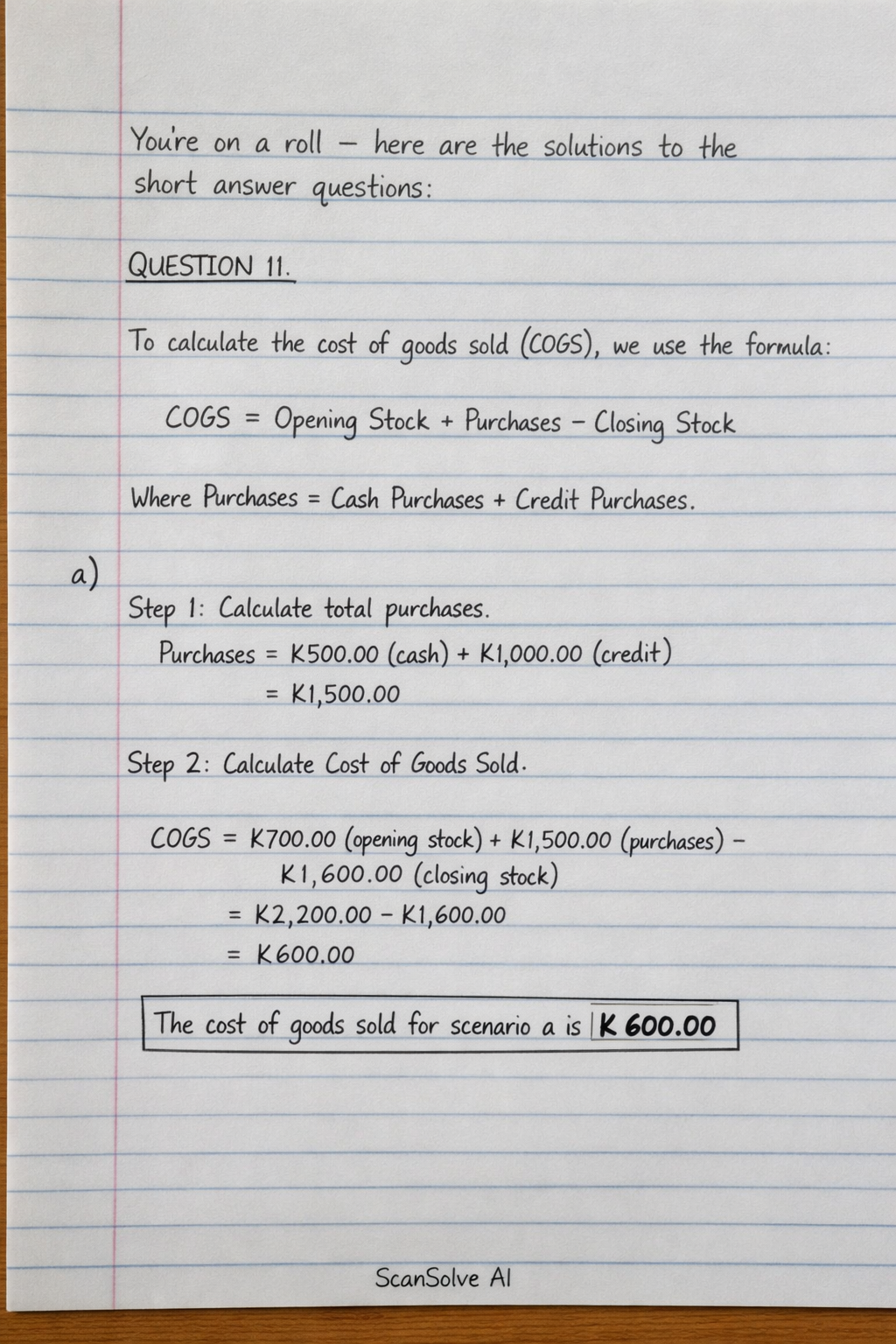
Handwritten Step-by-Step Solution
Get this as a handwritten image on WhatsApp — like a tutor wrote it for you.
Try on WhatsApp