We read your photo as:

Create an income statement and balance sheet for a hypothetical farming enterprise.

Accounting

ScanSolve AI Answer

Here are the solutions for the remaining tasks:

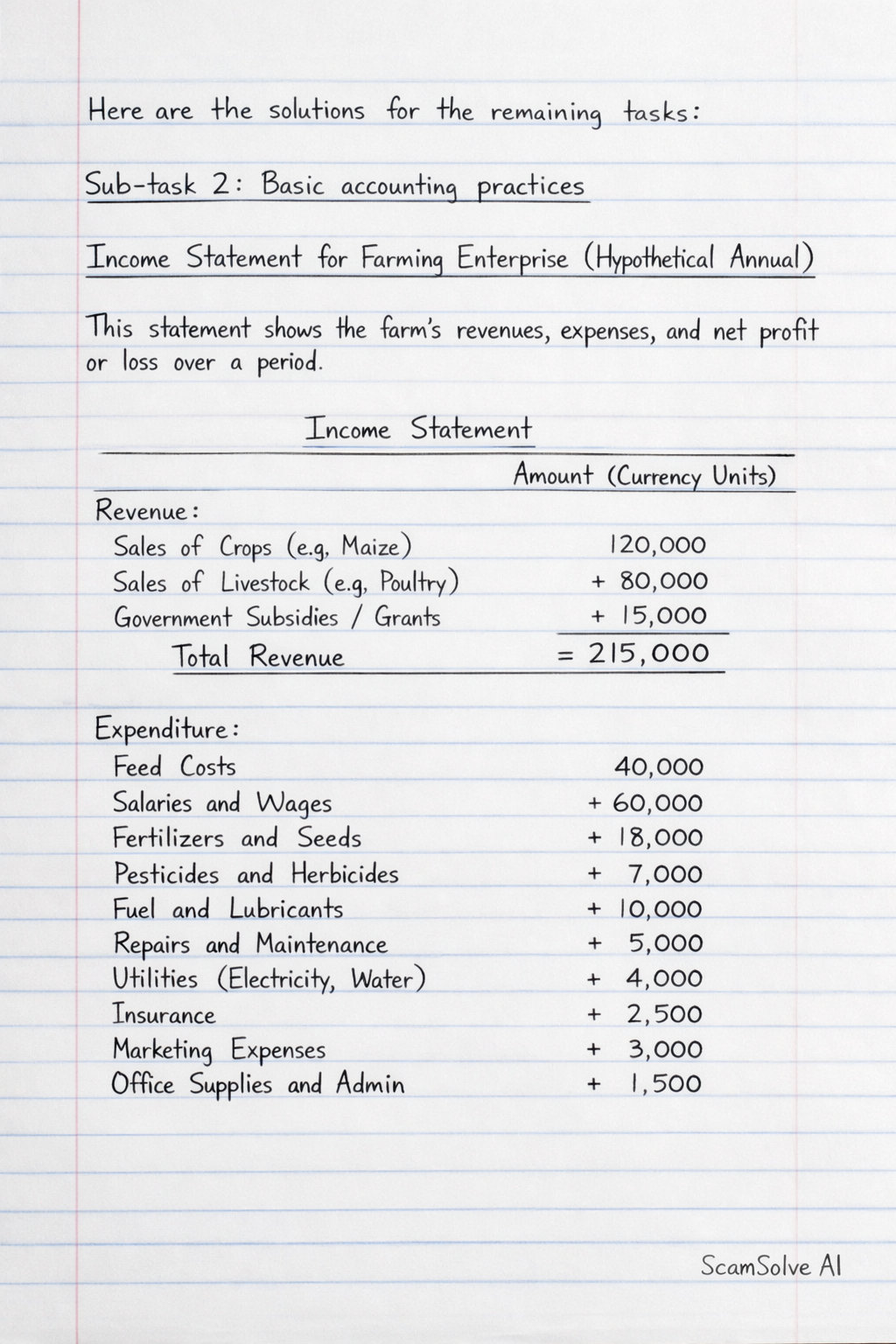
Sub-task 2: Basic accounting practices

  • Income Statement for Farming Enterprise (Hypothetical Annual)

    This statement shows the farm's revenues, expenses, and net profit or loss over a period.

    Income StatementAmount (Currency Units)Revenue:Sales of Crops (e.g., Maize)120,000Sales of Livestock (e.g., Poultry)80,000Government Subsidies/Grants15,000Total Revenue215,000Expenditure:Feed Costs40,000Salaries and Wages60,000Fertilizers and Seeds18,000Pesticides and Herbicides7,000Fuel and Lubricants10,000Repairs and Maintenance5,000Utilities (Electricity, Water)4,000Insurance2,500Marketing Expenses3,000Office Supplies and Admin1,500Total Expenditure151,000Net Profit (Total Revenue - Total Expenditure)64,000\begin{array}{|l|r|} \hline \textbf{Income Statement} & \textbf{Amount (Currency Units)} \\ \hline \textbf{Revenue:} & \\ \text{Sales of Crops (e.g., Maize)} & 120,000 \\ \text{Sales of Livestock (e.g., Poultry)} & 80,000 \\ \text{Government Subsidies/Grants} & 15,000 \\ \textbf{Total Revenue} & \textbf{215,000} \\ \hline \textbf{Expenditure:} & \\ \text{Feed Costs} & 40,000 \\ \text{Salaries and Wages} & 60,000 \\ \text{Fertilizers and Seeds} & 18,000 \\ \text{Pesticides and Herbicides} & 7,000 \\ \text{Fuel and Lubricants} & 10,000 \\ \text{Repairs and Maintenance} & 5,000 \\ \text{Utilities (Electricity, Water)} & 4,000 \\ \text{Insurance} & 2,500 \\ \text{Marketing Expenses} & 3,000 \\ \text{Office Supplies and Admin} & 1,500 \\ \textbf{Total Expenditure} & \textbf{151,000} \\ \hline \textbf{Net Profit (Total Revenue - Total Expenditure)} & \textbf{64,000} \\ \hline \end{array}
  • Balance Sheet for Farming Enterprise (Hypothetical as of Year-End)

    This statement shows the farm's assets, liabilities, and owner's equity at a specific point in time.

    Balance SheetAmount (Currency Units)Assets:Current Assets:Cash in Bank25,000Accounts Receivable (money owed to farm)10,000Inventory (e.g., harvested crops, feed stock)15,000Total Current Assets50,000Non-Current Assets:Land200,000Buildings (e.g., barns, storage)70,000Machinery and Equipment50,000Livestock (breeding stock)30,000Total Non-Current Assets350,000Total Assets400,000Liabilities:Current Liabilities:Accounts Payable (money farm owes)8,000Short-term Loan12,000Total Current Liabilities20,000Non-Current Liabilities:Long-term Bank Loan180,000Total Non-Current Liabilities180,000Total Liabilities200,000Owner’s Equity:Owner’s Capital136,000Retained Earnings (accumulated profits)64,000Total Owner’s Equity200,000Total Liabilities + Owner’s Equity400,000\begin{array}{|l|r|} \hline \textbf{Balance Sheet} & \textbf{Amount (Currency Units)} \\ \hline \textbf{Assets:} & \\ \textbf{Current Assets:} & \\ \text{Cash in Bank} & 25,000 \\ \text{Accounts Receivable (money owed to farm)} & 10,000 \\ \text{Inventory (e.g., harvested crops, feed stock)} & 15,000 \\ \textbf{Total Current Assets} & \textbf{50,000} \\ \textbf{Non-Current Assets:} & \\ \text{Land} & 200,000 \\ \text{Buildings (e.g., barns, storage)} & 70,000 \\ \text{Machinery and Equipment} & 50,000 \\ \text{Livestock (breeding stock)} & 30,000 \\ \textbf{Total Non-Current Assets} & \textbf{350,000} \\ \textbf{Total Assets} & \textbf{400,000} \\ \hline \textbf{Liabilities:} & \\ \textbf{Current Liabilities:} & \\ \text{Accounts Payable (money farm owes)} & 8,000 \\ \text{Short-term Loan} & 12,000 \\ \textbf{Total Current Liabilities} & \textbf{20,000} \\ \textbf{Non-Current Liabilities:} & \\ \text{Long-term Bank Loan} & 180,000 \\ \textbf{Total Non-Current Liabilities} & \textbf{180,000} \\ \textbf{Total Liabilities} & \textbf{200,000} \\ \hline \textbf{Owner's Equity:} & \\ \text{Owner's Capital} & 136,000 \\ \text{Retained Earnings (accumulated profits)} & 64,000 \\ \textbf{Total Owner's Equity} & \textbf{200,000} \\ \hline \textbf{Total Liabilities + Owner's Equity} & \textbf{400,000} \\ \hline \end{array}

Sub-task 3: Investment capital and types of costs

  • Short, Medium, and Long-term Capital Needs

    Capital NeedsExampleType of FinanceWhere to Obtain FinanceShort-term (up to 1 year)Fertilizers, seeds, animal feed, fuel, wagesCash, short-term bank loan, supplier creditCommercial banks, personal savings, suppliersMedium-term (1-5 years)Small machinery (e.g., tractor), breeding livestock, minor renovationsMedium-term bank loan, lease financeAgricultural development banks, commercial banks, equipment leasing companiesLong-term (over 5 years)Land acquisition, construction of major buildings (e.g., large storage facilities), irrigation systemsLong-term bank loan, equity investment, government grantsDevelopment banks, private investors, government agricultural programs\begin{array}{|l|l|l|l|} \hline \textbf{Capital Needs} & \textbf{Example} & \textbf{Type of Finance} & \textbf{Where to Obtain Finance} \\ \hline \textbf{Short-term (up to 1 year)} & \text{Fertilizers, seeds, animal feed, fuel, wages} & \text{Cash, short-term bank loan, supplier credit} & \text{Commercial banks, personal savings, suppliers} \\ \textbf{Medium-term (1-5 years)} & \text{Small machinery (e.g., tractor), breeding livestock, minor renovations} & \text{Medium-term bank loan, lease finance} & \text{Agricultural development banks, commercial banks, equipment leasing companies} \\ \textbf{Long-term (over 5 years)} & \text{Land acquisition, construction of major buildings (e.g., large storage facilities), irrigation systems} & \text{Long-term bank loan, equity investment, government grants} & \text{Development banks, private investors, government agricultural programs} \\ \hline \end{array}
  • Tabulation of Costs

    Cost CategoryPurchase ItemCost Incurred (Currency Units)MaterialsSeeds5,000Fertilizer13,000Animal Feed40,000Packaging3,000LabourFarmhands’ Wages50,000Manager’s Salary10,000Direct OverheadFuel for Tractors8,000Electricity for Irrigation2,000Equipment Rental3,000Indirect OverheadOffice Supplies1,500Insurance Premium2,500Depreciation of Machinery4,000\begin{array}{|l|l|l|} \hline \textbf{Cost Category} & \textbf{Purchase Item} & \textbf{Cost Incurred (Currency Units)} \\ \hline \textbf{Materials} & \text{Seeds} & 5,000 \\ & \text{Fertilizer} & 13,000 \\ & \text{Animal Feed} & 40,000 \\ & \text{Packaging} & 3,000 \\ \textbf{Labour} & \text{Farmhands' Wages} & 50,000 \\ & \text{Manager's Salary} & 10,000 \\ \textbf{Direct Overhead} & \text{Fuel for Tractors} & 8,000 \\ & \text{Electricity for Irrigation} & 2,000 \\ & \text{Equipment Rental} & 3,000 \\ \textbf{Indirect Overhead} & \text{Office Supplies} & 1,500 \\ & \text{Insurance Premium} & 2,500 \\ & \text{Depreciation of Machinery} & 4,000 \\ \hline \end{array}

Report Introduction and Conclusion

  • A paragraph on three potential challenges and suggested solutions: One significant challenge for agribusinesses is climate change and unpredictable weather patterns, leading to crop failures or reduced yields. A solution involves implementing drought-resistant crop varieties, efficient irrigation systems, and diversified farming practices to mitigate risks. Another challenge is market price volatility, which can severely impact profitability. This can be addressed through forward contracts, value-added processing of products, and direct sales channels to reduce reliance on fluctuating wholesale markets. Lastly, access to affordable finance is often a barrier for expansion and modernization. Solutions include seeking government agricultural loans, forming cooperatives to pool resources, and exploring microfinance options.

  • Suitable pictures, diagrams, photographs or illustrations: (These would be included in a physical report to visually represent the farm, its operations, challenges, and solutions, such as images of irrigation systems, diversified crops, or market stalls.)

  • A conclusion that briefly indicates why the agriculture enterprise is successful: This agricultural enterprise is successful due to its strategic planning, efficient resource management, and adaptability to market demands. By focusing on sustainable practices, maintaining high-quality produce, and diversifying both crops and sales channels, the farm ensures consistent revenue streams and resilience against external pressures. Strong financial management and continuous investment in modern techniques further contribute to its long-term profitability and growth.

  • Neat, correct report format including pictures, illustrations, etc.: (The entire submission would be presented in a clear, organized report format with appropriate headings, subheadings, and the inclusion of visual aids as mentioned above.)

Was this helpful?

Still stuck on this one?

Ask a follow-up, and the answer starts from this question.

Got a different question?Ask your own question
Handwritten step-by-step solution preview

Handwritten Step-by-Step Solution

Get this as a handwritten image on WhatsApp — like a tutor wrote it for you.

Try on WhatsApp