
We read your photo as:
D) Standard material = 2kg/unit at les/kg. Actual: 1000 units produced using 2,200kg but be 6/kg. i) Calculate Material price Variance ii) Compute Material usage variance iii) Analyze the causes of these Variance iv) Explain two benefits OF Standard costing.
Accounting
ScanSolve AI Answer
Answers
2 partsStep-by-step solution
5 stepsHere's the solution to question 8.b):
Part b(i)· 3 steps
Calculate materials price variance.
Given:
Standard material = 2 kg/unit at Le 5/kg
Actual production = 1,000 units
Actual material used = 2,200 kg
Actual price = Le 6/kg (implied from "but be 6/kg")
Determine the standard quantity for actual output.
Standard Quantity for Actual Output (SQ) = Actual Output Standard Quantity per unit
Apply the formula for Materials Price Variance (MPV).
Substitute the values and calculate.
Part b(ii)
Compute material usage variance.
Apply the formula for Materials Usage Variance (MUV).
Substitute the values and calculate.
Part b(iii)
Analyze the causes of these variances.
- Materials Price Variance (Adverse): This adverse variance of Le 2,200 means the company paid more for materials than the standard price. Possible causes include an increase in the market price of materials, failure by the purchasing department to negotiate favorable prices, or purchasing higher quality (and thus more expensive) materials than planned.
- Materials Usage Variance (Adverse): This adverse variance of Le 1,000 means the company used more materials than the standard quantity allowed for the actual output. Possible causes include poor quality of materials leading to increased waste, inefficient production processes, defective machinery causing spoilage, or lack of skilled labor resulting in excessive material usage.
Part b(iv)
Explain two benefits of standard costing.
- Cost Control and Performance Evaluation: Standard costing provides a benchmark against which actual costs can be compared. This helps management identify areas where costs are out of control, investigate the reasons for variances, and evaluate the efficiency and performance of different departments or individuals.
- Pricing Decisions: Standard costs provide a reliable basis for setting selling prices for products or services. By knowing the expected cost of production, businesses can quote competitive prices, prepare tenders, and make informed decisions about profitability.
Was this helpful?
Try one yourself
A new problem that tests the same skill.
Still stuck on this one?
Ask a follow-up, and the answer starts from this question.
Got a different question?Ask your own question
More Accounting Questions
QDetermine the material usage variance.QCalculate the material and labor variances for table production based on the provided standard and…QCalculate the direct material cost.QCalculate the value of normal loss, abnormal gain, and finished goods if the actual output is 4,650…QDistinguish between cost of living and standard of living. (b) What factors determine a country's…
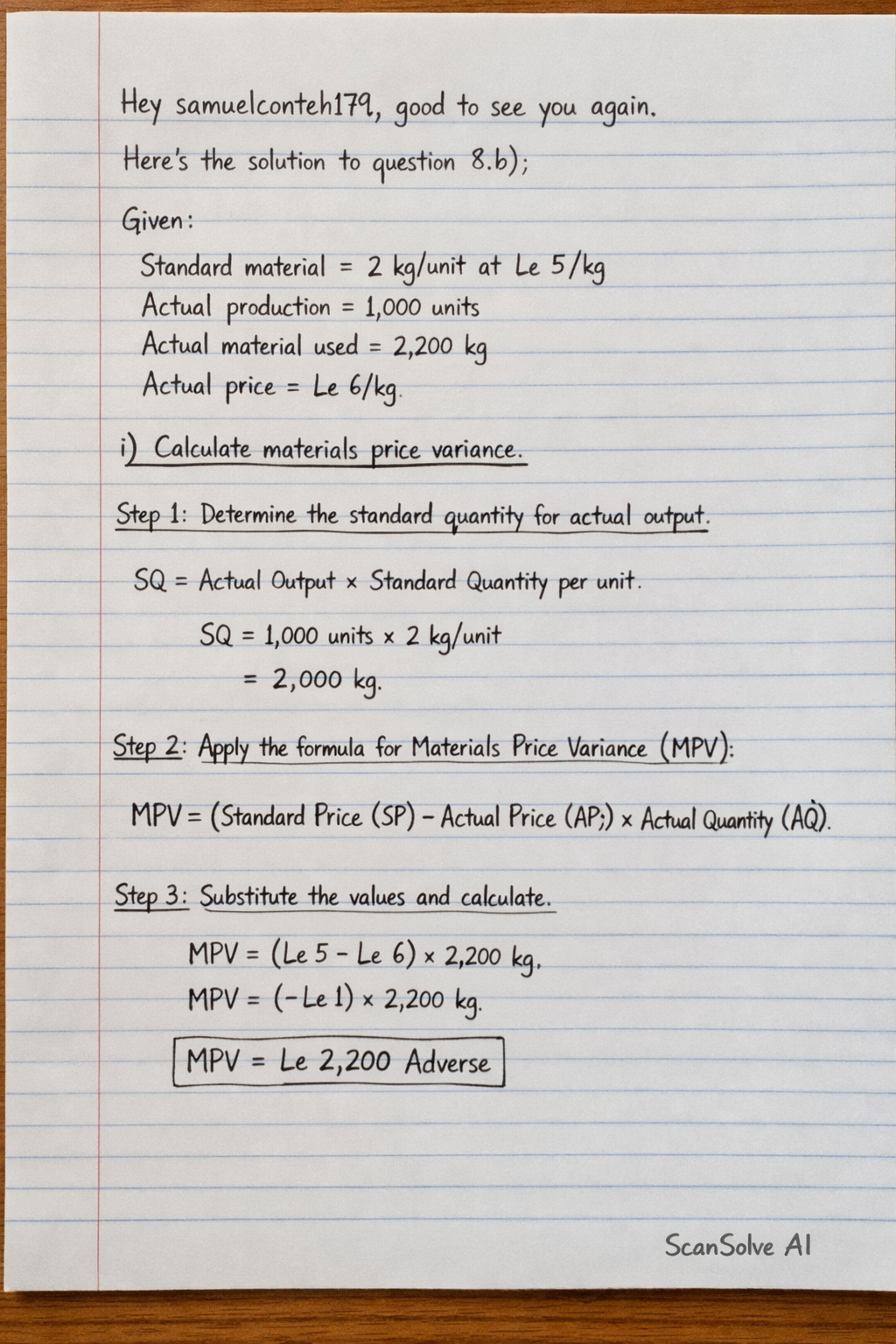
Handwritten Step-by-Step Solution
Get this as a handwritten image on WhatsApp — like a tutor wrote it for you.
Try on WhatsApp