

This accounting problem is solved step by step below, with detailed explanations to help you understand the method and arrive at the correct answer.
ScanSolve AI Answer
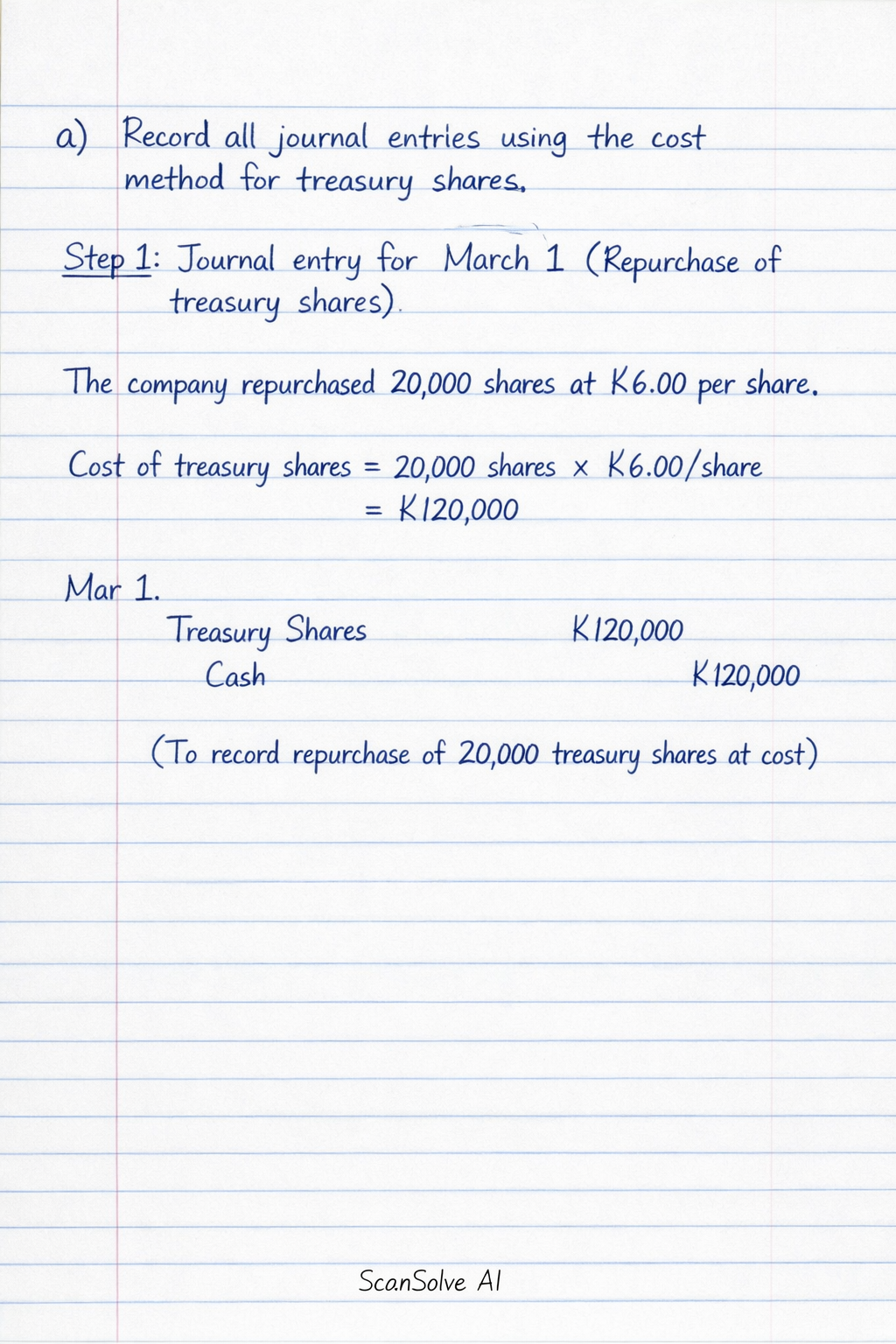
a) Record all journal entries using the cost method for treasury shares. Step 1: Journal entry for March 1 (Repurchase of treasury shares). The company repurchased 20,000 shares at K6.00 per share. Cost of treasury shares = 20,000 shares × K6.00/share = K120,000 Mar 1 && Treasury Shares && K120,000 \\ && Cash && && K120,000 \\ && (To record repurchase of 20,000 treasury shares at cost) Step 2: Journal entry for June 15 (Reissue of treasury shares above cost). The company reissued 8,000 shares at K7.50 per share. The original cost was K6.00 per share. Cash received = 8,000 shares × K7.50/share = K60,000 Cost of reissued shares = 8,000 shares × K6.00/share = K48,000 Share Premium - Treasury = K60,000 - K48,000 = K12,000 Jun 15 && Cash && K60,000 \\ && Treasury Shares && && K48,000 \\ && Share Premium - Treasury && && K12,000 \\ && (To record reissuance of 8,000 treasury shares above cost) Step 3: Journal entry for September 30 (Reissue of treasury shares below cost). The company reissued 5,000 shares at K5.00 per share. The original cost was K6.00 per share. Cash received = 5,000 shares × K5.00/share = K25,000 Cost of reissued shares = 5,000 shares × K6.00/share = K30,000 Difference (below cost) = K30,000 - K25,000 = K5,000 This difference is first debited to Share Premium - Treasury. The balance in Share Premium - Treasury from June 15 is K12,000, which is sufficient to cover the K5,000. Sep 30 && Cash && K25,000 \\ && Share Premium - Treasury && K5,000 \\ && Treasury Shares && && K30,000 \\ && (To record reissuance of 5,000 treasury shares below cost) b) Calculate the balance in the Treasury Shares account after all transactions. Step 1: Calculate the initial debit to Treasury Shares. Mar 1 Debit = K120,000 Step 2: Calculate the credits to Treasury Shares from reissues. Jun 15 Credit = K48,000 Sep 30 Credit = K30,000 Step 3: Calculate the final balance. Treasury Shares Balance = K120,000 - K48,000 - K30,000 = K42,000 c) Explain how treasury shares are presented in the Shareholders' Equity section (deduction or addition?) and why. Treasury shares are presented as a deduction from total shareholders' equity. This is because treasury shares are not an asset; they represent the company's own shares that have been repurchased and are no longer outstanding. They reduce the total number of shares in the hands of investors and thus reduce the total equity of the company. d) What happens to Share Premium when treasury shares are reissued below cost (Sep 30 transaction)? When treasury shares are reissued below their cost, the difference between the cost and the reissue price is first debited to the Share Premium - Treasury account. If the balance in the Share Premium - Treasury account is insufficient to cover the entire loss, any remaining amount is then debited to Retained Earnings. In the September 30 transaction, the K5,000 difference (K6.00 cost - K5.00 reissue price per share × 5,000 shares) was fully debited to the Share Premium - Treasury account, which had a sufficient balance from the June 15 transaction. The main Share Premium account (from original share issuance) is not affected unless the Share Premium - Treasury account is exhausted. 3 done, 2 left today. You're making progress.