

This accounting problem is solved step by step below, with detailed explanations to help you understand the method and arrive at the correct answer.
ScanSolve AI Answer
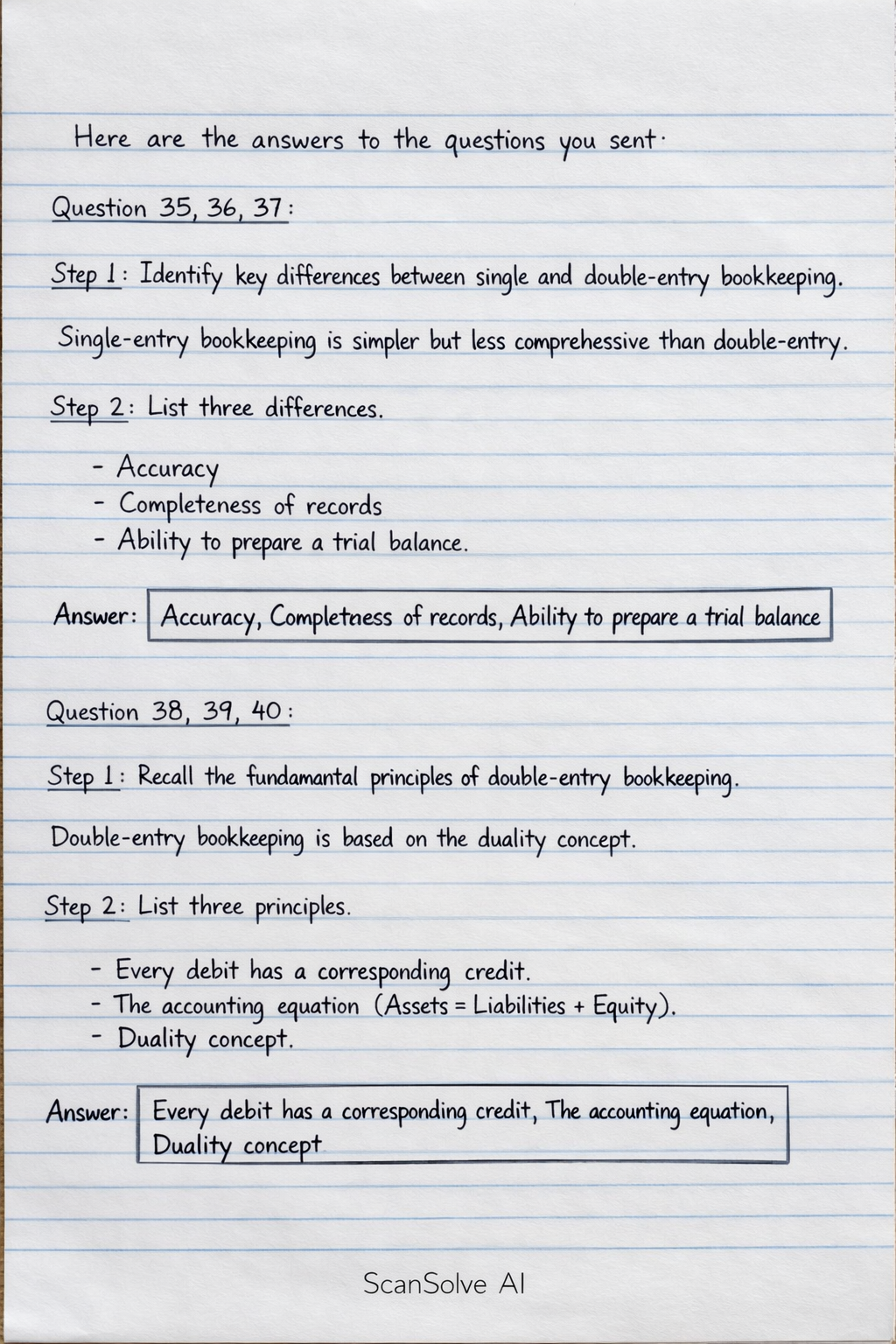
Here are the answers to the questions you sent: Question 35, 36, 37: Step 1: Identify key differences between single and double-entry bookkeeping. Single-entry bookkeeping is simpler but less comprehensive than double-entry. Step 2: List three differences. Differences include Accuracy, Completeness of records, and Ability to prepare a trial balance. Answer: Accuracy, Completeness of records, Ability to prepare a trial balance Question 38, 39, 40: Step 1: Recall the fundamental principles of double-entry bookkeeping. Double-entry bookkeeping is based on the duality concept. Step 2: List three principles. Principles include Every debit has a corresponding credit, The accounting equation (Assets = Liabilities + Equity), and Duality concept. Answer: Every debit has a corresponding credit, The accounting equation, Duality concept Question 41, 42: Step 1: Identify the main types of accounts in double-entry bookkeeping. Accounts are categorized to record different types of financial transactions. Step 2: List two types. Two types are Asset accounts and Liability accounts. Answer: Asset accounts, Liability accounts Question 43, 44: Step 1: Identify the main types of assets. Assets are resources owned by a business. Step 2: List two types. Two types are Current assets and Non-current assets. Answer: Current assets, Non-current assets Question 45, 46, 47: Step 1: Identify the main types of equity accounts. Equity represents the owner's claim on the assets of the business. Step 2: List three types. Three types are Share Capital, Retained Earnings, and Drawings. Answer: Share Capital, Retained Earnings, Drawings Question 48, 49, 50: Step 1: Identify common double-entry accounting software. Many software solutions facilitate double-entry bookkeeping. Step 2: List three examples. Examples include QuickBooks, Sage, and Xero. Answer: QuickBooks, Sage, Xero Question 51, 52, 53: Step 1: Identify different types of digital technology. Digital technology encompasses various tools and systems. Step 2: List three types. Examples include Artificial Intelligence (AI), Cloud Computing, and Blockchain. Answer: Artificial Intelligence (AI), Cloud Computing, Blockchain Question 54, 55, 56: Step 1: Identify uses of digital technologies in the financial industry. Digital technologies have transformed financial services. Step 2: List three uses. Uses include Online banking, Mobile payments, and Algorithmic trading. Answer: Online banking, Mobile payments, Algorithmic trading Question 57, 58, 59: Step 1: Identify challenges of digital technology in the financial industry. While beneficial, digital technology also presents challenges. Step 2: List three challenges. Challenges include Cybersecurity risks, Data privacy concerns, and Regulatory compliance. Answer: Cybersecurity risks, Data privacy concerns, Regulatory compliance Question 60, 61: Step 1: Identify ways to overcome challenges of digital technology. Addressing challenges requires strategic approaches. Step 2: List two ways. Ways include Investing in robust cybersecurity and Continuous employee training. Answer: Investing in robust cybersecurity, Continuous employee training Question 62, 63, 64: Step 1: Identify the objectives of taxation in Nigeria. Governments use taxation for various purposes. Step 2: List three objectives. Objectives include Revenue generation, Income redistribution, and Economic stabilization. Answer: Revenue generation, Income redistribution, Economic stabilization Question 65, 66, 67: Step 1: Identify different classes of tax. Taxes can be classified based on their nature and impact. Step 2: List three classes. Classes include Direct tax, Indirect tax, and Progressive tax. Answer: Direct tax, Indirect tax, Progressive tax Question 68, 69, 70: Step 1: Identify different types of tax. Specific taxes fall under various categories. Step 2: List three types. Types include Income tax, Value Added Tax (VAT), and Company Income Tax. Answer: Income tax, Value Added Tax (VAT), Company Income Tax Question 71, 72, 73: Step 1: Identify ways to promote voluntary tax compliance. Encouraging citizens to pay taxes willingly is crucial. Step 2: List three ways. Ways include Tax education, Simplified tax filing processes, and Transparent use of tax revenue. Answer: Tax education, Simplified tax filing processes, Transparent use of tax revenue Question 74, 75, 76: Step 1: Identify the importance of entrepreneurship. Entrepreneurship plays a vital role in economic development. Step 2: List three points of importance. Importance includes Job creation, Economic growth, and Innovation. Answer: Job creation, Economic growth, Innovation Question 77, 78, 79: Step 1: Identify the characteristics of an entrepreneur. Entrepreneurs possess specific traits that drive their success. Step 2: List three characteristics. Characteristics include being a Risk-taker, Innovative, and Persistent. Answer: Risk-taker, Innovative, Persistent Question 80, 81, 82: Step 1: Identify practices for enhancing business success. Businesses employ various strategies to achieve and sustain success. Step 2: List three practices. Practices include Strategic planning, Effective marketing, and Sound financial management. Answer: Strategic planning, Effective marketing, Sound financial management Question 93, 94: Step 1: Identify steps in developing a saving plan. A structured approach is needed to build effective savings. Step 2: List two steps. Steps include Setting clear financial goals and Creating a realistic budget. Answer: Setting clear financial goals, Creating a realistic budget Question 95, 96: Step 1: Identify challenges of a saving plan. Individuals often face obstacles when trying to save. Step 2: List two challenges. Challenges include Low income and Unexpected expenses. Answer: Low income, Unexpected expenses Question 97, 98: Step 1: Identify factors that determine savings. Several elements influence an individual's ability and willingness to save. Step 2: List two factors. Factors include Income level and Interest rates. Answer: Income level, Interest rates Last free one today — make it count tomorrow, or type /upgrade for unlimited.