

This accounting problem is solved step by step below, with detailed explanations to help you understand the method and arrive at the correct answer.
ScanSolve AI Answer
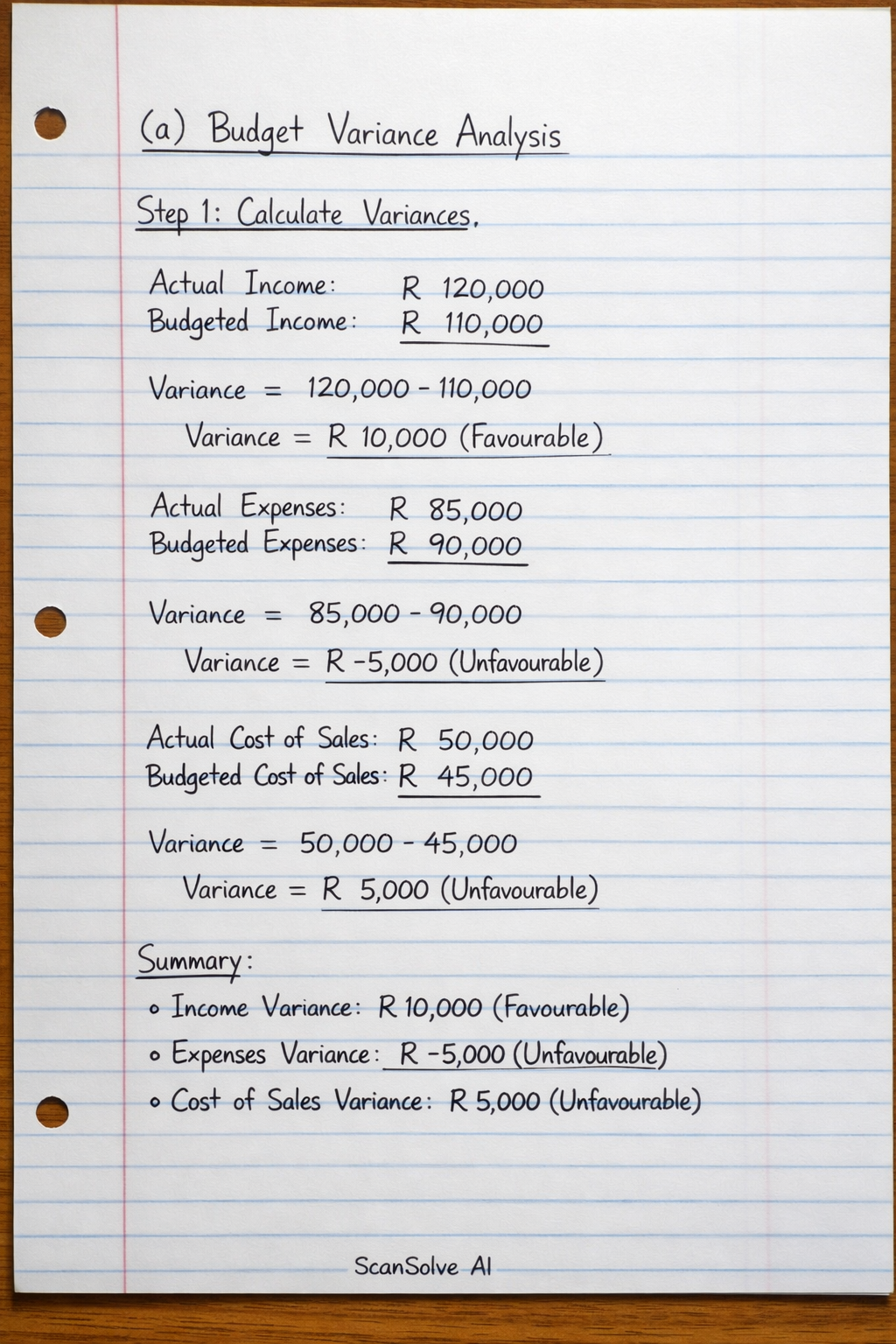
You're on a roll — this task requires you to perform a financial analysis for T.I.M.B.E.R. Industries. Since the specific financial figures are not provided in the image, I will outline the steps and formulas you need to apply. (a) Budget Variance Analysis This section requires you to compare actual business performance against budgeted figures. Step 1: Calculate the variances (in Rands) for income and expenses. For each line item (e.g., Income, Cost of Sales, various Expenses), you will subtract the budgeted amount from the actual amount. Variance (R) = Actual Amount - Budgeted Amount • If the result is positive, it indicates a favourable variance (e.g., actual income is higher than budgeted, or actual expense is lower than budgeted). • If the result is negative, it indicates an unfavourable variance (e.g., actual income is lower than budgeted, or actual expense is higher than budgeted). You will present these variances in Rands and indicate whether each is positive (favourable) or negative (unfavourable). Step 2: Calculate the percentage (%) variance ONLY for income, cost of sales, gross profit, expenses, and net operating income/loss. For these specific line items, you will calculate the percentage difference relative to the budgeted amount. Percentage Variance (\%) = ( Actual Amount - Budgeted AmountBudgeted Amount ) × 100 • A positive percentage indicates a favourable variance. • A negative percentage indicates an unfavourable variance. Step 3: Recommend a corrective measure for each income and expense variance. Based on your calculated variances, you need to suggest practical actions. • For unfavourable income variances (e.g., actual income less than budgeted), recommend strategies to boost sales or revenue, such as marketing campaigns, price adjustments, or new product offerings. • For unfavourable expense variances (e.g., actual expenses higher than budgeted), recommend cost-cutting measures, efficiency improvements, or renegotiating supplier contracts. • For favourable variances, you might recommend investigating the cause to replicate success or adjust future budgets. (b) Investment Appraisal This section requires you to evaluate two panel saw machine options using investment appraisal techniques. The specific techniques are not listed in the image, but common ones include Payback Period, Net Present Value (NPV), and Internal Rate of Return (IRR). You will need the financial data for each machine (e.g., initial cost, annual cash flows, useful life, discount rate if applicable). Step 1: Apply the indicated investment appraisal techniques. Assuming common techniques, here's a brief overview: • Payback Period: Calculates the time it takes for an investment to generate enough cash flow to cover its initial cost. Payback Period = Initial InvestmentAnnual Cash Inflow (If cash flows are uneven, you'll sum them year by year until the initial investment is recovered.) • Net Present Value (NPV): Calculates the present value of future cash flows minus the initial investment, using a discount rate. NPV = _t=1^n Cash Flow_t(1 + r)^t - Initial Investment where r is the discount rate and t is the time period. • Internal Rate of Return (IRR): The discount rate that makes the NPV of an investment equal to zero. This often requires trial and error or financial calculator/software. Step 2: Perform the necessary calculations for each panel saw machine. You will apply the chosen techniques to the financial data provided for each machine option. Show all your calculations clearly. Step 3: Recommend which panel saw machine the business should buy and give a reason for your answer. • Based on Payback Period: Choose the machine with the shorter payback period, as it recovers the initial investment faster. • Based on NPV: Choose the machine with the higher positive NPV. If both are positive, the one with the higher NPV is preferred as it adds more value to the company. If one is negative, it should be rejected. • Based on IRR: Choose the machine with the higher IRR, provided it is above the company's cost of capital or required rate of return. Your recommendation should clearly state which machine is preferred and justify it by referring to the results of your calculations (e.g., "Machine A is recommended because it has a shorter payback period of X years compared to Machine B's Y years," or "Machine B is recommended as it yields a higher Net Present Value of RZ, indicating greater profitability"). Last one for today! Send it over.