
So i am given opening inventory and and closing inventory and cost of sales also, so i'm told to calculate gross margin
ScanSolve AI Answer
Answer
Step-by-step solution
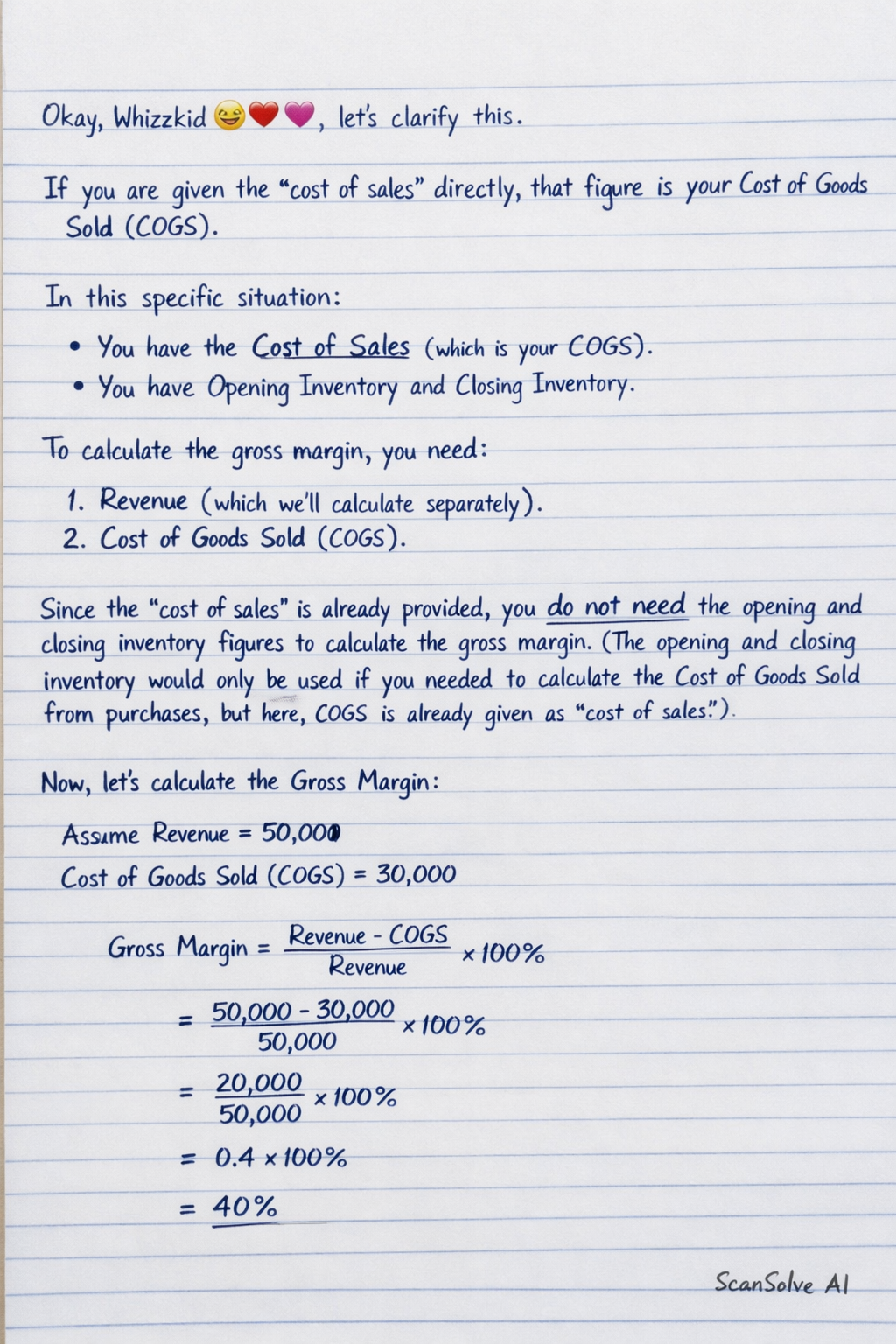
3 stepsOkay, Whizzkid😘❤💓, let's clarify this.
If you are given the cost of sales directly, that figure is your Cost of Goods Sold (COGS).
In this specific situation:
- You have the Cost of Sales (which is your COGS).
- You have Opening Inventory and Closing Inventory.
To calculate the gross margin, you need:
- Revenue (which must be provided or calculated separately, as it's not given in your list).
- Cost of Goods Sold (COGS).
Since the "cost of sales" is already provided, you do not need the opening and closing inventory figures to calculate the gross margin. The opening and closing inventory would only be used if you needed to calculate the Cost of Goods Sold from purchases, but here, COGS is already given as "cost of sales."
The formula for gross margin remains:
Identify the Revenue figure.
(This is a crucial piece of information that must be available from your problem.)
Use the given Cost of Sales figure as your Cost of Goods Sold.
Substitute these values into the formula to calculate the gross margin.
For example, if:
Revenue = $150,000
Cost of Sales (COGS) = $90,000
Try one yourself
A new problem that tests the same skill.
Still stuck on this one?
Ask a follow-up, and the answer starts from this question.
More Accounting Questions
Handwritten Step-by-Step Solution
Get this as a handwritten image on WhatsApp — like a tutor wrote it for you.
Try on WhatsApp