
We read your photo as:
What are the correct answers and explanations for questions 13-17 regarding accounting principles?
ScanSolve AI Answer
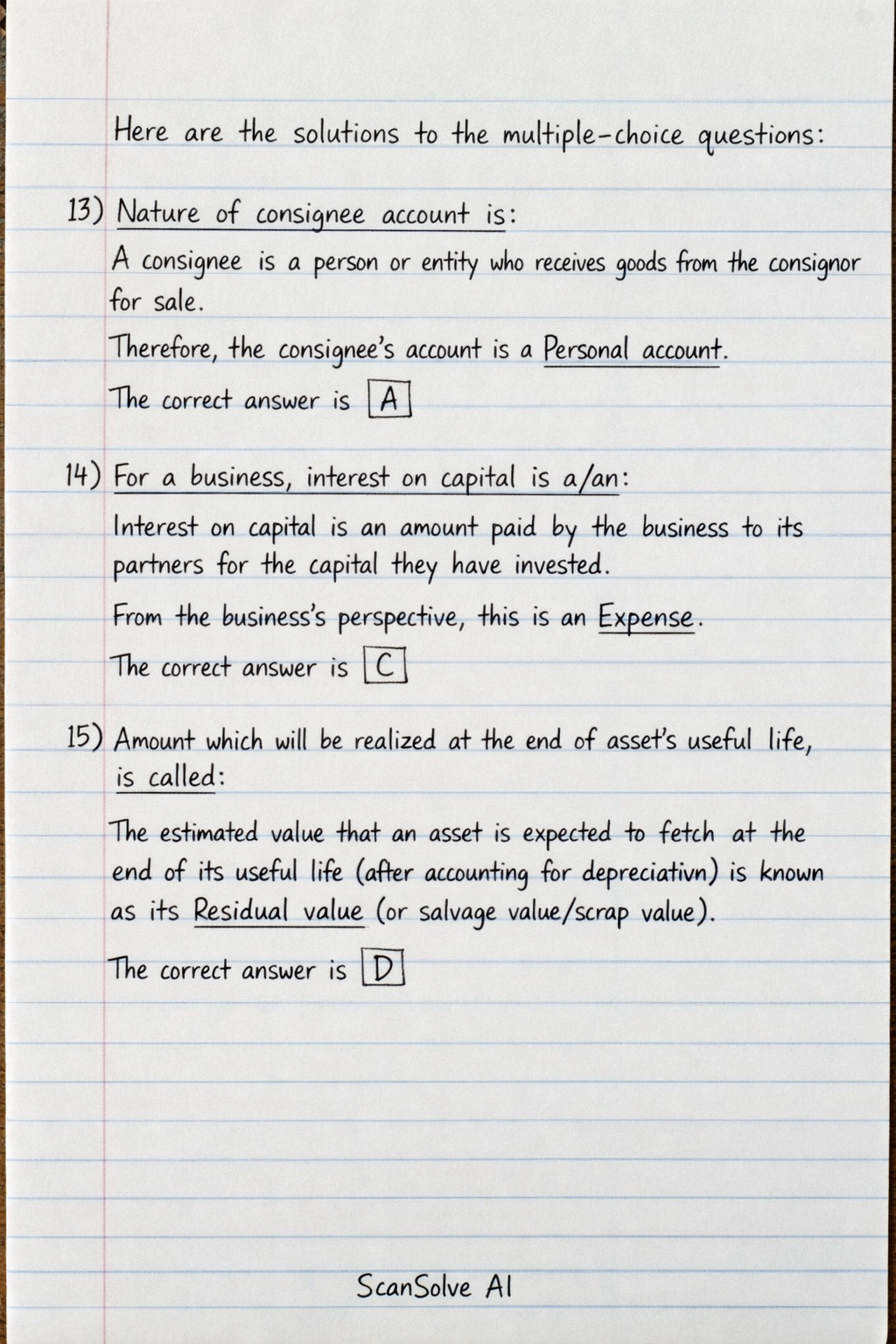
Here are the solutions to the multiple-choice questions:
13) Nature of consignee account is:
A consignee is a person or entity who receives goods from the consignor for sale. Therefore, the consignee's account is a Personal account.
The correct answer is
14) For a business, interest on capital is a/an:
Interest on capital is an amount paid by the business to its partners for the capital they have invested. From the business's perspective, this is an Expense.
The correct answer is
15) Amount which will be realized at the end of asset's useful life, is called:
The estimated value that an asset is expected to fetch at the end of its useful life (after accounting for depreciation) is known as its Residual value (or salvage value/scrap value).
The correct answer is
16) Sinking fund investment is:
A sinking fund is created by setting aside funds periodically to meet a future obligation (like repaying a debt or replacing an asset). These funds are then invested, and these investments are considered an Asset of the company.
The correct answer is
17) The process of allocating the cost of an intangible asset over its useful life, is called:
The systematic allocation of the cost of an intangible asset (like patents, copyrights, goodwill) over its useful life is called Amortization. Depreciation applies to tangible assets.
The correct answer is
18) Subscription outstanding is a/an:
Subscription outstanding represents income that has been earned but not yet received. This is a claim the organization has, making it an Asset.
The correct answer is
19) Book value of an asset is equal to:
The book value of an asset is its original cost minus the accumulated depreciation charged against it over its useful life.
The correct answer is
20) Which of the following is not a depreciable asset?
Depreciable assets are tangible assets with a limited useful life. Land is generally considered to have an unlimited useful life and therefore is not depreciated. Equipment, machinery, and motor cars all have limited useful lives and are depreciated.
The correct answer is
Still stuck on this one?
Ask a follow-up, and the answer starts from this question.
More Accounting Questions
Handwritten Step-by-Step Solution
Get this as a handwritten image on WhatsApp — like a tutor wrote it for you.
Try on WhatsApp