

This accounting problem is solved step by step below, with detailed explanations to help you understand the method and arrive at the correct answer.
ScanSolve AI Answer
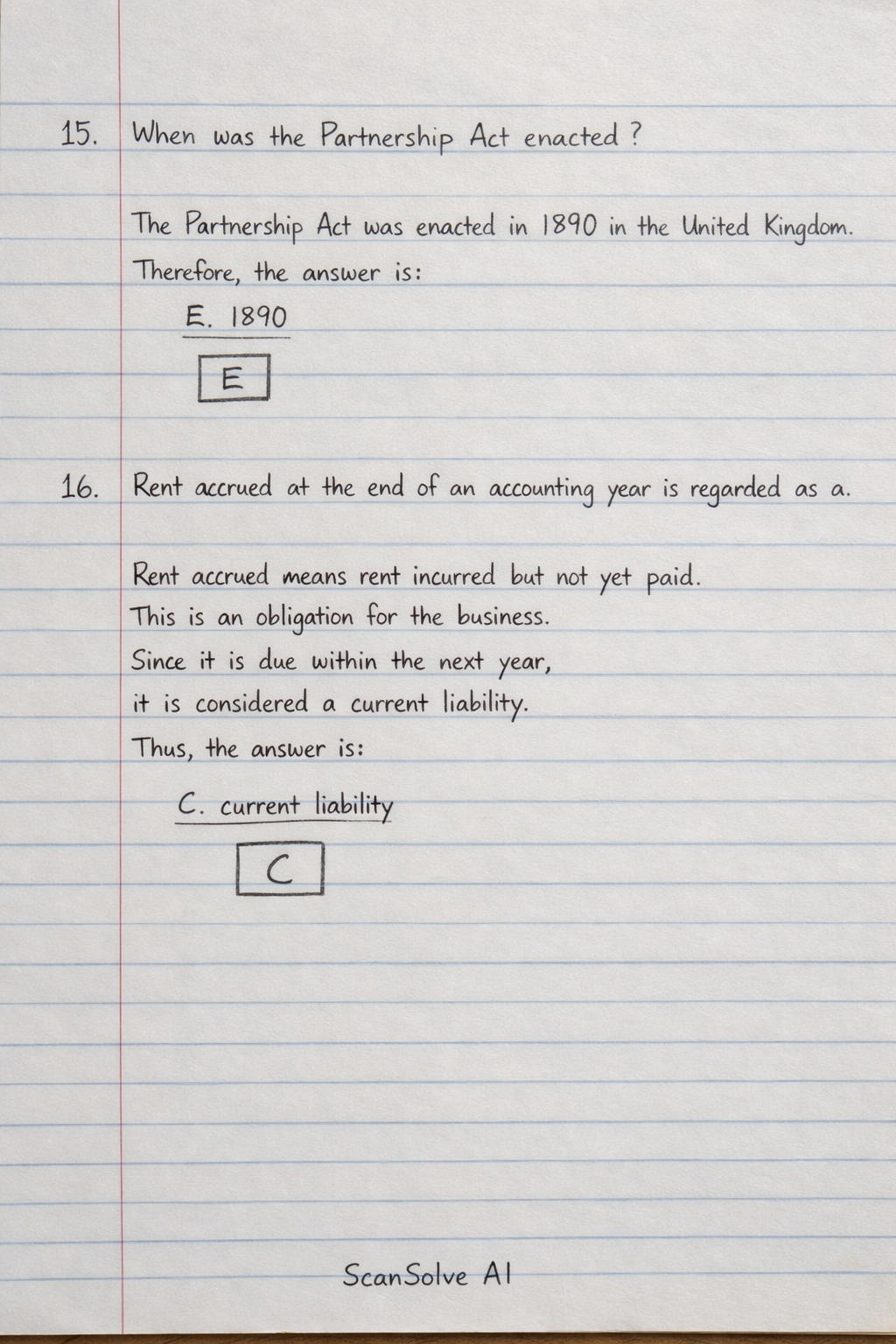
here are the answers to the questions: 15. When was the partnership Act enacted? The Partnership Act, which governs partnerships in many common law jurisdictions, was enacted in 1890 in the United Kingdom, and this forms the basis for similar acts globally. E. 1890 E 16. Rent accrued at the end of an accounting year is regarded as a Rent accrued means rent that has been incurred but not yet paid. This represents an obligation for the business that is due within the next year, making it a current liability. C. current liability. C 17. The sales of departments X and Y are N300,000 and N240,000 respectively. An office expense of N30,000 is to be shared based on turnover. What is the office expense of department X? Step 1: Calculate the total turnover for both departments. Total Turnover = Sales of Department X + Sales of Department Y Total Turnover = N300,000 + N240,000 = N540,000 Step 2: Determine the proportion of Department X's sales to the total turnover. Proportion for X = Sales of Department XTotal Turnover = N300,000N540,000 = (30)/(54) = (5)/(9) Step 3: Calculate Department X's share of the office expense. Office Expense for X = Proportion for X × Total Office Expense Office Expense for X = (5)/(9) × N30,000 = N150,0009 = N16,666.67 Rounding to the nearest whole number gives N16,667. A. N16,667 A 18. The sales of departments X and Y are N300,000 and N240,000 respectively. An office expense of N30,000 is to be shared based on turnover. Office expense of department Y is Step 1: Calculate the total turnover for both departments (from Q17). Total Turnover = N300,000 + N240,000 = N540,000 Step 2: Determine the proportion of Department Y's sales to the total turnover. Proportion for Y = Sales of Department YTotal Turnover = N240,000N540,000 = (24)/(54) = (4)/(9) Step 3: Calculate Department Y's share of the office expense. Office Expense for Y = Proportion for Y × Total Office Expense Office Expense for Y = (4)/(9) × N30,000 = N120,0009 = N13,333.33 Rounding to the nearest whole number gives N13,333. C. N13,333. C 19. The following are methods of apportionment of expenses in a departmental account except Methods of apportioning expenses in departmental accounts include direct analysis, floor space, number of articles, and turnover (rate of turnover). Ratio analysis is a technique used to interpret financial statements, not a method for allocating expenses. E. ratio analysis E 20. What is the total cash received for the period? The provided table is a summary of cash/bank transactions. The debit side (Dr) typically represents receipts. Cheques received: N1,875 Balance b/d: N118,500 (This is usually the opening balance, not a receipt during* the period). If "Balance b/d" is the opening balance, then the total cash received for the period is N1,875. However, this is not among the options, and the options are significantly larger. This indicates that the table might be incomplete, or "Balance b/d" is intended to be part of the receipts for the period, or the question refers to the total of the debit side. If we consider the total of the debit side (opening balance + receipts), it would be N118,500 + N1,875 = N120,375. This is also not an option. Due to the ambiguity and lack of a matching option, this question cannot be accurately solved with the given information. 21. What is the total cash paid for the period? The credit side (Cr) typically represents payments. Purchases returns: N708 (Assuming this is cash paid out related to returns, which is unusual for "purchases returns" but it's on the credit side) Cash paid suppliers: N1,708 Balance c/d: N4,300 (This is the closing balance, not a payment). Total cash paid for the period = N708 + N1,708 = N2,416. This amount is not among the options. The options are significantly larger, and N4,300 (option E) is the closing balance, not total payments. Due to the ambiguity and lack of a matching option, this question cannot be accurately solved with the given information. 22. Which of the following is used to record credit This question is incomplete as the rest of the question and options are cut off. 2 left today — send the next one.