
We read your photo as:
Assume the following additional information for question 3 only: (i) Total annual fixed costs will be R80 000 (ii) The contribution for cotton will be R90 per unit and for Linen will R110 per unit (iii) The sales mix is 4:2 (iv) All other information remains as given.
ScanSolve AI Answer
Step-by-step solution
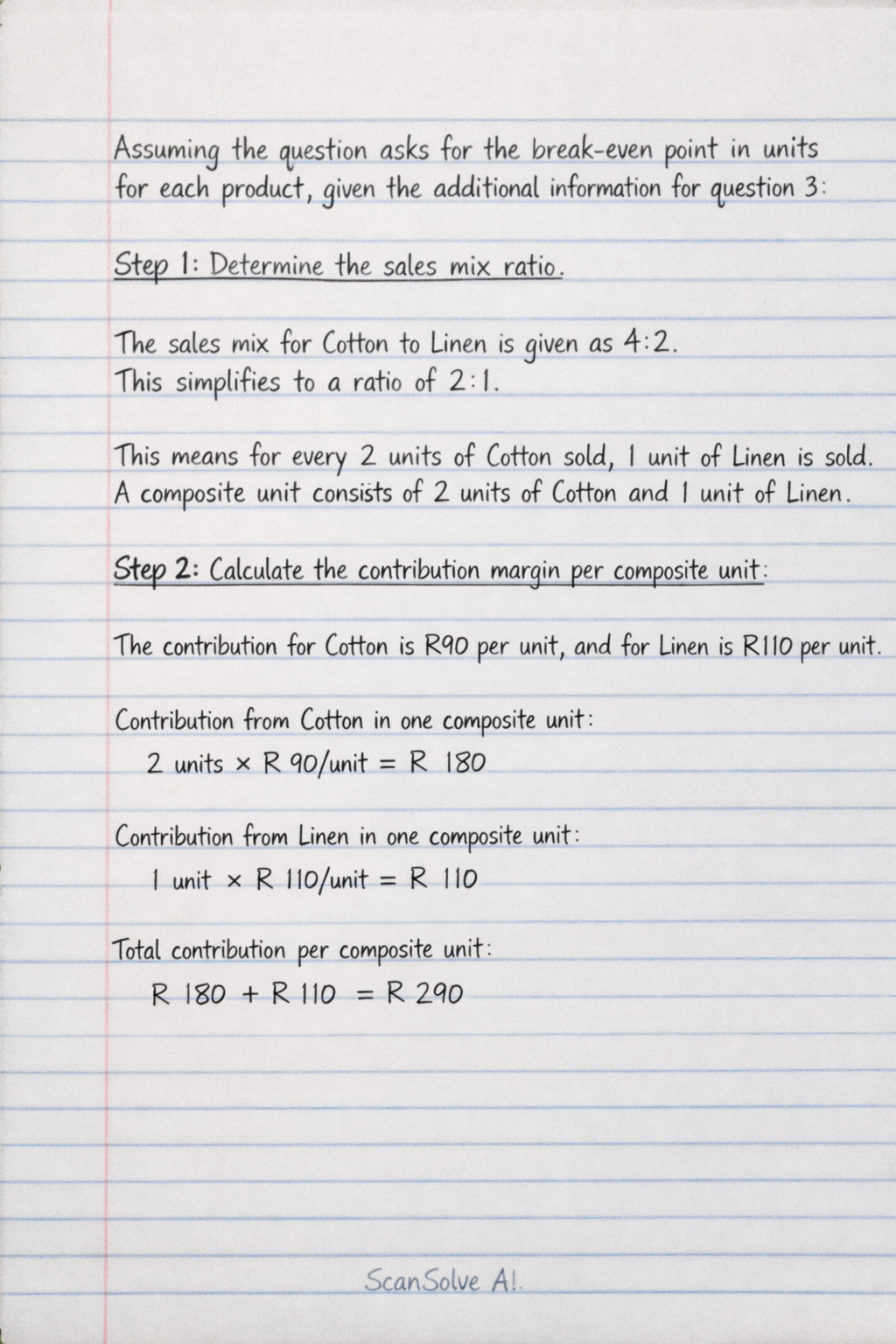
4 stepsAssuming the question asks for the break-even point in units for each product, given the additional information for question 3:
Determine the sales mix ratio.
The sales mix for Cotton to Linen is given as 4:2. This simplifies to a ratio of 2:1.
This means for every 2 units of Cotton sold, 1 unit of Linen is sold. A composite unit consists of 2 units of Cotton and 1 unit of Linen.Calculate the contribution margin per composite unit.
The contribution for Cotton is R90 per unit, and for Linen is R110 per unit.
Contribution from Cotton in one composite unit:Contribution from Linen in one composite unit:
Total contribution per composite unit:
Calculate the break-even point in composite units.
The total annual fixed costs for question 3 are R80 000.
Since units must be whole, we round up to the next whole number to ensure all fixed costs are covered.
Calculate the break-even point in units for each product.
For Cotton:
For Linen:
The break-even point is:
- Cotton:
- Linen:
Still stuck on this one?
Ask a follow-up, and the answer starts from this question.
More Economics Questions
Handwritten Step-by-Step Solution
Get this as a handwritten image on WhatsApp — like a tutor wrote it for you.
Try on WhatsApp