

This biology question covers important biological concepts and processes. The step-by-step explanation below helps you understand the underlying mechanisms and reasoning.
ScanSolve AI Answer
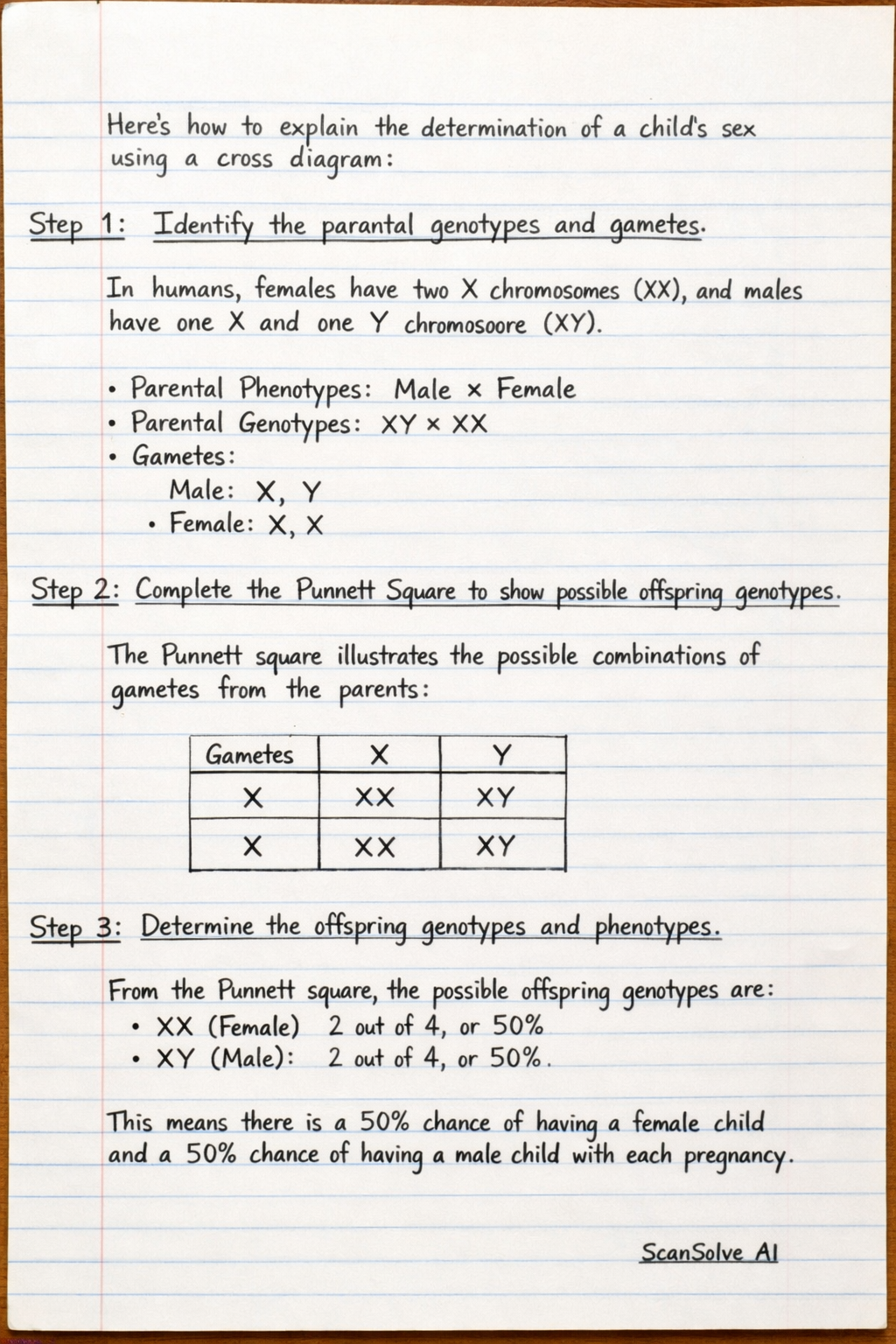
Here's how to explain the determination of a child's sex using a cross diagram: Step 1: Identify the parental genotypes and gametes. In humans, females have two X chromosomes (XX), and males have one X and one Y chromosome (XY). Parental Phenotypes: Male × Female Parental Genotypes: XY × XX Gametes: Male: X, Y Female: X, X Step 2: Complete the Punnett Square to show possible offspring genotypes. The Punnett square illustrates the possible combinations of gametes from the parents. |c|c|c| Gametes & X & Y \\ X & XX & XY \\ X & XX & XY \\ Step 3: Determine the offspring genotypes and phenotypes. From the Punnett square, the possible offspring genotypes are: XX (Female): 2 out of 4, or 50% XY (Male): 2 out of 4, or 50% This means there is a 50% chance of having a female child and a 50% chance of having a male child with each pregnancy. Step 4: Explain the results to the man. The sex of a child is determined by the father, not the mother. The mother always contributes an X chromosome to her offspring. The father, however, can contribute either an X chromosome (resulting in a female child, XX) or a Y chromosome (resulting in a male child, XY). Therefore, the man's complaint is incorrect, as he is the one who determines the sex of his children, and there is an equal probability of having a son or a daughter in each pregnancy. That's 2 down. 3 left today — send the next one.