
We read your photo as:
A grey (G) male rabbit was mated with an albino (g) female rabbit. The F1 generation was grey. Show the phenotypic ratio of their offspring if an F1 male was mated with an albino female.
ScanSolve AI Answer
Step-by-step solution
13 stepshere are the solutions for the genetics questions.
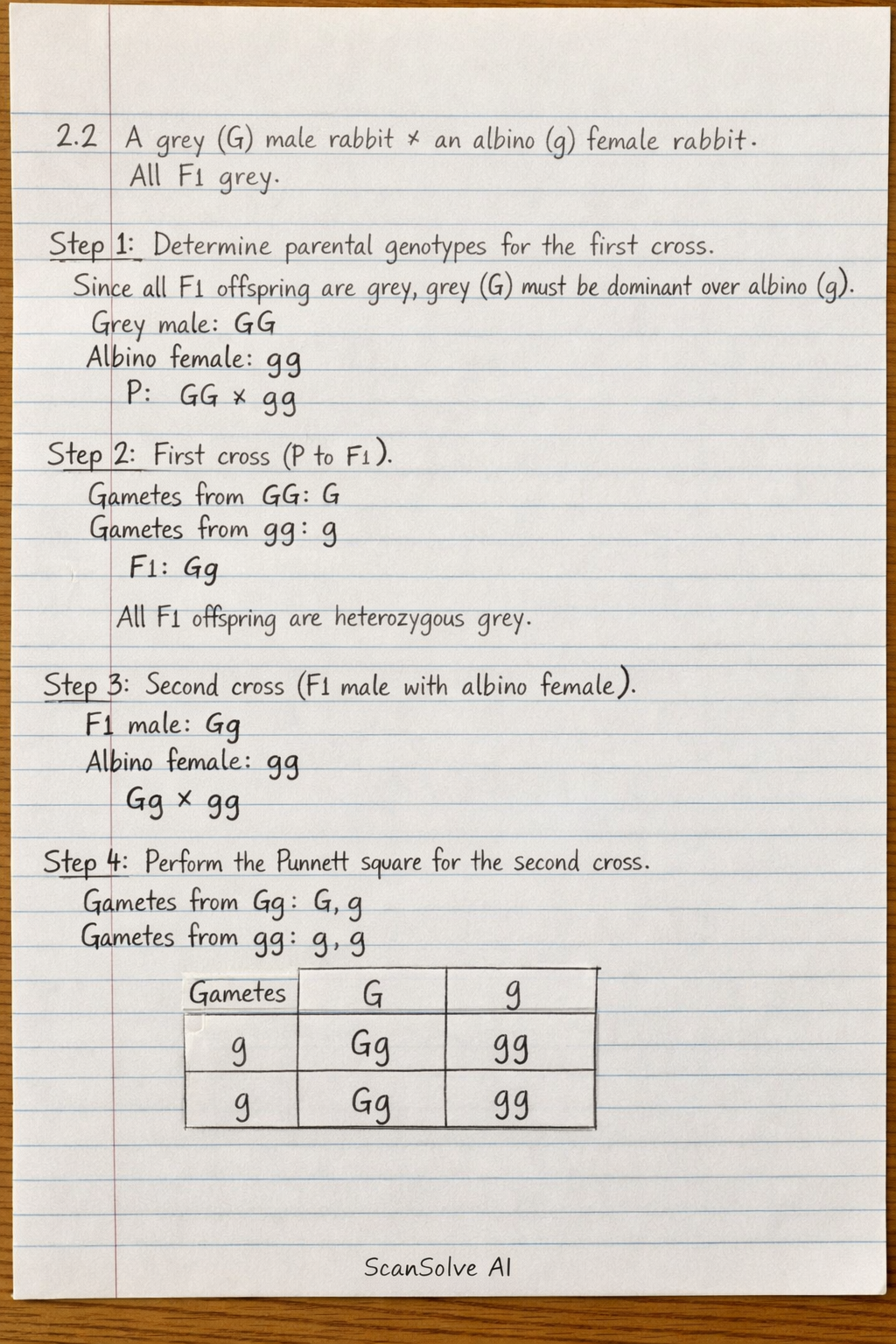
2.2 A grey (G) male rabbit was mated with an albino (g) female rabbit. The entire F1 generation was grey. Use a genetic cross to show the phenotypic ratio of their offspring if one of the males of the F1 generation was mated with an albino female.
Step 1: Determine parental genotypes for the first cross.
Since all F1 offspring are grey, grey (G) must be dominant over albino (g). The grey male must be homozygous dominant () and the albino female homozygous recessive ().
Step 2: First cross (P to F1).
Gametes from :
Gametes from :
All F1 offspring are heterozygous grey.
Step 3: Second cross (F1 male with albino female).
An F1 male is . An albino female is .
Step 4: Perform the Punnett square for the second cross.
Gametes from :
Gametes from :
Step 5: Determine the genotypic and phenotypic ratios.
- Genotypes: ,
- Phenotypes: Grey, Albino
- Phenotypic ratio:
Part 2.2· 4 steps
1 Name the type of Dominance shown.
- Answer:
2.6 You have two rose plants, both with pink flowers. You cross them and find that, while most of the offspring are pink, some are red and some are white. Use a genetic cross to show how breeding two pink flowering plants can result in pink, red and white flowering plants. Use the letter R for the red allele and W for the white allele.
Identify the type of dominance.
Since pink flowers result from a cross that also produces red and white flowers, this indicates incomplete dominance where pink is the heterozygous phenotype.
- Red phenotype:
- White phenotype:
- Pink phenotype:
Set up the cross.
Parents are two pink flowering plants.
Perform the Punnett square.
Gametes from first :
Gametes from second :Determine the genotypic and phenotypic ratios.
- Genotypes: , ,
- Phenotypes: Red, Pink, White
- Phenotypic ratio:
3. A blue fly (BB) is crossed with a yellow fly (YY). All of the offspring produced are green (BY).
Part 3.1· 3 steps
Use a genetic cross to show the phenotypic ratio and genotypic ratio off F1 generation.
Set up the cross.
Parents: Blue fly () Yellow fly ()
Perform the Punnett square.
Gametes from :
Gametes from :Determine the genotypic and phenotypic ratios for F1.
- Genotypes (F1): All ()
- Phenotypes (F1): All Green ()
- Genotypic ratio:
- Phenotypic ratio:
Part 3.2· 3 steps
Two green flies mate. Illustrate the F2 generation using a genetic cross.
Set up the cross.
Parents: Green fly () Green fly ()
Perform the Punnett square.
Gametes from first :
Gametes from second :Determine the genotypic and phenotypic ratios for F2.
- Genotypes (F2): , ,
- Genotypic ratio:
- Phenotypes (F2): Blue, Green, Yellow
- Phenotypic ratio:
Part 3.3
Name the type of dominance illustrated by this cross.
- Answer:
4. A male dog that has white fur (WW) is bred with a female dog that has black fur (BB). All the offspring produced have black and white fur.
Part 4.1
Name the type of dominance shown.
- Answer:
Part 4.2· 3 steps
Use a genetic cross to show the phenotypes and genotypes of the F1 generation.
Set up the cross.
Parents: White fur male () Black fur female ()
Perform the Punnett square.
Gametes from :
Gametes from :Determine the genotypic and phenotypic ratios for F1.
- Genotypes (F1): All ()
- Phenotypes (F1): All Black and white fur ()
- Genotypic ratio:
- Phenotypic ratio:
Still stuck on this one?
Ask a follow-up, and the answer starts from this question.
More Biology Questions
Handwritten Step-by-Step Solution
Get this as a handwritten image on WhatsApp — like a tutor wrote it for you.
Try on WhatsApp