
We read your photo as:
A man who cannot roll his tongue marries a woman who can. The woman's mother cannot roll her tongue. What are the genotypes and phenotypes of their children?
Biology
ScanSolve AI Answer
Step-by-step solution
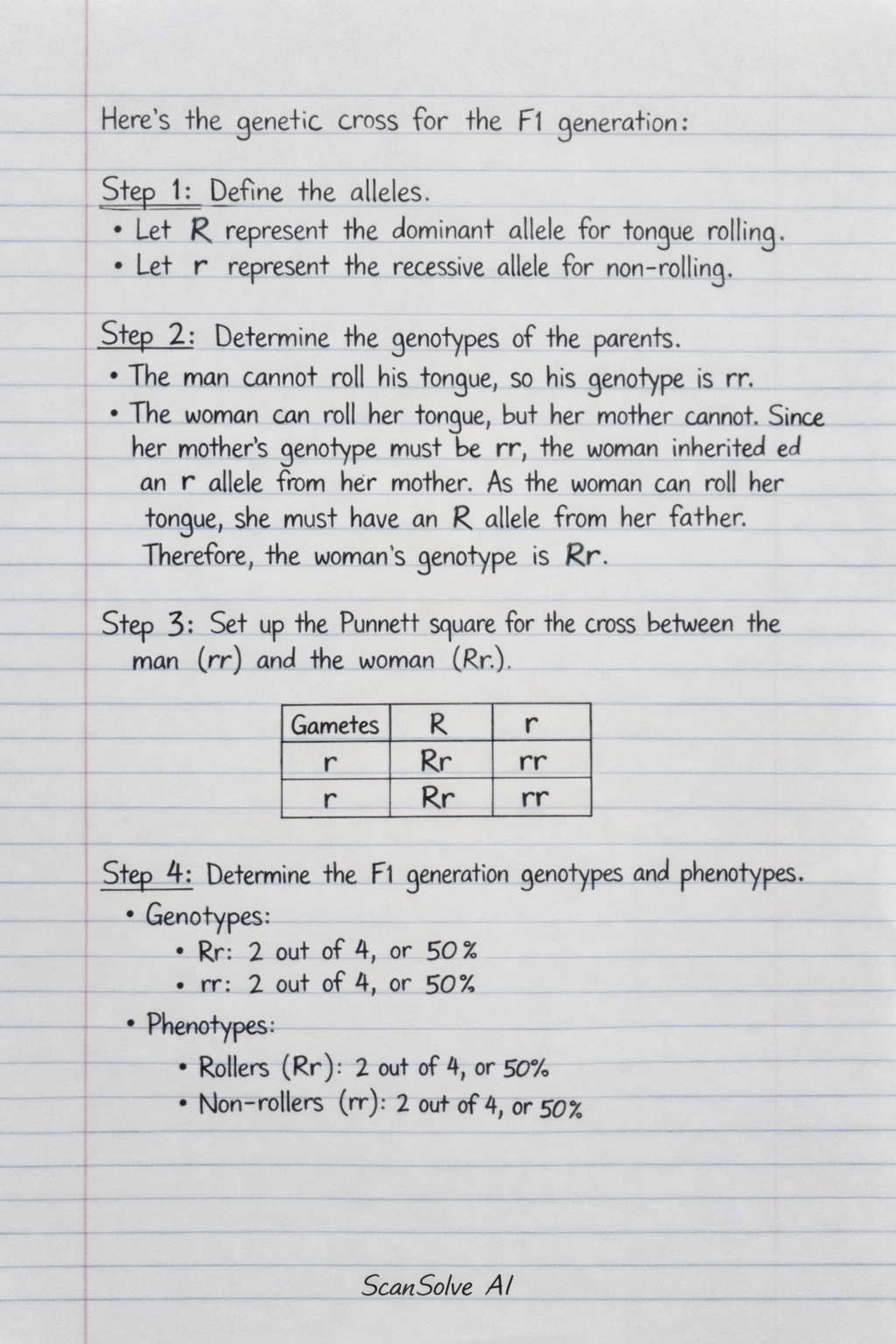
4 stepsHere's the genetic cross for the F1 generation:
Define the alleles.
- Let represent the dominant allele for tongue rolling.
- Let represent the recessive allele for non-rolling.
Determine the genotypes of the parents.
- The man cannot roll his tongue, so his genotype is rr.
- The woman can roll her tongue, but her mother cannot. Since her mother's genotype must be rr, the woman inherited an allele from her mother. As the woman can roll her tongue, she must have an allele from her father. Therefore, the woman's genotype is Rr.
Set up the Punnett square for the cross between the man () and the woman ().
Determine the F1 generation genotypes and phenotypes.
- Genotypes:
- : 2 out of 4, or 50%
- : 2 out of 4, or 50%
- Phenotypes:
- Rollers (): 2 out of 4, or 50%
- Non-rollers (): 2 out of 4, or 50%
The F1 generation will have a 1:1 ratio of heterozygous rollers () to homozygous non-rollers ().
Phenotypically, there will be a 1:1 ratio of rollers to non-rollers.- Genotypes:
Was this helpful?
Still stuck on this one?
Ask a follow-up, and the answer starts from this question.
Got a different question?Ask your own question
More Biology Questions
QA man with normal red blood cells and a woman who is a carrier of sickle cell anemia have children…Q(continued) b) The Rhesus negative daughter (genotype rr) is married to a Rhesus positive but…QGive the genotypes of the parentsQA man with normal red blood cells is married to a woman who is a sickle cell carrier. With the aid…QWrite the genotypes in every possible place. If individuals 1 and 2 marry, what is the probability…
Browse by topic:Genetics
Handwritten Step-by-Step Solution
Get this as a handwritten image on WhatsApp — like a tutor wrote it for you.
Try on WhatsApp