
We read your photo as:
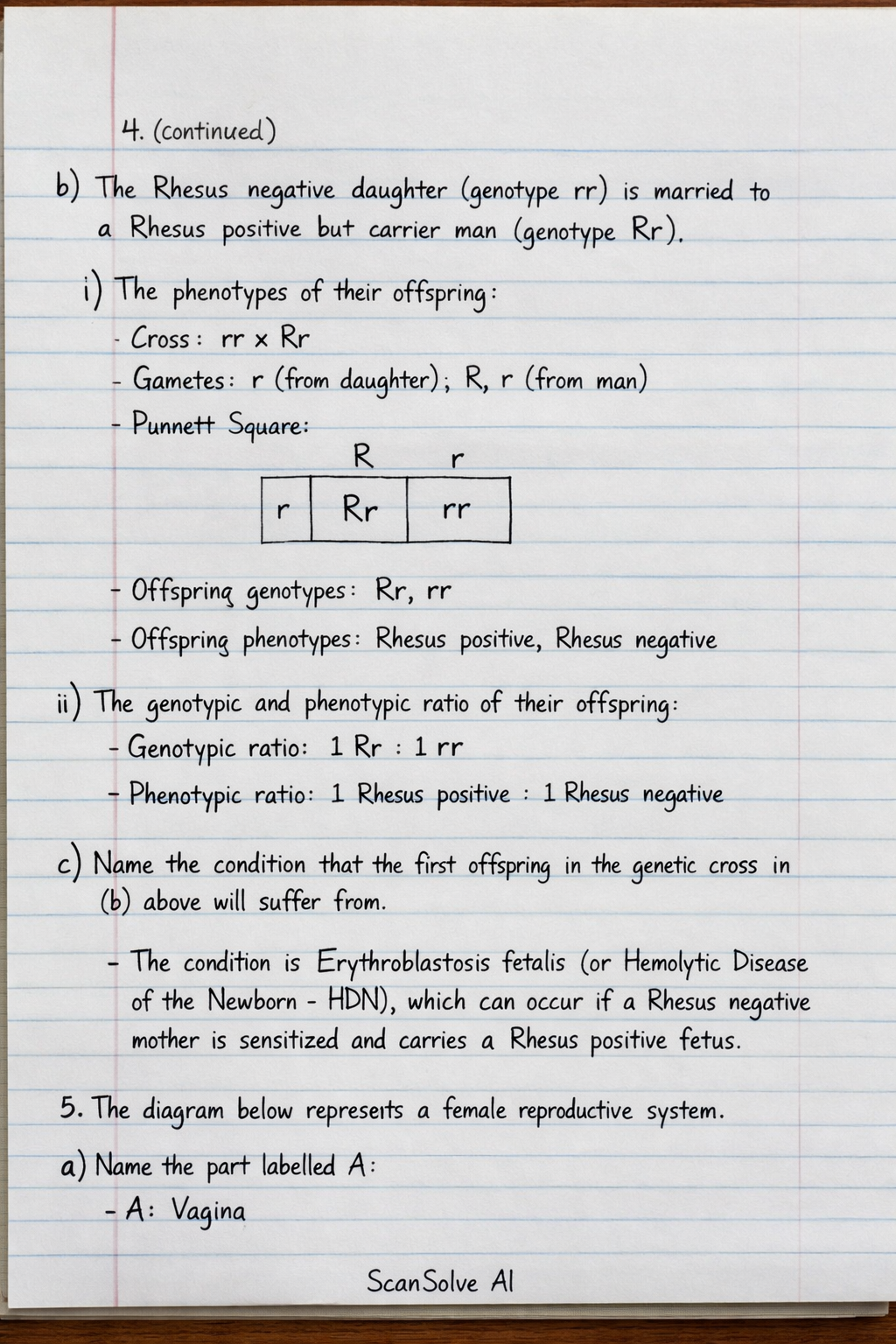
(continued) b) The Rhesus negative daughter (genotype rr) is married to a Rhesus positive but carrier man (genotype Rr). i) The phenotypes of their offspring: ii) The genotypic and phenotypic ratio of
ScanSolve AI Answer
4. (continued)
b) The Rhesus negative daughter (genotype rr) is married to a Rhesus positive but carrier man (genotype Rr).
i) The phenotypes of their offspring:
- Cross: rr Rr
- Gametes: r (from daughter); R, r (from man)
- Punnett Square:
- Offspring genotypes: Rr, rr
- Offspring phenotypes: Rhesus positive, Rhesus negative
ii) The genotypic and phenotypic ratio of their offspring:
- Genotypic ratio: 1 Rr : 1 rr
- Phenotypic ratio: 1 Rhesus positive : 1 Rhesus negative
c) Name the condition that the first offspring in the genetic cross in (b) above will suffer from.
- The condition is Erythroblastosis fetalis (or Hemolytic Disease of the Newborn - HDN), which can occur if a Rhesus negative mother is sensitized and carries a Rhesus positive fetus.
5. The diagram below represents a female reproductive system.
a) Name the part labelled A
- A: Vagina
b) Identify the letter representing the organ where fertilization takes place
- Fertilization takes place in the Fallopian tube, labelled E.
c) Name the hormones produced by the part labelled F
- F is the ovary. The hormones produced are estrogen and progesterone.
d) Explain how an ovum moves along the labelled E
- The ovum moves along the Fallopian tube (E) due to the beating action of cilia lining the tube and peristaltic contractions of the smooth muscle in the tube walls.
e) Explain why if the parts labelled F are removed after the fourth month, pregnancy can proceed normally.
- F represents the ovaries. In early pregnancy, the ovaries (specifically the corpus luteum) produce progesterone to maintain the uterine lining. However, after approximately the first trimester (around 10-12 weeks, or by the fourth month), the placenta is fully developed and takes over the production of progesterone, which is sufficient to sustain the pregnancy. Therefore, the ovaries are no longer essential for hormone production after this point.
Still stuck on this one?
Ask a follow-up, and the answer starts from this question.
More Biology Questions
Handwritten Step-by-Step Solution
Get this as a handwritten image on WhatsApp — like a tutor wrote it for you.
Try on WhatsApp