
We read your photo as:
A pure-line pea plant with green pods is crossed with a pure-line plant with yellow pods. All F1 plants have green pods. Using G for the dominant allele and g for the recessive allele, determine the g
Biology
ScanSolve AI Answer
Step-by-step solution
4 stepsSET 2
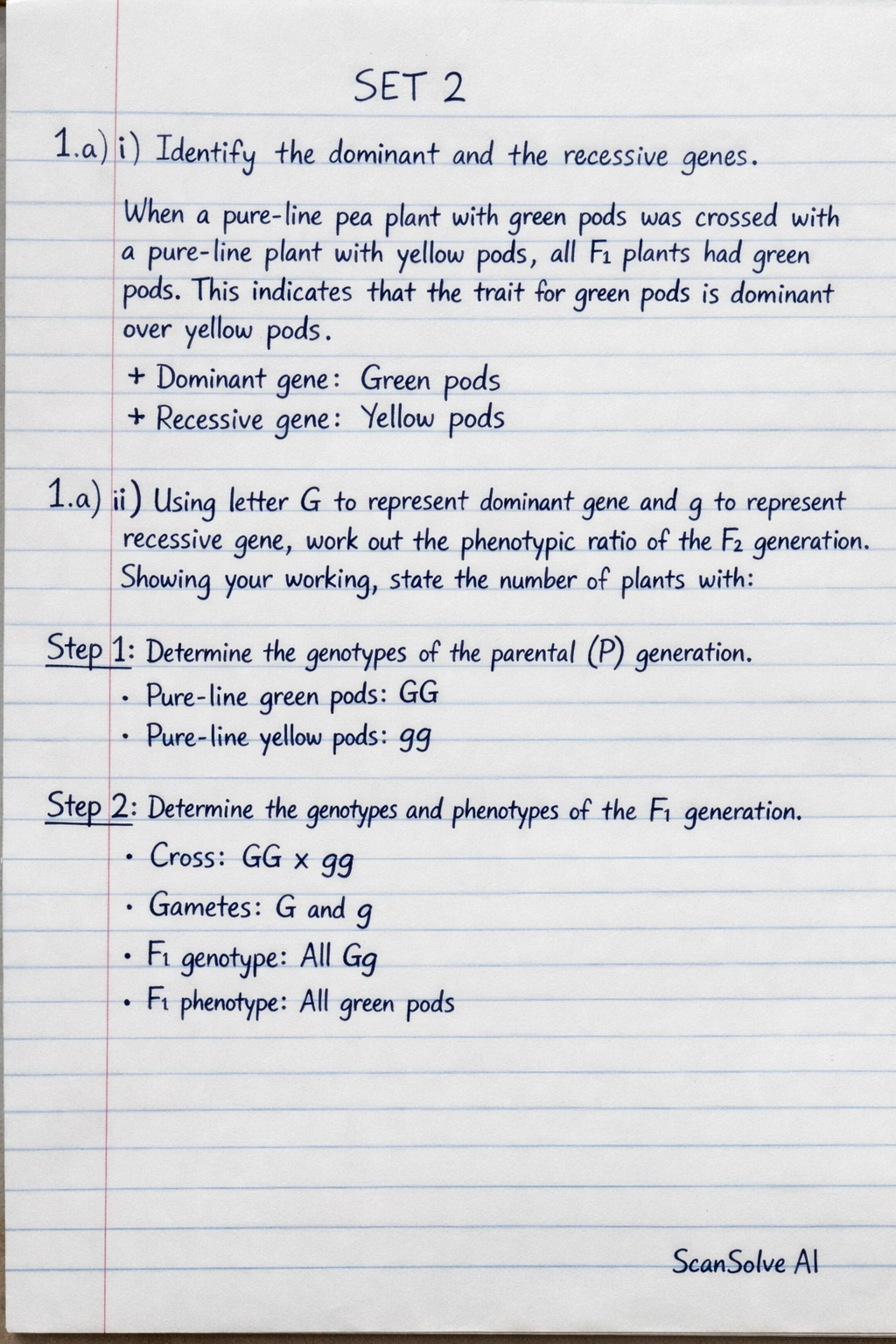
1. a) i) Identify the dominant and the recessive genes.
- When a pure-line pea plant with green pods was crossed with a pure-line plant with yellow pods, all F1 plants had green pods. This indicates that the trait for green pods is dominant over yellow pods.
- Dominant gene: Green pods
- Recessive gene: Yellow pods
1. a) ii) Using letter G to represent dominant gene and g to represent recessive gene, work out the phenotypic ratio of the F2 generation. Showing your working, state the number of plants with:
Determine the genotypes of the parental (P) generation.
- Pure-line green pods: GG
- Pure-line yellow pods: gg
Determine the genotypes and phenotypes of the F1 generation.
- Cross: GG gg
- Gametes: G and g
- F1 genotype: All Gg
- F1 phenotype: All green pods
Determine the genotypes and phenotypes of the F2 generation by self-crossing the F1 plants.
- Cross: Gg Gg
- Gametes: G, g and G, g
- Punnett Square:
- F2 Genotypes: 1 GG : 2 Gg : 1 gg
- F2 Phenotypes: 3 Green pods (GG, Gg) : 1 Yellow pods (gg)
- Phenotypic ratio of F2 generation: 3 Green : 1 Yellow
Calculate the expected number of plants for each phenotype in the F2 generation.
- Total F2 plants = 1160
- Number of green plants =
- Number of yellow plants =
- Number of plants with green pods: 870
- Number of plants with yellow pods: 290
1. b) State the number of plants with:
- Based on the F2 genotypic ratio (1 GG : 2 Gg : 1 gg) and total 1160 plants: i. Recessive genes (gg): ii. Dominant genes (GG): iii. Heterozygous genes (Gg):
1. c) i) What is sickle cell Anemia?
- Sickle cell anemia is a genetic blood disorder characterized by abnormally shaped red blood cells (sickle-shaped) due to a mutation in the gene for hemoglobin. These rigid, sticky cells can block blood flow, leading to pain, organ damage, and other complications.
1. c) ii) State one problem faced by people suffering from sickle cell anemia?
- One problem faced by people with sickle cell anemia is severe pain crises (vaso-occlusive crises) caused by blocked blood vessels, leading to tissue and organ damage. Other problems include anemia, increased risk of infections, and stroke.
2. a) i) State the aim of the experiment.
- The aim of the experiment is to demonstrate anaerobic respiration (fermentation) in yeast and to show that carbon dioxide is produced during this process.
Was this helpful?
Still stuck on this one?
Ask a follow-up, and the answer starts from this question.
Got a different question?Ask your own question
More Biology Questions
QExplain the inheritance of flower color from a cross between a homozygous white pea plant and a…QIn peas, blue flowers are dominant over white. If pure breeding blue is crossed with pure breeding…QPea plants heterozygous for seed shape and seed color are crossed. Determine the phenotypic ratio of…QA homozygous sweet pea with white flowers was crossed with a homozygous sweet pea with red flowers…QThe plant is heterozygous for green leaves. Green (G) is dominant over variegated (g).
Browse by topic:Genetics
Handwritten Step-by-Step Solution
Get this as a handwritten image on WhatsApp — like a tutor wrote it for you.
Try on WhatsApp