
We read your photo as:
A student is investigating the water retention properties of three different soil types, Q, R, and S, using the experimental setup shown in Fig. 21. The table below shows the amount of water that drai
Biology
ScanSolve AI Answer
Answer
Step-by-step solution
4 stepsPart a· 2 steps
Analyze Fig.
21 to determine the water retention of each soil type.
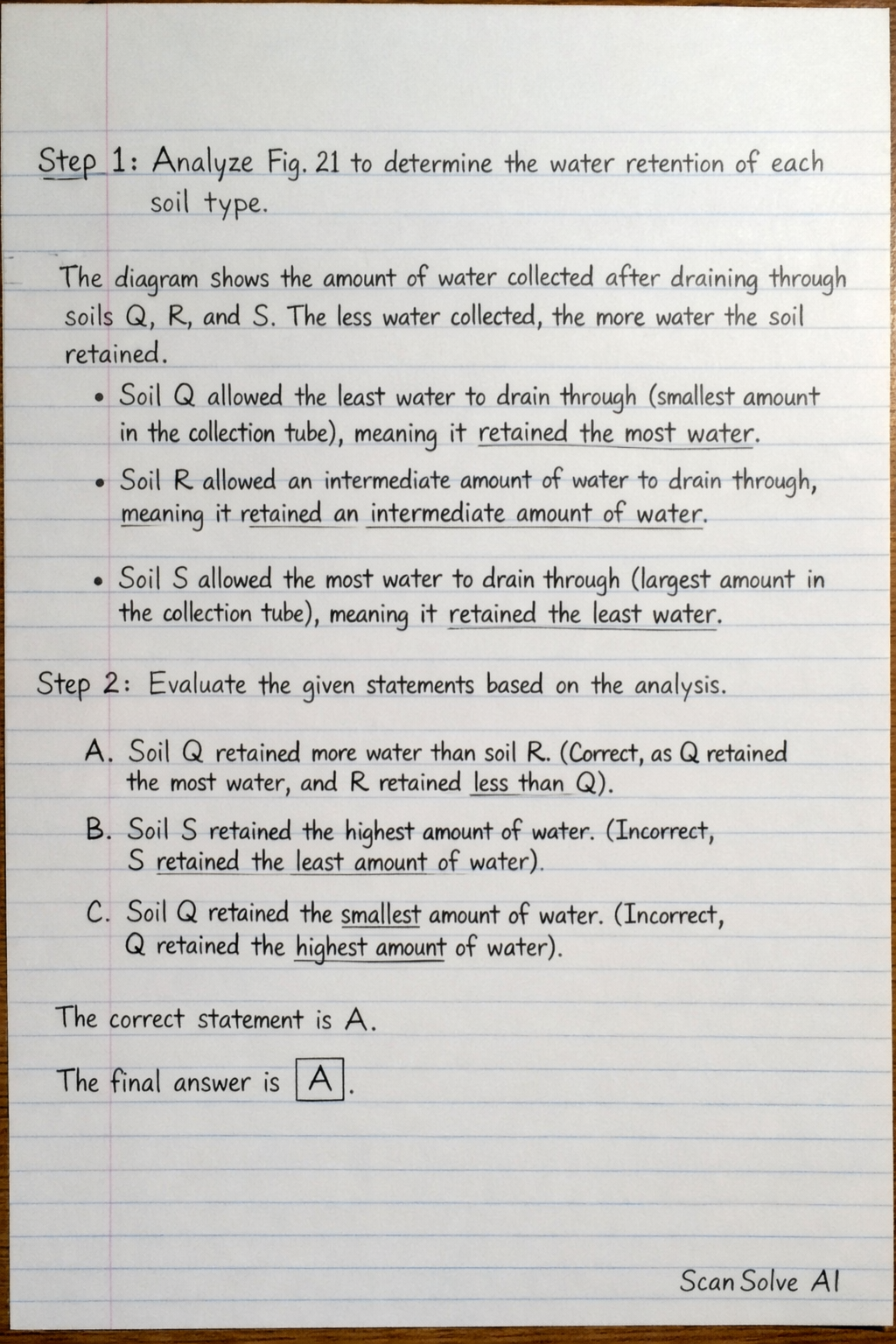
The diagram shows the amount of water collected after draining through soils Q, R, and S. The less water collected, the more water the soil retained.- Soil Q allowed the least water to drain through (smallest amount in the collection tube), meaning it retained the most water.
- Soil R allowed an intermediate amount of water to drain through, meaning it retained an intermediate amount of water.
- Soil S allowed the most water to drain through (largest amount in the collection tube), meaning it retained the least water.
Evaluate the given statements based on the analysis.
- A. Soil Q retained more water than soil R. (Correct, as Q retained the most water, and R retained less than Q).
- B. Soil S retained the highest amount of water. (Incorrect, S retained the least amount of water).
- C. Soil Q retained the smallest amount of water. (Incorrect, Q retained the highest amount of water).
The correct statement is A.
The final answer is
Part b· 2 steps
Relate water retention characteristics from Fig.
21 to known soil properties.
- Soil Q retained the most water. Soils with very small particles, like clay, have high water retention.
- Soil S retained the least water. Soils with large particles, like sand, have low water retention and good drainage.
- Soil R retained an intermediate amount of water. Loam soil, a mixture, has moderate water retention.
Identify soils Q, R, and S based on these properties.
- Soil Q, with the highest water retention, is Clay soil.
- Soil S, with the lowest water retention, is Sand soil.
- Soil R, with intermediate water retention, is Loam soil.
Therefore:
- Q = Clay soil
- R = Loam soil
- S = Sand soil
Was this helpful?
Try one yourself
A new problem that tests the same skill.
Still stuck on this one?
Ask a follow-up, and the answer starts from this question.
Got a different question?Ask your own question
More Biology Questions
QIdentify the physical property of soil investigated, describe the experimental procedure, and…QIdentify the soil types labeled Q, R, and S in the image, which shows a soil sedimentation…QUse the diagrams of soil drainage setups to answer the following questions: 1) Name the soil types…QDescribe an experiment to test drainage and water retention in soils K, L, and M. Discuss the…QPart a: Describe an experiment to investigate drainage rate and water retention capacity of…
Handwritten Step-by-Step Solution
Get this as a handwritten image on WhatsApp — like a tutor wrote it for you.
Try on WhatsApp