
We read your photo as:
Identify the physical property of soil investigated, describe the experimental procedure, and classify three soil samples (P, Q, R) based on their water retention capacity.
Geography
ScanSolve AI Answer
Step-by-step solution
5 stepsPart a· 5 steps
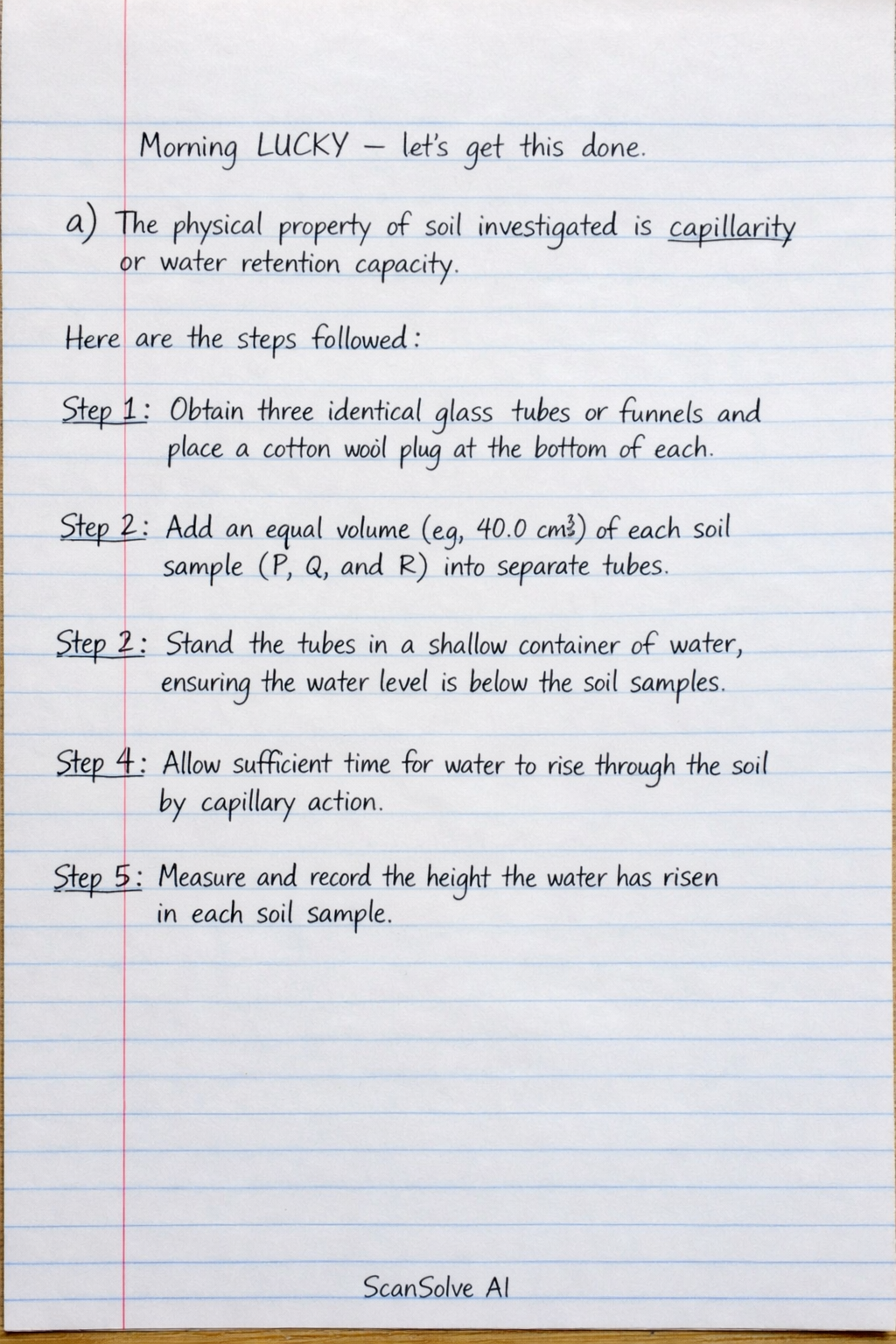
The physical property of soil investigated is capillarity or *water retention capacity
Here are the steps followed:
Obtain three identical glass tubes or funnels and place a cotton wool plug at the bottom of each.
Add an equal volume (e.g., 40.0 cm³) of each soil sample (P, Q, and R) into separate tubes.
Stand the tubes in a shallow container of water, ensuring the water level is below the soil samples.
Allow sufficient time for water to rise through the soil by capillary action.
Measure and record the height the water has risen in each soil sample.
Part b
Based on the height risen by water
- Soil Q is sandy soil. Reason: Sandy soil has large particle sizes and large pore spaces, which results in weak capillary action and therefore the lowest rise in water (9.0 cm).
- Soil R is loam soil. Reason: Loam soil is a mixture of sand, silt, and clay, giving it moderate particle sizes and pore spaces, leading to an intermediate rise in water (17.0 cm).
- Soil P is clay soil. Reason: Clay soil has very small particle sizes and very fine, numerous pore spaces, which creates strong capillary action, allowing water to rise to the greatest height (28.0 cm).
Part c
The results in Table 1 demonstrate the varying capillary action of different soil types, which is determined by their particle size and *pore space
- Clay soil (P) has the smallest particles, creating many tiny pore spaces. These small pores exert strong capillary forces, pulling water up to the highest level (28.0 cm).
- Sandy soil (Q) has the largest particles, resulting in large pore spaces. These large pores have weak capillary forces, causing water to rise to the lowest level (9.0 cm).
- Loam soil (R) has a balanced mix of particle sizes, leading to intermediate pore sizes. This results in moderate capillary action, allowing water to rise to an intermediate height (17.0 cm).
Was this helpful?
Still stuck on this one?
Ask a follow-up, and the answer starts from this question.
Got a different question?Ask your own question
More Geography Questions
QA student is investigating the water retention properties of three different soil types, Q, R, and…QIdentify the soil types labeled Q, R, and S in the image, which shows a soil sedimentation…QDescribe an experiment to test drainage and water retention in soils K, L, and M. Discuss the…QPart a: Describe an experiment to investigate drainage rate and water retention capacity of…QExplain the classification of the soil
Browse by topic:Earth Science
Handwritten Step-by-Step Solution
Get this as a handwritten image on WhatsApp — like a tutor wrote it for you.
Try on WhatsApp