
We read your photo as:
Describe an experiment to test drainage and water retention in soils K, L, and M. Discuss the suitability of each soil type for maize cultivation. Identify hazard symbols I, II, III, and IV, give exam
ScanSolve AI Answer
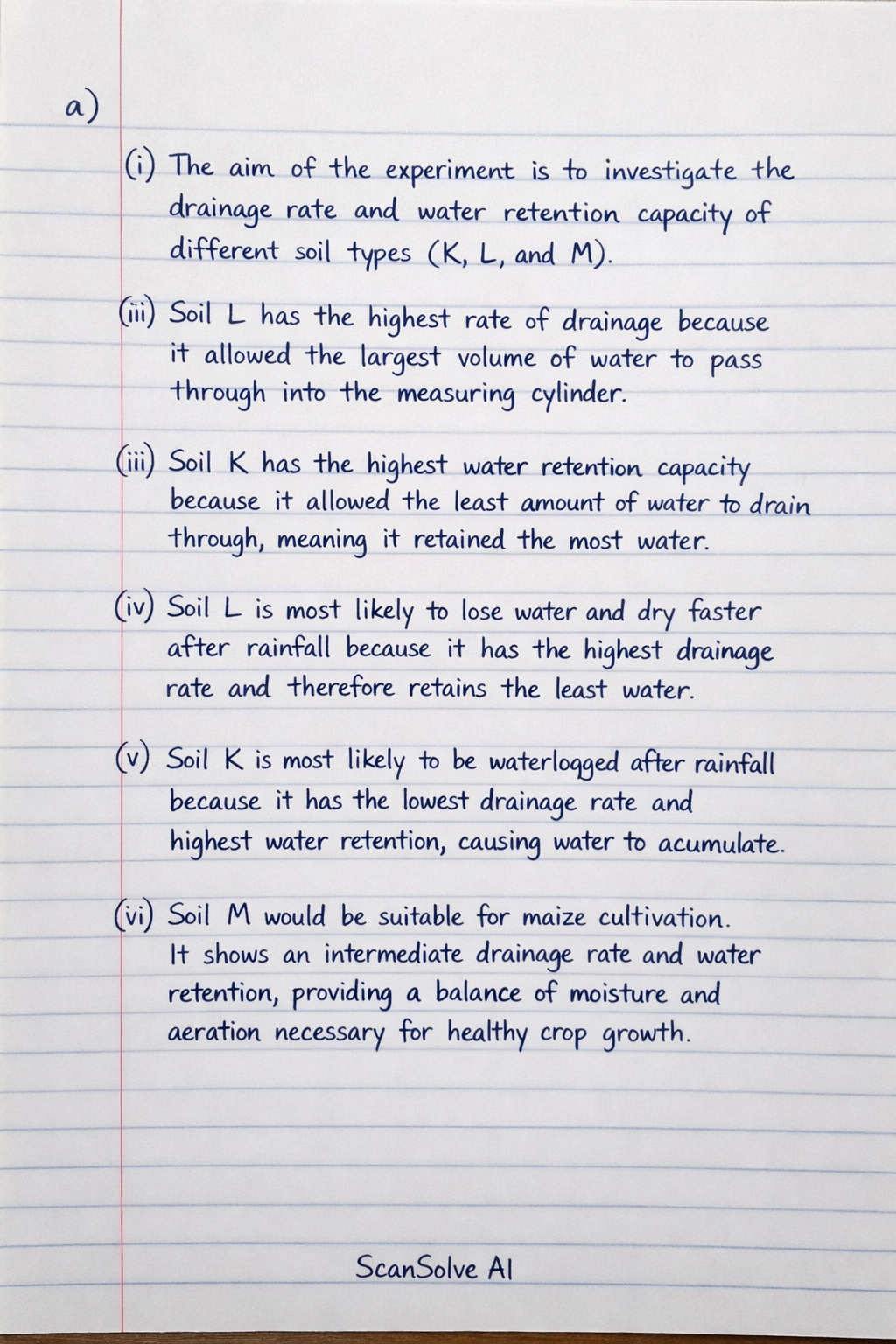
a)
-
(i) The aim of the experiment is to investigate the drainage rate and water retention capacity of different soil types (K, L, and M).
-
(ii) Soil L has the highest rate of drainage because it allowed the largest volume of water to pass through into the measuring cylinder.
-
(iii) Soil K has the highest water retention capacity because it allowed the least amount of water to drain through, meaning it retained the most water.
-
(iv) Soil L is most likely to lose water and dry faster after rainfall because it has the highest drainage rate and therefore retains the least water.
-
(v) Soil K is most likely to be waterlogged after rainfall because it has the lowest drainage rate and highest water retention, causing water to accumulate.
-
(vi) Soil M would be suitable for maize cultivation. It shows an intermediate drainage rate and water retention, providing a balance of moisture and aeration necessary for healthy crop growth.
b)
-
(i)
- I: Toxic or Poisonous
- II: Irritant or Harmful
- III: Flammable
- IV: No firearms or No weapons
-
(ii)
- I (Toxic): Cyanide
- II (Irritant/Harmful): Bleach
- III (Flammable): Petrol
-
(iii)
- II (Irritant/Harmful): Laboratories
- IV (No firearms): Airports
-
(iv) The symbols displayed on chemical containers are I, II, and III.
Still stuck on this one?
Ask a follow-up, and the answer starts from this question.
More Biology Questions
Handwritten Step-by-Step Solution
Get this as a handwritten image on WhatsApp — like a tutor wrote it for you.
Try on WhatsApp