
We read your photo as:
Part a: Describe an experiment to investigate drainage rate and water retention capacity of different soil types (K, L, M). Explain the results. Part b: Explain the meaning of hazard symbols I, II, II
ScanSolve AI Answer
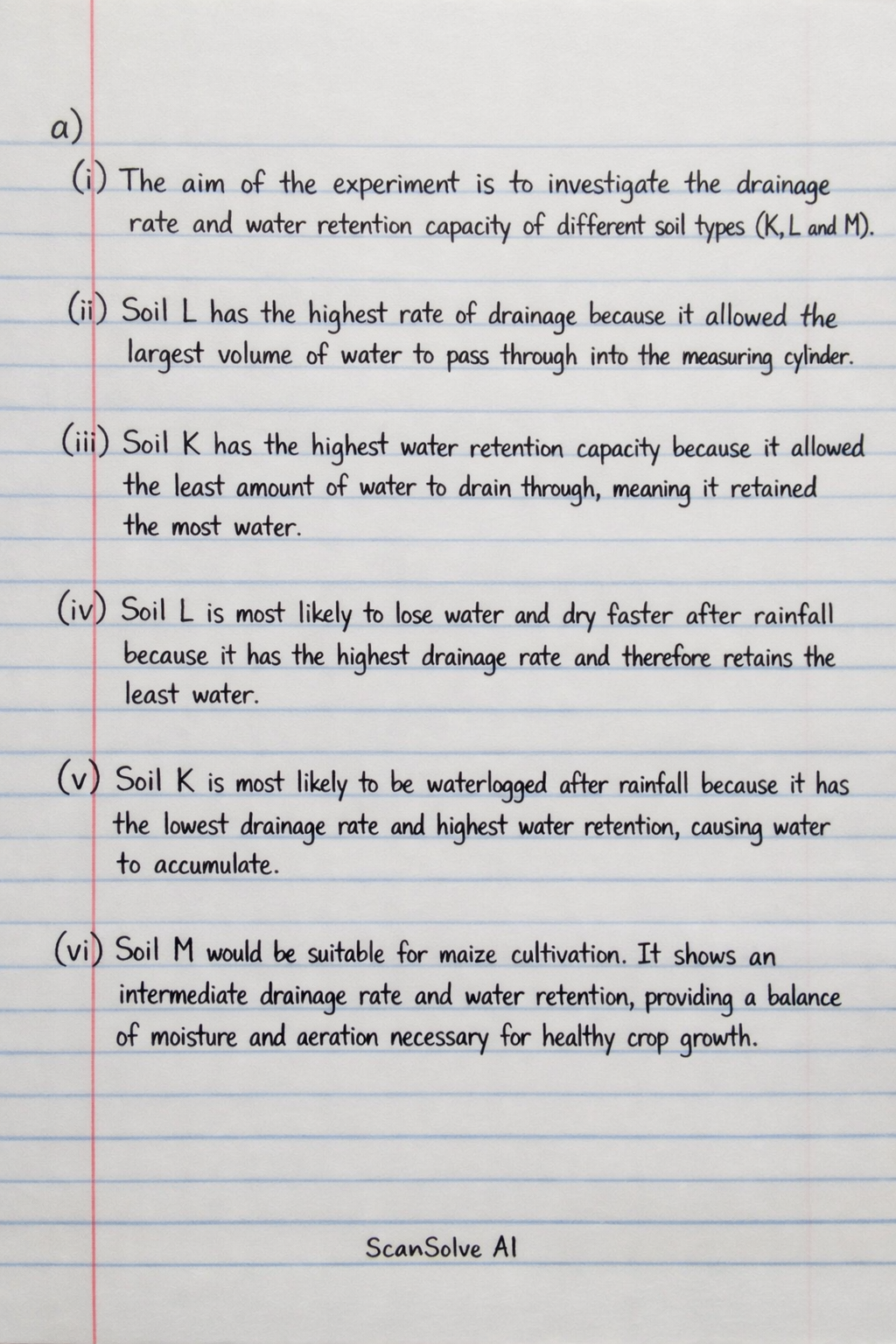
a)
-
(i) The aim of the experiment is to investigate the drainage rate and water retention capacity of different soil types (K, L, and M).
-
(ii) Soil L has the highest rate of drainage because it allowed the largest volume of water to pass through into the measuring cylinder.
-
(iii) Soil K has the highest water retention capacity because it allowed the least amount of water to drain through, meaning it retained the most water.
-
(iv) Soil L is most likely to lose water and dry faster after rainfall because it has the highest drainage rate and therefore retains the least water.
-
(v) Soil K is most likely to be waterlogged after rainfall because it has the lowest drainage rate and highest water retention, causing water to accumulate.
-
(vi) Soil M would be suitable for maize cultivation. It shows an intermediate drainage rate and water retention, providing a balance of moisture and aeration necessary for healthy crop growth.
b)
-
(i)
- I: Toxic or Poisonous
- II: Irritant or Harmful
- III: Flammable
- IV: No firearms or No weapons
-
(ii)
- I (Toxic): Cyanide
- II (Irritant/Harmful): Bleach
- III (Flammable): Petrol
-
(iii)
- II (Irritant/Harmful): Laboratories
- IV (No firearms): Airports
-
(iv) The symbols displayed on chemical containers are I, II, and III.
Still stuck on this one?
Ask a follow-up, and the answer starts from this question.
More Biology Questions
Handwritten Step-by-Step Solution
Get this as a handwritten image on WhatsApp — like a tutor wrote it for you.
Try on WhatsApp