
We read your photo as:
A diagram shows a soil profile with labels I, II, III, IV representing different horizons. Answer the following questions about the diagram: (i) What does the diagram represent? (ii) Name each labelle
Geography
ScanSolve AI Answer
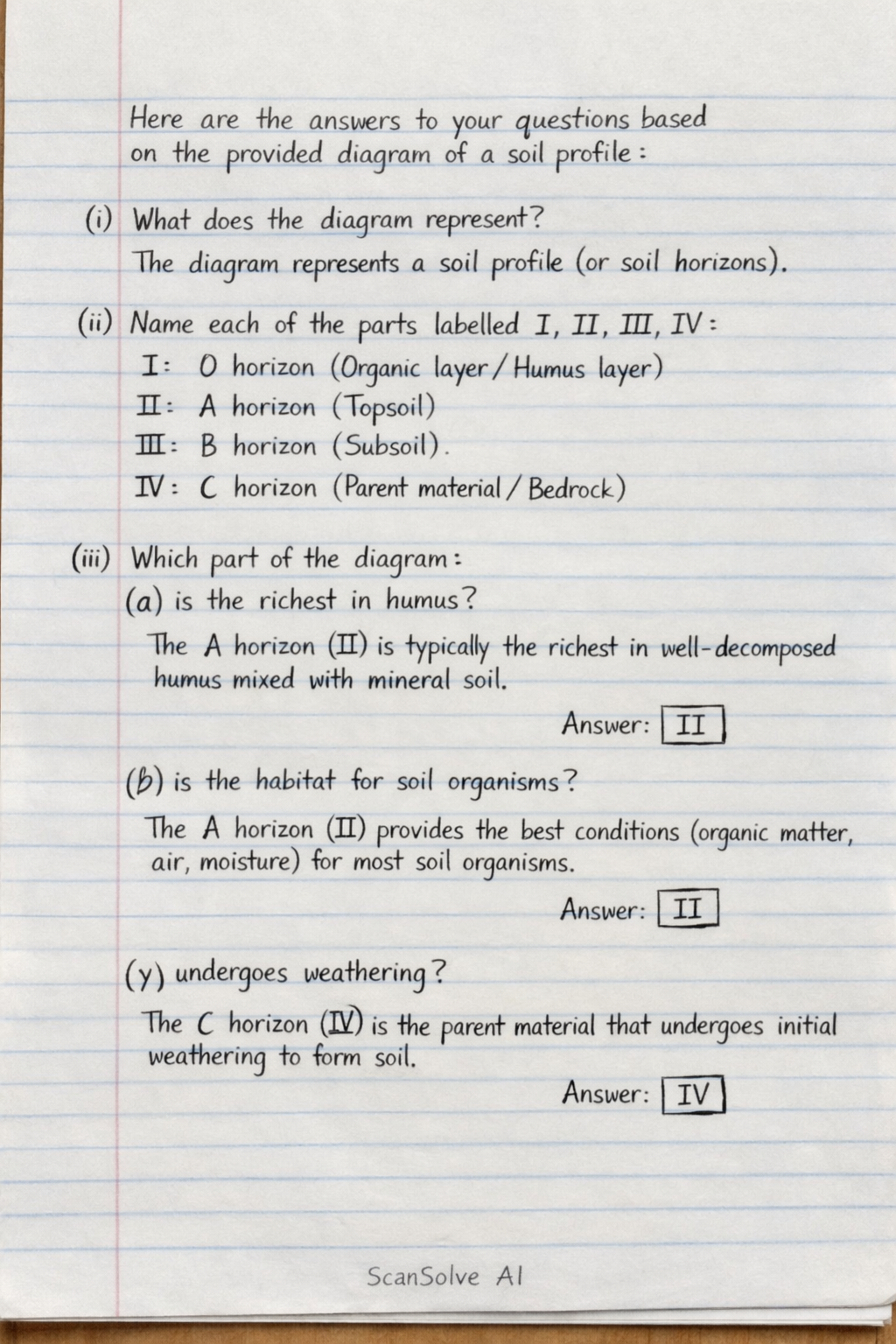
Here are the answers to your questions based on the provided diagram of a soil profile:
-
(i) What does the diagram represent? The diagram represents a soil profile (or soil horizons).
-
(ii) Name each of the parts labelled I, II, III, IV.
- I: O horizon (Organic layer / Humus layer)
- II: A horizon (Topsoil)
- III: B horizon (Subsoil)
- IV: C horizon (Parent material / Bedrock)
-
(iii) Which part of the diagram:
- (α) is the richest in humus?
- The A horizon (II) is typically the richest in well-decomposed humus mixed with mineral soil.
- Answer:
- (β) is the habitat for soil organisms?
- The A horizon (II) provides the best conditions (organic matter, air, moisture) for most soil organisms.
- Answer:
- (γ) undergoes weathering?
- The C horizon (IV) is the parent material that undergoes initial weathering to form soil.
- Answer:
- (α) is the richest in humus?
-
(iv) What is the effect of heavy rainfall on the part labelled I? Heavy rainfall on part I (the O horizon/organic layer) can cause soil erosion, washing away the loose organic matter and fine soil particles. It can also lead to leaching of nutrients from this layer.
Was this helpful?
Still stuck on this one?
Ask a follow-up, and the answer starts from this question.
Got a different question?Ask your own question
More Geography Questions
QA) A soil profile is a vertical cross-section of the soil, showing the different layers or horizons…QIdentify and describe the different layers of the Earth based on the provided diagram and questions.QWhat is a soil profile? (10 marks)QIdentify the labeled parts (A, B, C, I, II, III, IV, V) in the diagram illustrating vegetative…QSoil profile in detail
Browse by topic:Earth Science
Handwritten Step-by-Step Solution
Get this as a handwritten image on WhatsApp — like a tutor wrote it for you.
Try on WhatsApp