
Soil profile in detail
Geography
ScanSolve AI Answer
Answer
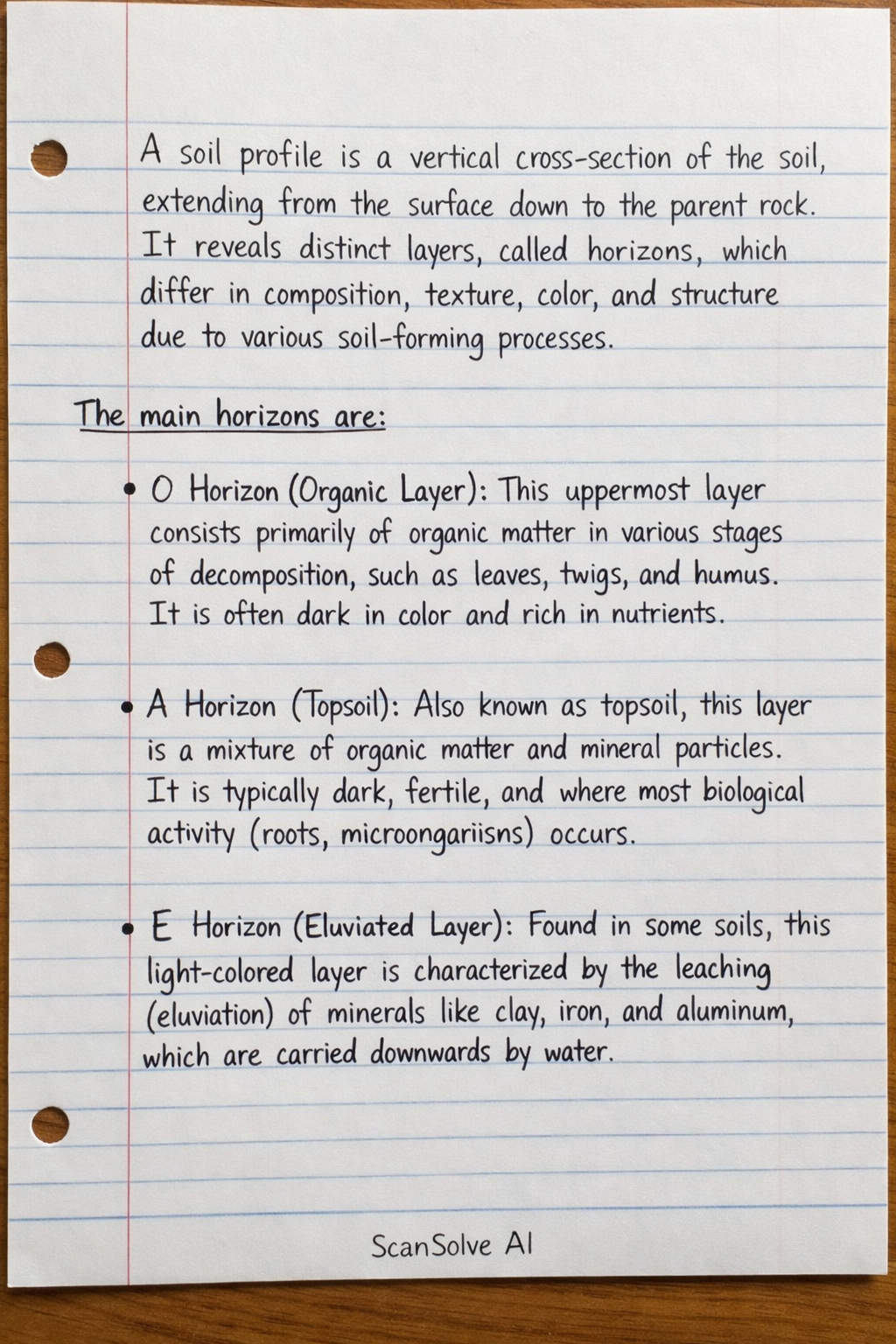
A soil profile is a vertical cross-section of the soil, extending from the surface down to the parent rock. It reveals distinct layers, called horizons, which differ in composition, texture, color, and structure due to various soil-forming processes.
The main horizons are:
- O Horizon (Organic Layer): This uppermost layer consists primarily of organic matter in various stages of decomposition, such as leaves, twigs, and humus. It is often dark in color and rich in nutrients.
- A Horizon (Topsoil): Also known as topsoil, this layer is a mixture of organic matter and mineral particles. It is typically dark, fertile, and where most biological activity (roots, microorganisms) occurs.
- E Horizon (Eluviated Layer): Found in some soils, this light-colored layer is characterized by the leaching (eluviation) of minerals like clay, iron, and aluminum, which are carried downwards by water.
- B Horizon (Subsoil): This layer, also called subsoil, accumulates minerals and organic matter leached from the A and E horizons. It is often denser, has a higher clay content, and may be reddish or yellowish due to iron oxides.
- C Horizon (Parent Material): Consisting of partially weathered parent rock or unconsolidated material, this layer shows little to no evidence of soil formation processes. It is the source material from which the upper horizons develop.
- R Horizon (Bedrock): This is the unweathered, solid bedrock layer beneath the soil profile. It can be granite, limestone, sandstone, or other types of rock.
Was this helpful?
Still stuck on this one?
Ask a follow-up, and the answer starts from this question.
Got a different question?Ask your own question
More Geography Questions
QDifferent type of soil profileQWhat is a soil profile? (10 marks)QWith reference to a name major soil type, explain the formation of its profile.QA) A soil profile is a vertical cross-section of the soil, showing the different layers or horizons…QA diagram shows a soil profile with labels I, II, III, IV representing different horizons. Answer…
Browse by topic:Earth Science
Handwritten Step-by-Step Solution
Get this as a handwritten image on WhatsApp — like a tutor wrote it for you.
Try on WhatsApp