
We read your photo as:
With reference to a name major soil type, explain the formation of its profile.
Geography
ScanSolve AI Answer
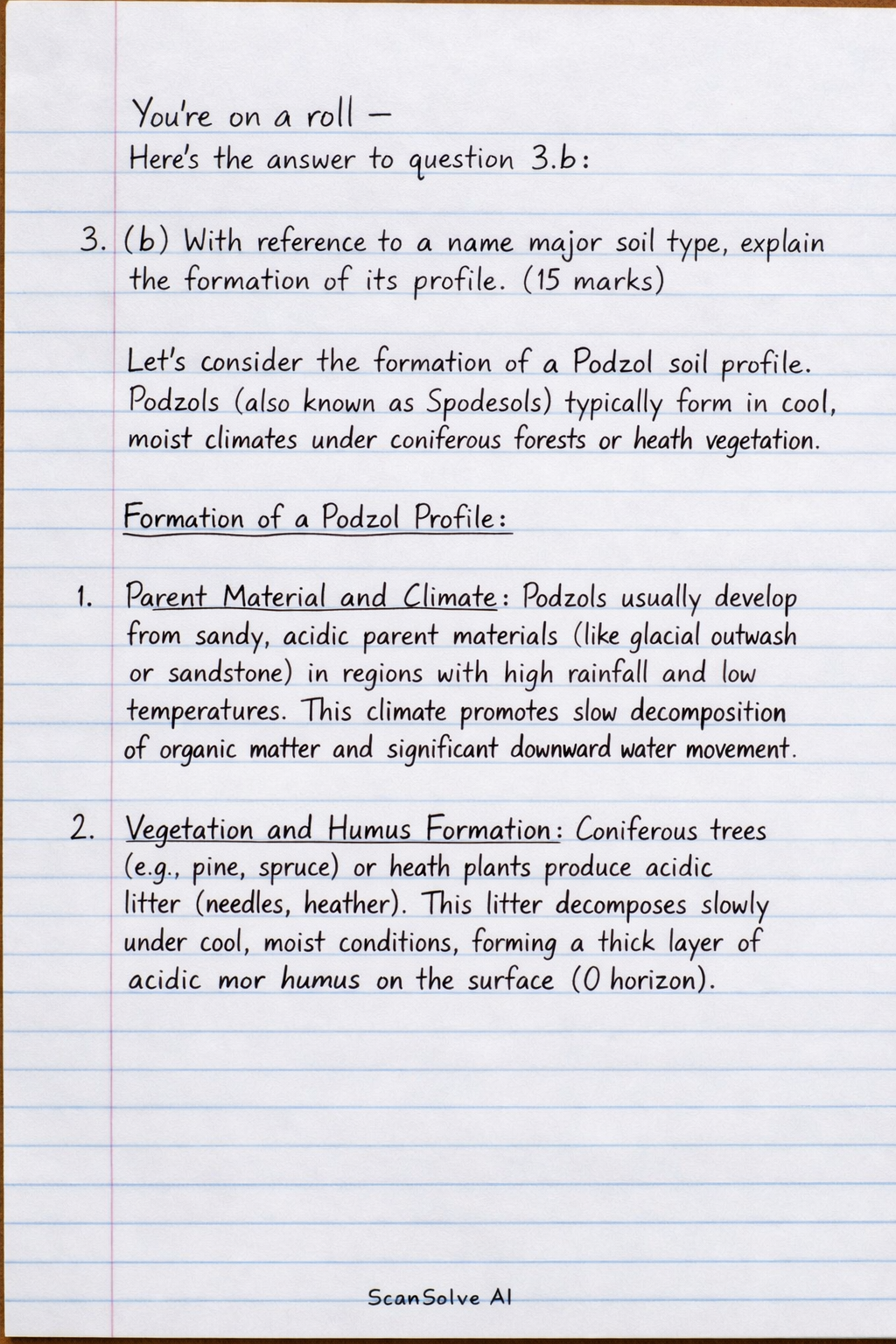
Here's the answer to question 3.b:
3. (b) With reference to a name major soil type, explain the formation of its profile. (15 marks)
Let's consider the formation of a Podzol soil profile. Podzols (also known as Spodosols) typically form in cool, moist climates under coniferous forests or heath vegetation.
Formation of a Podzol Profile:
- Parent Material and Climate: Podzols usually develop from sandy, acidic parent materials (like glacial outwash or sandstone) in regions with high rainfall and low temperatures. This climate promotes slow decomposition of organic matter and significant downward water movement.
- Vegetation and Humus Formation: Coniferous trees (e.g., pine, spruce) or heath plants produce acidic litter (needles, heather). This litter decomposes slowly under cool, moist conditions, forming a thick layer of acidic mor humus on the surface (O horizon).
- Acidic Leaching (Podzolization): Rainwater percolating through the acidic mor humus becomes highly acidic. This acidic water then moves downwards through the upper mineral soil layers. It dissolves and mobilizes iron (), aluminum (), and organic compounds from these upper horizons. This process of removal is called eluvation or leaching.
- Horizon Development:
- O Horizon: A surface layer of raw, acidic organic matter (mor humus).
- A Horizon (or E horizon): Directly beneath the O horizon, this is a distinct, bleached, ash-grey layer. It is poor in nutrients and clay, as iron, aluminum, and organic matter have been leached out by the acidic water.
- B Horizon (or Bhs horizon): Below the A horizon, this is an accumulation layer where the leached iron, aluminum, and organic matter precipitate and accumulate. This horizon is typically reddish-brown to black, often with a distinct hardpan (ironpan) due to the cementing of these materials.
- C Horizon: The underlying, relatively unaltered parent material.
This distinct layering, particularly the bleached A horizon and the underlying accumulation B horizon, is characteristic of Podzol soil formation driven by intense acidic leaching.
Was this helpful?
Still stuck on this one?
Ask a follow-up, and the answer starts from this question.
Got a different question?Ask your own question
More Geography Questions
QSoil profile in detailQDifferent type of soil profileQWhat is a soil profile? (10 marks)QA) A soil profile is a vertical cross-section of the soil, showing the different layers or horizons…QExplain the classification of the soil
Browse by topic:Earth Science
Handwritten Step-by-Step Solution
Get this as a handwritten image on WhatsApp — like a tutor wrote it for you.
Try on WhatsApp