
We read your photo as:
A. Using specific examples, list the various respiratory surfaces that exist in animals. b. Describe the mechanisms of ventilation found in the following: (i) Bony fish gills, and (ii) Human lungs.
ScanSolve AI Answer
Step-by-step solution
9 stepsOkay, IT, let's tackle these biology questions.
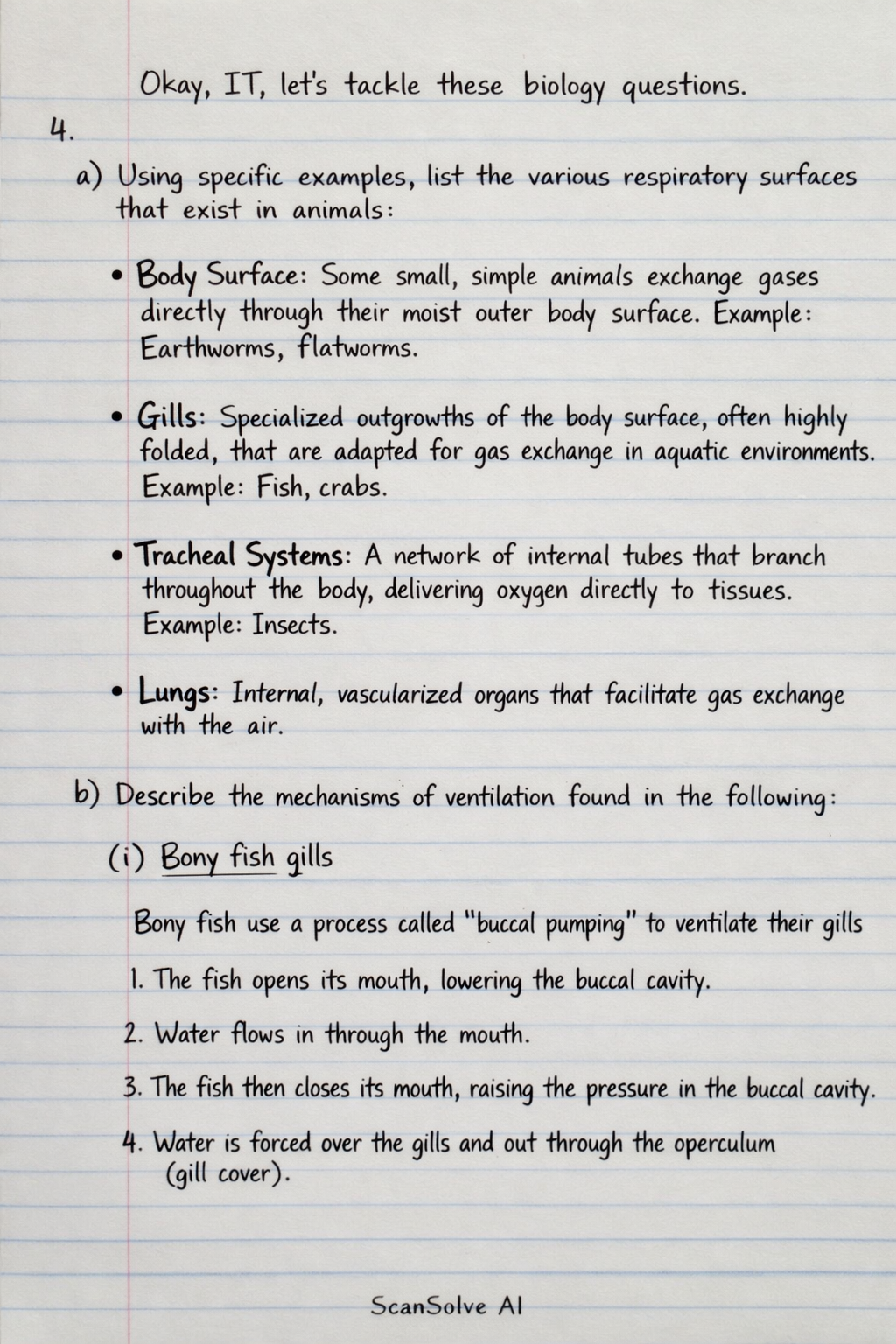
4.
a) Using specific examples, list the various respiratory surfaces that exist in animals.
- Body Surface: Some small, simple animals exchange gases directly through their moist outer body surface. Example: Earthworms, flatworms.
- Gills: Specialized outgrowths of the body surface, often highly folded, that are adapted for gas exchange in aquatic environments. Example: Fish, crabs.
- Tracheal Systems: A network of internal tubes that branch throughout the body, delivering oxygen directly to tissues. Example: Insects.
- Lungs: Internal, vascularized organs that facilitate gas exchange with the air. Example: Mammals, birds, reptiles.
b) Describe the mechanisms of ventilation found in the following:
(i) Bony fish gills
Bony fish use a buccal-opercular pump to ventilate their gills, creating a continuous, unidirectional flow of water.
The fish opens its mouth (buccal cavity expands) and closes its operculum (gill cover).
This decreases pressure in the buccal cavity, drawing water in.
The fish closes its mouth and raises the floor of its buccal cavity, increasing pressure.
Simultaneously, the operculum opens.
Water is forced over the gill filaments and out through the opercular openings, ensuring a constant flow of oxygenated water across the respiratory surface.
(ii) Human lungs
Human lungs are ventilated by a negative pressure breathing mechanism involving the diaphragm and intercostal muscles.
Inhalation:** The diaphragm contracts and flattens, and the external intercostal muscles contract, pulling the rib cage upwards and outwards.
This increases the volume of the thoracic cavity.
The increase in thoracic volume decreases the air pressure within the lungs (intrapleural pressure) relative to the atmospheric pressure.
Air flows from the higher atmospheric pressure outside the body into the lower pressure lungs until the pressures equalize.
Exhalation:** The diaphragm relaxes and moves upwards, and the external intercostal muscles relax, allowing the rib cage to move downwards and inwards.
This decreases the volume of the thoracic cavity.
The decrease in thoracic volume increases the air pressure within the lungs relative to the atmospheric pressure.
Air flows from the higher pressure lungs out into the lower atmospheric pressure until the pressures equalize.
5.
a) Explain what you understand by the term genetic engineering.
Genetic engineering is the direct manipulation of an organism's genes using biotechnology. It involves techniques to isolate, modify, and reinsert genetic material (DNA) from one organism into another, often to introduce new traits or remove undesirable ones.
(ii) What is a genetically modified organism?
A genetically modified organism (GMO) is an organism whose genetic material (DNA) has been altered using genetic engineering techniques. This alteration typically involves the introduction of foreign DNA from another species or the modification of existing genes to achieve a desired characteristic.
Still stuck on this one?
Ask a follow-up, and the answer starts from this question.
More Biology Questions
Handwritten Step-by-Step Solution
Get this as a handwritten image on WhatsApp — like a tutor wrote it for you.
Try on WhatsApp