
We read your photo as:
After the golden eagles started nesting on the island, the skunk population began to increase. Which of the following best explains why the skunk population increased as the island fox population decreased?
ScanSolve AI Answer
Step-by-step solution
3 stepsThe question describes a scenario where golden eagles arrive, the skunk population increases, and the island fox population decreases. We need to find the best explanation for the decrease in the island fox population based on its relationship with the skunk population.
Analyze the observed population changes.
- Golden eagles arrive.
- Skunk population increases.
- Island fox population decreases.
Evaluate the given options based on ecological interactions between skunks and island foxes.
- A) The skunk preyed on the island fox. If skunks preyed on island foxes, an increase in the skunk population would lead to more predation on foxes, causing the fox population to decrease. While this fits the observed pattern, skunks are generally smaller than foxes and are not typically predators of adult foxes. They might prey on fox kits, but it's less common for them to be a primary predator causing a significant population decline of foxes.
- B) The skunk competed with the island fox. Both skunks and island foxes are omnivores that consume similar resources like insects, small mammals, birds, eggs, and plant matter. If the skunk population increases, competition for these shared, limited resources would intensify. This increased competition would negatively impact the island fox population, leading to its decrease. This is a highly plausible ecological interaction.
- C) The skunk and the island fox had a parasitic relationship. In a parasitic relationship, one organism benefits at the expense of the other. While an increase in parasites can harm a host population, it's less likely to be the primary explanation for a population decline of this magnitude between two such species, and skunks are not typically parasites of foxes.
- D) The skunk and the island fox had a mutualistic relationship. In a mutualistic relationship, both species benefit. If this were the case, an increase in the skunk population would likely lead to an increase, or at least not a decrease, in the island fox population. This contradicts the observed data.
Determine the best explanation.
Considering the biological roles of skunks and island foxes, competition for resources (Option B) is the most plausible explanation for why an increase in the skunk population would lead to a decrease in the island fox population. The arrival of golden eagles could have initiated these changes (e.g., by preying on foxes, reducing their numbers and thus competition for skunks, or by preying on a predator of skunks, allowing skunks to increase). Regardless of the eagles' exact role, the direct interaction between skunks and foxes that best explains the observed pattern is competition.
The final answer is
Still stuck on this one?
Ask a follow-up, and the answer starts from this question.
More Biology Questions
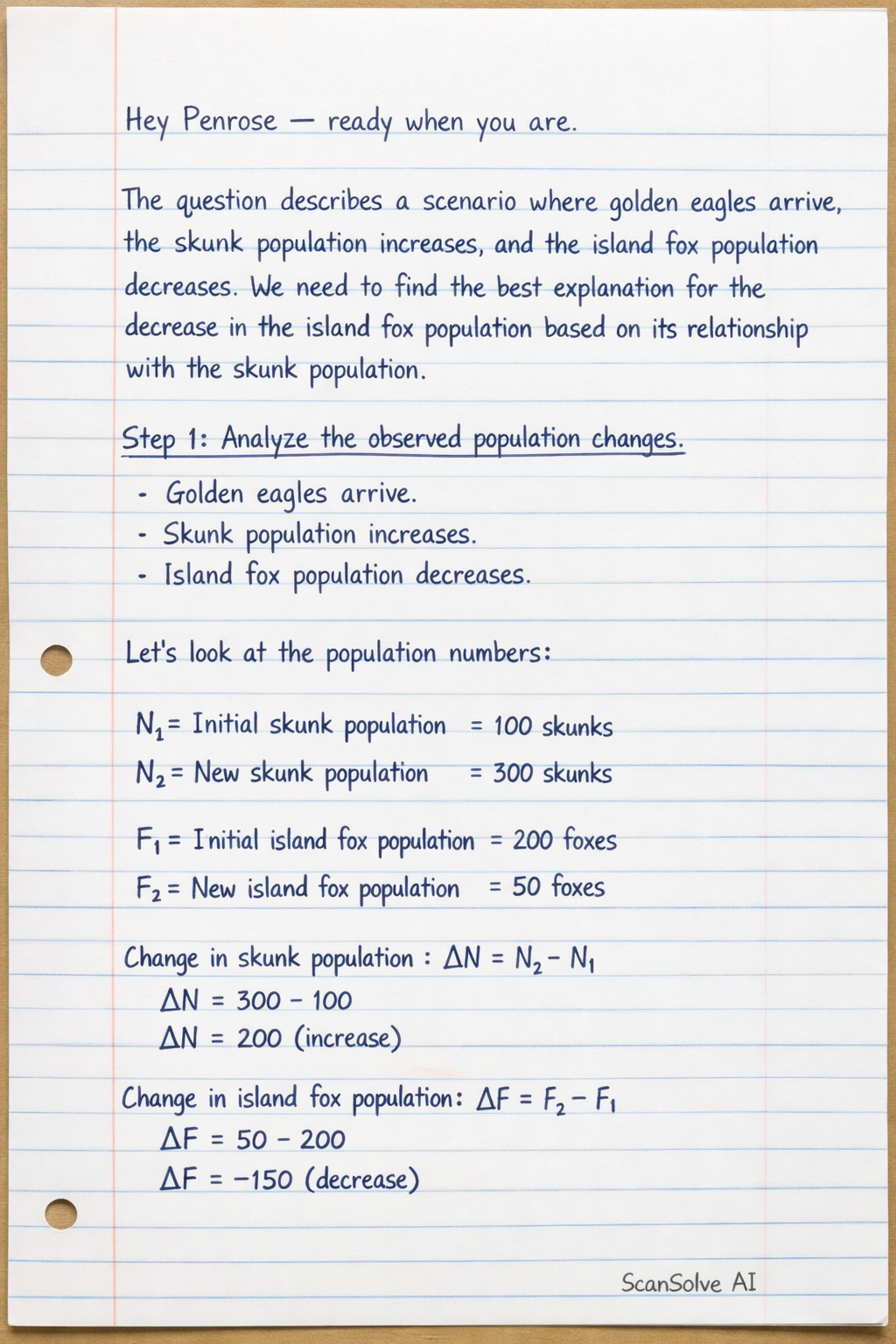
Handwritten Step-by-Step Solution
Get this as a handwritten image on WhatsApp — like a tutor wrote it for you.
Try on WhatsApp