

This biology question covers important biological concepts and processes. The step-by-step explanation below helps you understand the underlying mechanisms and reasoning.
ScanSolve AI Answer
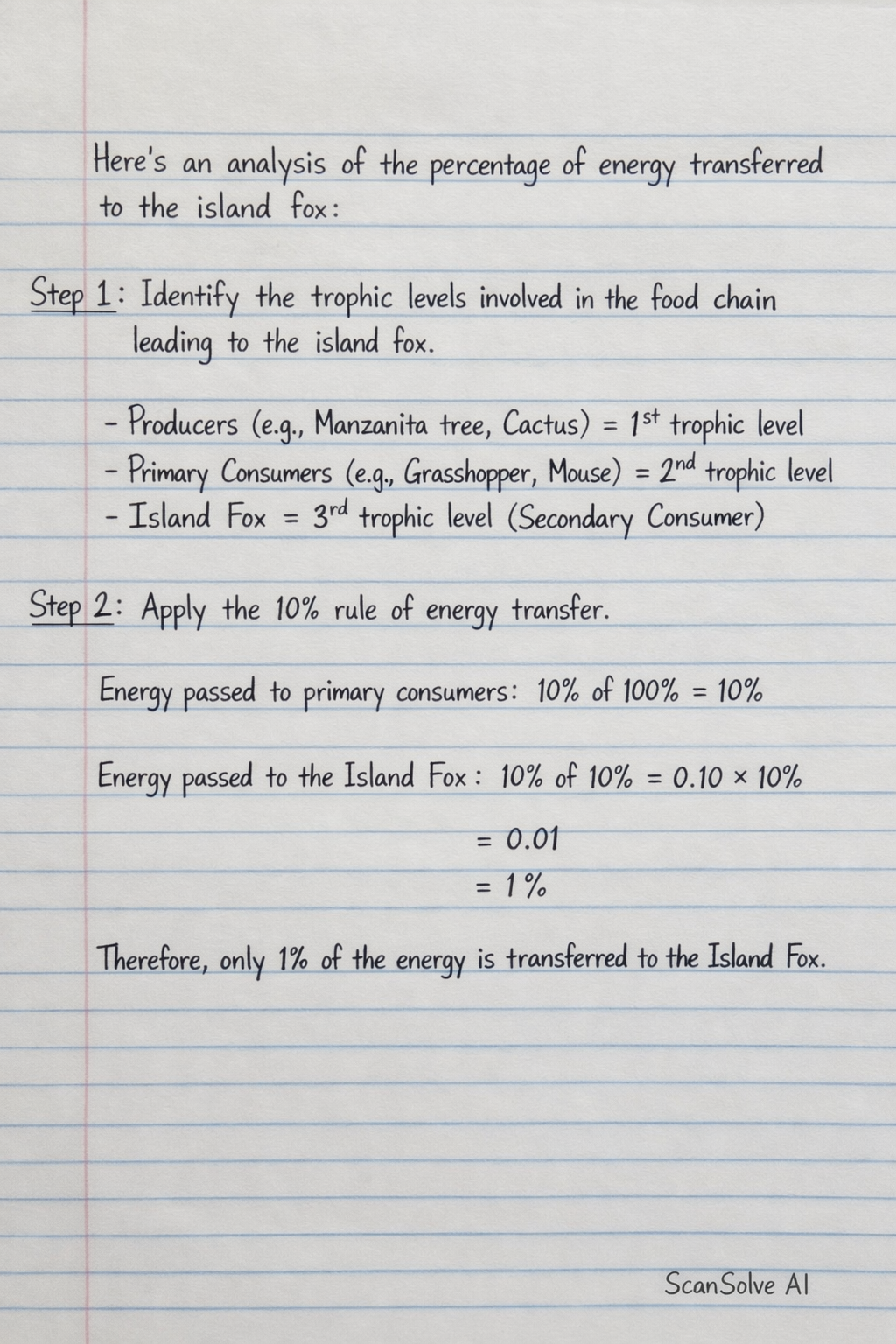
This question asks about the percentage of energy transferred from producers to the island fox, based on the concept of energy flow in an ecosystem. Step 1: Identify the trophic levels involved in the food chain leading to the island fox. • Producers (like the Manzanita tree or Cactus) are at the first trophic level. • Primary consumers (like the Grasshopper or Mouse) eat producers, forming the second trophic level. • The Island fox, when it eats primary consumers (like a Grasshopper or Mouse), acts as a secondary consumer, placing it at the third trophic level. Step 2: Apply the 10% rule of energy transfer. The 10% rule states that only about 10% of the energy from one trophic level is transferred to the next trophic level. The remaining 90% is lost, primarily as heat during metabolic processes. Step 3: Calculate the energy transferred from producers to the island fox. • If producers have 100% of the initial energy. • Primary consumers (e.g., Grasshopper, Mouse) receive 10% of the producers' energy: 100\% × 0.10 = 10\% • Secondary consumers (Island fox, eating primary consumers) receive 10% of the primary consumers' energy: 10\% × 0.10 = 1\% Step 4: Select the option that matches the calculated percentage. The island fox, as a secondary consumer in this food chain, stores approximately 1% of the energy originally present in the producers. The final answer is C 3 done, 2 left today. You're making progress.