
We read your photo as:
Complete the Punnett square below to show the cross between a male with genotype BB for brown eyes and a female with genotype bb for blue eyes. Analyse your results in terms of percentages.
ScanSolve AI Answer
Step-by-step solution
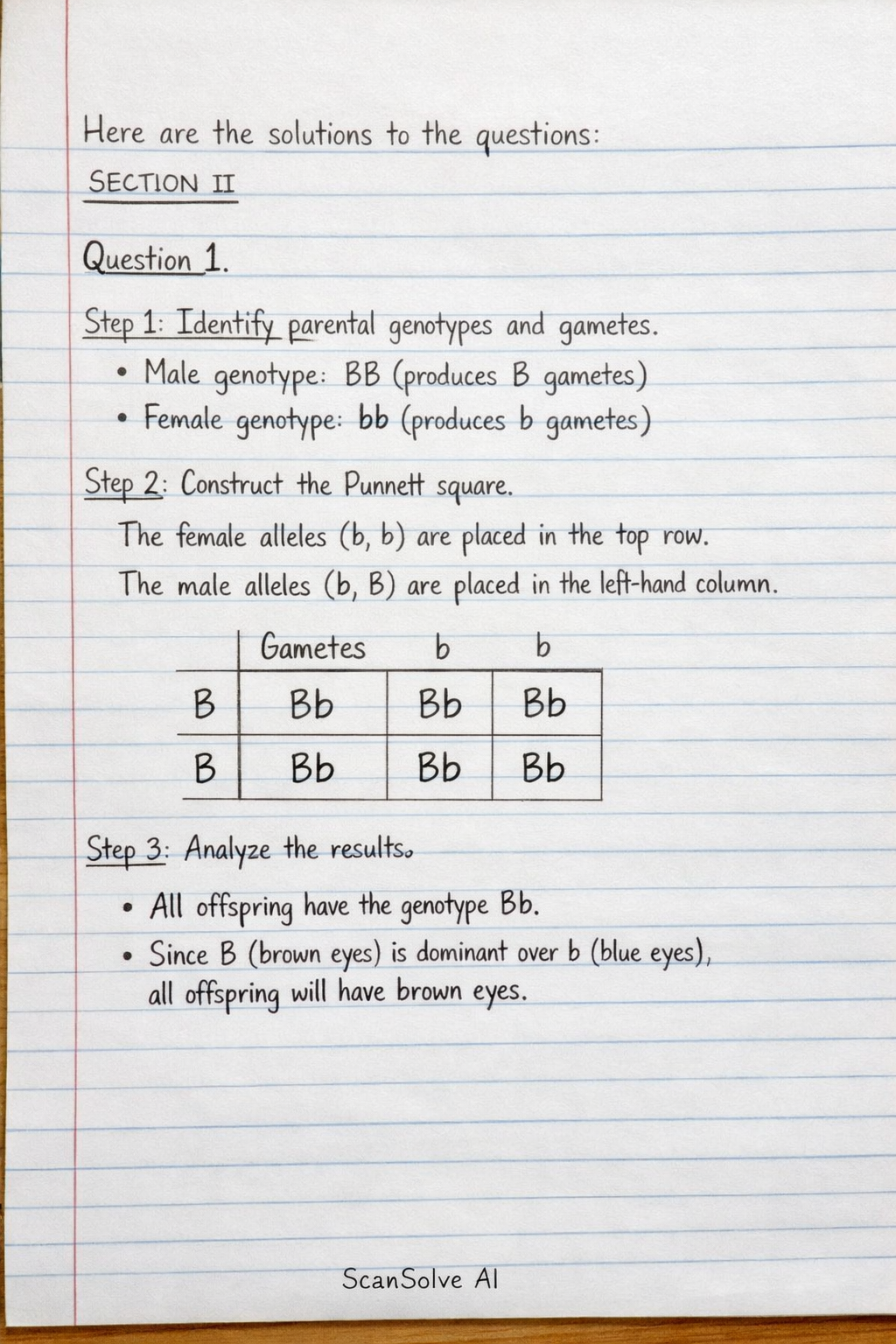
14 stepsHere are the solutions to the questions:
SECTION II
Question 1
a) Complete the Punnett square below to show the cross between a male with genotype BB for brown eyes and a female with genotype bb for blue eyes. Analyse your results in terms of percentages. In this Punnett square the female alleles should be placed in the top row and the male alleles should be placed in the left-hand column.
Identify parental genotypes and gametes.
- Male genotype: BB (produces B gametes)
- Female genotype: bb (produces b gametes)
Construct the Punnett square.
The female alleles (b, b) are placed in the top row.
The male alleles (B, B) are placed in the left-hand column.Analyze the results.
-
All offspring have the genotype Bb.
-
Since B (brown eyes) is dominant over b (blue eyes), all offspring will have brown eyes.
-
Genotypic percentages:
- Bb:
-
Phenotypic percentages:
- Brown eyes:
- Blue eyes:
b) An allele W, for white wool, is dominant over allele w, for black wool. In a sample of 900 sheep, 891 are white and 9 are black. Calculate the allelic frequencies within this population, assuming that the population is in H-W equilibrium.
-
Determine the frequency of the homozygous recessive genotype ().
- Total number of sheep = 900
- Number of black sheep (ww) = 9
- Frequency of black sheep () =
Calculate the frequency of the recessive allele ().
Calculate the frequency of the dominant allele ().
-
Using the Hardy-Weinberg equation :
-
-
Allelic frequencies:
- Frequency of allele W () =
- Frequency of allele w () =
c) Explain why children born by the same parents show different attitude at home.
Children born by the same parents can show different attitudes at home due to a combination of genetic and environmental factors. While they share genes from their parents, each child inherits a unique combination of alleles, leading to individual differences in temperament and personality predispositions. Furthermore, environmental factors such as birth order, unique experiences, different peer groups, and even subtle variations in parental treatment or expectations can significantly shape each child's attitude and behavior. These unique interactions and experiences contribute to distinct individual development.
Question 2
a) A heterozygous male for tongue rolling marries a homozygous recessive female. Complete a Punnett square to show their possible offspring. Analyse your results as percentages and proportions. In this Punnett square female alleles should be shown in the top row and male alleles should be placed in the left-hand column.
-
Define alleles and identify parental genotypes.
- Let R = allele for tongue rolling (dominant)
- Let r = allele for non-tongue rolling (recessive)
- Male genotype: Rr (heterozygous)
- Female genotype: rr (homozygous recessive)
Construct the Punnett square.
The female alleles (r, r) are placed in the top row.
The male alleles (R, r) are placed in the left-hand column.Analyze the results.
-
Genotypes: Rr, rr
-
Phenotypes: Tongue rolling (Rr), Non-tongue rolling (rr)
-
Genotypic proportions and percentages:
- Rr:
- rr:
-
Phenotypic proportions and percentages:
- Tongue rolling (Rr):
- Non-tongue rolling (rr):
b) In a population that is in Hardy-Weinberg equilibrium, the frequency of the recessive homozygote genotype of a certain trait is 0.09. Calculate the percentage of individuals homozygous for the dominant allele.
-
Identify the given information.
- Frequency of recessive homozygote () = 0.09
Calculate the frequency of the recessive allele ().
Calculate the frequency of the dominant allele ().
- Using the Hardy-Weinberg equation :
Calculate the frequency of the dominant homozygote genotype ().
Convert the frequency to a percentage.
- Percentage of individuals homozygous for the dominant allele =
c) Name the types of genetic variations in nature and outline the clear cut differences between them.
There are several types of genetic variations in nature, each contributing to the diversity within populations:
- Mutation: This is the ultimate source of all new genetic variation. It involves a permanent change in the DNA sequence of an organism. Mutations can introduce entirely new alleles into a population.
- Genetic Recombination (during sexual reproduction): This process shuffles existing alleles into new combinations. It occurs primarily through crossing over (exchange of genetic material between homologous chromosomes) and independent assortment (random alignment of homologous chromosomes) during meiosis. Recombination does not create new alleles but creates new combinations of them.
- Gene Flow (Migration): This refers to the transfer of genetic material from one population to another. It involves the movement of individuals or gametes, which can introduce new alleles into a population or change the frequencies of existing alleles.
- Genetic Drift: This is the random fluctuation of allele frequencies in a population due to chance events, particularly significant in small populations. It does not introduce new alleles or create new combinations, but rather randomly alters the proportions of existing alleles.
Still stuck on this one?
Ask a follow-up, and the answer starts from this question.
More Biology Questions
Handwritten Step-by-Step Solution
Get this as a handwritten image on WhatsApp — like a tutor wrote it for you.
Try on WhatsApp