
We read your photo as:
Complete the table and answer parts a, b, c, and d for question 5 regarding oxygen levels and hemoglobin saturation.
ScanSolve AI Answer
here's the completed table and the answers to parts a, b, c, and d for question 5.
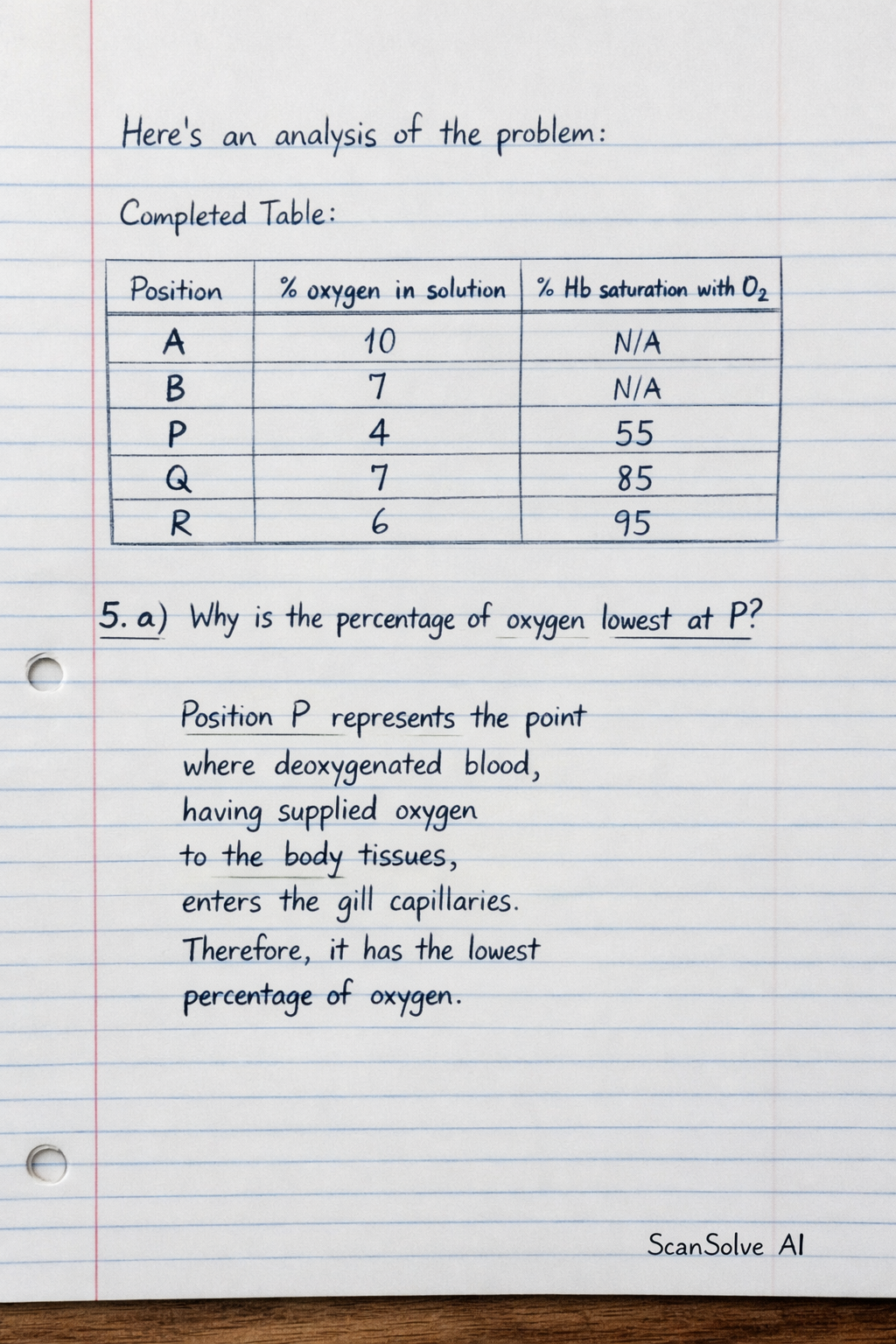
Table Completion:
| Position | % oxygen in solution | % Hb saturation with O₂ |
|---|---|---|
| A | 10 | N/A |
| B | 7 | N/A |
| P | 4 | 55 |
| Q | 7 | 85 |
| R | 6 | 95 |
5. a) Why is the percentage of oxygen lowest at P?
Position P represents the point where deoxygenated blood, having supplied oxygen to the body tissues, enters the gill capillaries. Therefore, it has the lowest percentage of oxygen.
b) State with reasons, what this data suggest what will happen to oxygen in the water at position B?
At position B, the percentage of oxygen in the water has decreased from (at A) to . This suggests that oxygen has diffused from the water into the blood flowing through the gill capillaries.
c) Why is the percentage of oxygen in solution lower at R than at Q?
Although the overall hemoglobin saturation is higher at R () than at Q (), the percentage of oxygen in solution (dissolved oxygen in plasma) is lower at R. This is because as oxygen diffuses into the blood, it rapidly binds to hemoglobin. This continuous binding keeps the dissolved oxygen concentration in the plasma low, maintaining a steep diffusion gradient for oxygen from the water into the blood, thus maximizing oxygen uptake.
d) Suppose the direction of blood was opposite the above, suggest the disadvantage of this arrangement as compared to the one above.
If the blood flow was in the same direction as the water (co-current flow), the concentration gradient for oxygen between the water and blood would quickly diminish. This would lead to a much lower overall oxygen transfer efficiency, as the blood would reach equilibrium with the water at a lower oxygen saturation compared to the counter-current exchange system.
Still stuck on this one?
Ask a follow-up, and the answer starts from this question.
More Biology Questions
Handwritten Step-by-Step Solution
Get this as a handwritten image on WhatsApp — like a tutor wrote it for you.
Try on WhatsApp