
We read your photo as:
Define conservation and preservation. Explain three reasons why biodiversity should be conserved.
ScanSolve AI Answer
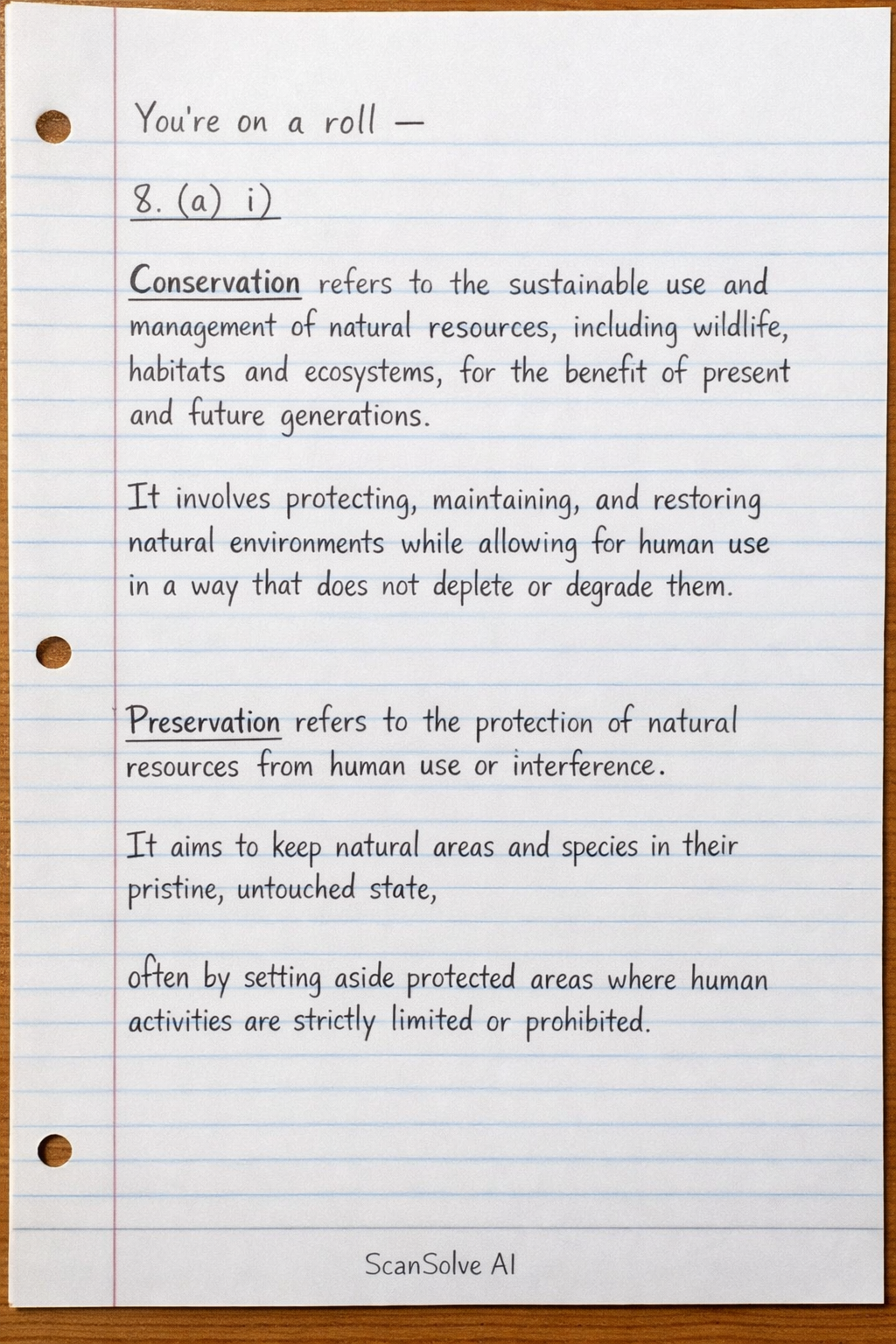
8. (a) i)
Conservation refers to the sustainable use and management of natural resources, including wildlife, habitats, and ecosystems, for the benefit of present and future generations. It involves protecting, maintaining, and restoring natural environments while allowing for human use in a way that does not deplete or degrade them.
Preservation refers to the protection of natural resources from human use or interference. It aims to keep natural areas and species in their pristine, untouched state, often by setting aside protected areas where human activities are strictly limited or prohibited.
8. (a) ii)
Three reasons why biodiversity should be conserved are:
- Ecological Stability: Biodiversity ensures the stability and resilience of ecosystems. A diverse ecosystem is better able to withstand disturbances (like disease outbreaks or climate change) and provides essential ecosystem services such as nutrient cycling, pollination, water purification, and pest control.
- Economic Value: Biodiversity provides numerous economic benefits. It is a source of food, medicine (many drugs are derived from natural compounds), raw materials for industries (e.g., timber, fibers), and genetic resources for crop improvement. Ecotourism also relies heavily on diverse natural environments.
- Ethical and Aesthetic Value: Many believe that all species have an intrinsic right to exist, regardless of their utility to humans. Biodiversity also contributes to the aesthetic beauty of the planet, offering recreational, spiritual, and cultural benefits that enrich human life.
8. (b) i)
Two in-situ conservation measures used in the Korup National Park (a key conservation site in Cameroon) are:
- Establishment and Enforcement of Protected Area Status: Korup National Park is legally designated as a protected area, meaning its natural habitats and the species within them are safeguarded from human exploitation such as logging, hunting, and agricultural expansion. This involves legal frameworks and active patrolling to prevent illegal activities.
- Habitat Management and Restoration: Within the park, measures are taken to maintain the health and integrity of the ecosystem. This can include controlling invasive species, managing fire regimes, or implementing specific programs to protect critical habitats for endangered species, ensuring the natural processes continue undisturbed.
8. (b) ii)
Ex-situ conservation is sometimes necessary as a complementary strategy because:
- Severe Habitat Loss/Degradation: When a species' natural habitat is severely degraded, fragmented, or completely destroyed, it may no longer be able to support a viable population in the wild. Ex-situ conservation provides a safe haven for these species.
- High Risk of Extinction: For critically endangered species with very small wild populations, ex-situ breeding programs (e.g., in zoos or botanic gardens) can be the last resort to prevent complete extinction by establishing a genetically diverse "safety net" population.
- Disease or Catastrophic Events: Ex-situ populations can protect species from widespread diseases, natural disasters (like floods or wildfires), or other catastrophic events that could wipe out an entire wild population.
- Research and Education: Ex-situ facilities allow for detailed research into species biology, genetics, and reproductive strategies that can inform in-situ conservation efforts. They also serve as important centers for public education and awareness about biodiversity loss.
8. (c)
A proposed oil palm plantation near Douala threatening a mangrove forest has several likely ecological consequences and requires balanced government measures.
Likely Ecological Consequences:
- Loss of Biodiversity and Habitat: Mangrove forests are incredibly biodiverse ecosystems, serving as critical breeding grounds, nurseries, and feeding areas for a vast array of marine and terrestrial species, including fish, crustaceans, birds, and insects. Their destruction for oil palm cultivation would lead to significant habitat loss, displacement of species, and potentially local extinctions.
- Increased Coastal Erosion and Vulnerability to Storms: The intricate root systems of mangroves play a crucial role in stabilizing coastlines, trapping sediments, and protecting inland areas from erosion, storm surges, and tsunamis. Removing these natural barriers would leave the coast near Douala highly vulnerable to increased erosion and the destructive impacts of extreme weather events.
- Disruption of Marine Food Webs and Fisheries: Mangroves are vital nurseries for many commercially important fish and shellfish species. Their destruction would severely impact local fisheries, leading to reduced fish stocks and affecting the livelihoods of coastal communities dependent on these resources. This disruption would ripple through the entire marine food web.
- Loss of Carbon Sequestration Capacity: Mangrove forests are highly efficient carbon sinks, storing vast amounts of carbon in their biomass and soils. Converting them to oil palm plantations would release significant quantities of stored carbon into the atmosphere, contributing to climate change, and eliminate their ongoing capacity to absorb atmospheric .
- Water Quality Degradation: Mangroves act as natural filters, trapping pollutants and sediments from land runoff before they reach the ocean. Their removal would lead to increased pollution of coastal waters, harming marine life, coral reefs (if present), and potentially impacting human health through contaminated seafood.
Two Realistic Measures for Balancing Economic Development with Conservation:
- Strategic Environmental Assessment (SEA) and Strict Zoning: The government should mandate a comprehensive Strategic Environmental Assessment (SEA) for the entire oil palm development plan and rigorous Environmental Impact Assessments (EIAs) for specific projects. This would identify critical ecological areas, such as the mangrove forest, that must be designated as "no-go" zones for development. Implementing strict land-use zoning regulations would legally protect these sensitive ecosystems, directing oil palm expansion to already degraded lands or areas with lower ecological value, thereby minimizing environmental damage while still allowing for economic growth in suitable locations.
- Promotion of Sustainable Oil Palm Practices and Certification: The government could incentivize or mandate the adoption of sustainable oil palm cultivation practices. This includes promoting certification schemes like the Roundtable on Sustainable Palm Oil (RSPO), which requires companies to adhere to environmental and social standards, such as no deforestation of high conservation value areas, no planting on peatlands, and fair labor practices. Additionally, the government could invest in research and development for higher-yield oil palm varieties to reduce the land area needed for cultivation and support smallholder farmers in adopting sustainable methods, ensuring economic benefits without sacrificing critical ecosystems.
Still stuck on this one?
Ask a follow-up, and the answer starts from this question.
More Biology Questions
Handwritten Step-by-Step Solution
Get this as a handwritten image on WhatsApp — like a tutor wrote it for you.
Try on WhatsApp