
We read your photo as:
Continuing with the "Transformation of Cassava to Garri" project: State your hypothesis, List the material required, and List the method or procedure.
Biology
ScanSolve AI Answer
Continuing with the "Transformation of Cassava to Garri" project:
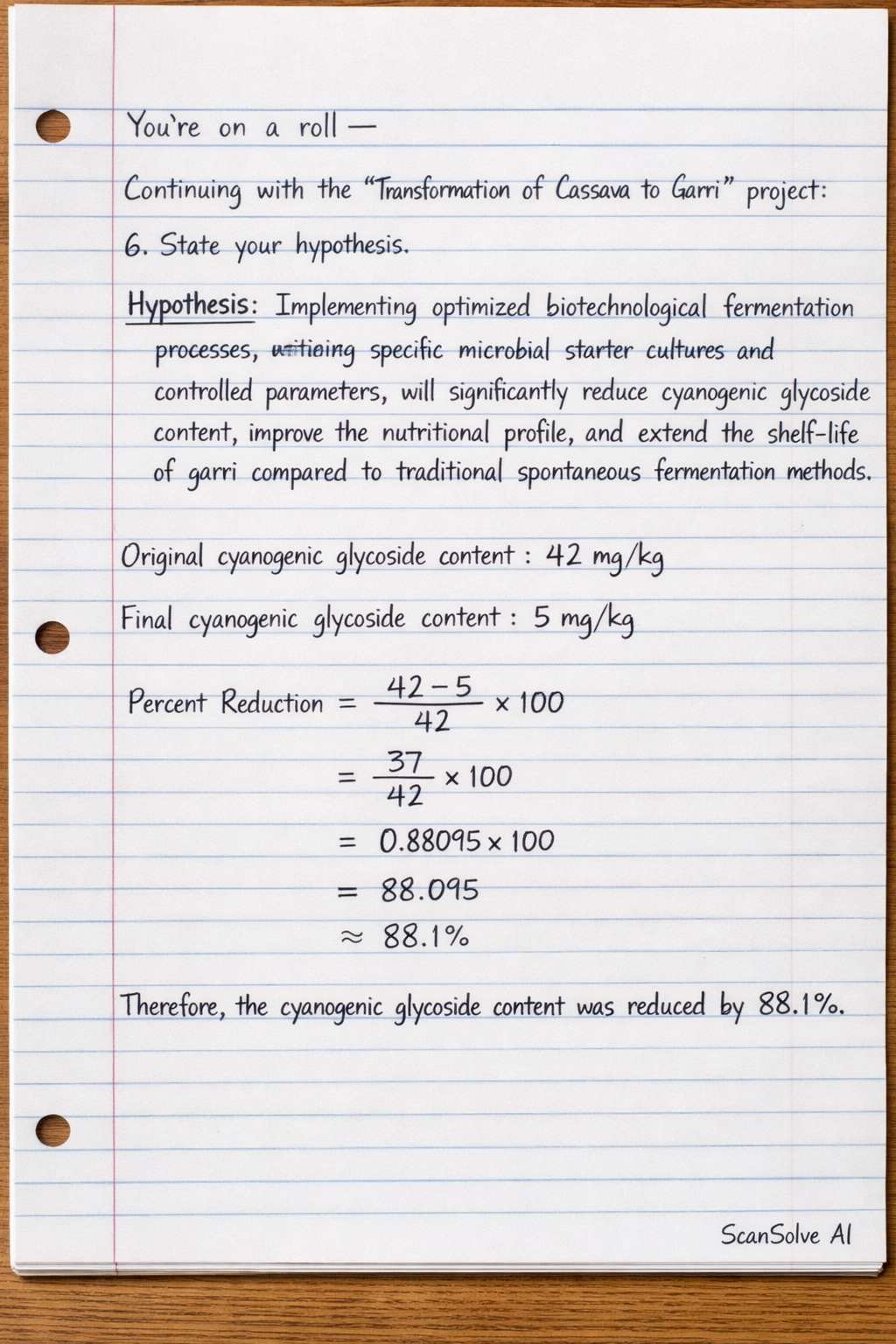
6. State your hypothesis
- Hypothesis: Implementing optimized biotechnological fermentation processes, utilizing specific microbial starter cultures and controlled parameters, will significantly reduce cyanogenic glycoside content, improve the nutritional profile, and extend the shelf-life of garri compared to traditional spontaneous fermentation methods.
7. List the material required
- Raw Materials: Fresh cassava roots (e.g., TMS 30572 variety), clean water.
- Microbial Cultures: Pure starter cultures of selected Lactobacillus species (e.g., L. plantarum) and/or Saccharomyces cerevisiae.
- Processing Equipment: Peeling knives, graters, hydraulic press, fermentation vessels (sterile plastic buckets or stainless steel tanks), sieves, garri fryer (roasting pan), weighing scales.
- Laboratory Equipment: pH meter, thermometer, incubator, autoclave, sterile glassware (beakers, flasks, petri dishes), spectrophotometer, centrifuge, microscope.
- Reagents & Media: Cyanide detection kits (e.g., picrate paper), microbial culture media (e.g., MRS agar, potato dextrose agar), distilled water, pH buffers, analytical grade chemicals for nutritional analysis.
8. List the method or procedure
- Step 1: Cassava Preparation: Select healthy cassava roots, peel, wash thoroughly, and grate into a fine mash.
- Step 2: Fermentation Setup:
- Control Group (Traditional): Divide a portion of the cassava mash into sacks and allow for spontaneous fermentation for 2-3 days at ambient temperature.
- Experimental Group (Optimized): Sterilize another portion of the mash. Inoculate with selected starter cultures at a predetermined concentration. Ferment in sterile vessels under controlled conditions (e.g., , pH monitored) for a specified duration (e.g., 24-48 hours).
- Step 3: Dewatering: Press both fermented mashes using a hydraulic press to remove excess water, reducing the moisture content.
- Step 4: Sieving: Break up the dewatered mash and sieve it to remove fibrous materials and achieve uniform particle size.
- Step 5: Roasting (Garification): Roast the sieved mash in a hot garri fryer, stirring continuously until dry, granular, and crispy, forming garri.
- Step 6: Product Analysis: Collect samples of both traditional and optimized garri. Analyze for:
- Cyanide Content: Using a quantitative method (e.g., enzymatic assay or spectrophotometry).
- Physicochemical Properties: pH, titratable acidity, moisture content, swelling capacity.
- Nutritional Composition: Protein, carbohydrate, fiber, vitamin content.
- Microbial Load: Total viable counts, specific microbial counts.
- Sensory Evaluation: Color, texture, aroma, and taste by a trained panel.
- Shelf-life: Monitor changes in quality parameters over an extended storage period.
- Step 7: Data Analysis: Compare the results between the traditional and optimized garri using appropriate statistical methods (e.g., ANOVA) to determine significant differences.
Was this helpful?
Still stuck on this one?
Ask a follow-up, and the answer starts from this question.
Got a different question?Ask your own question
More Biology Questions
QOutline a food transformation project on Cassava to Garri, including title, team members, and…QSummarize the interpretation of results and conclusion for the "Transformation of Cassava to Garri"…QIdentify the problems this biotechnological process of cassava to garri transformation will solve…QWhat are the expected results for a project transforming cassava to garri using biotechnological…QGari is prepared from cassava tubers through several steps:
Handwritten Step-by-Step Solution
Get this as a handwritten image on WhatsApp — like a tutor wrote it for you.
Try on WhatsApp