
We read your photo as:
Explain cultural practices in crop production and describe three post-planting activities. Also, explain the effect of red blood cells in hypertonic, hypotonic, and isotonic solutions, and describe ho
ScanSolve AI Answer
Step-by-step solution
6 stepsb)
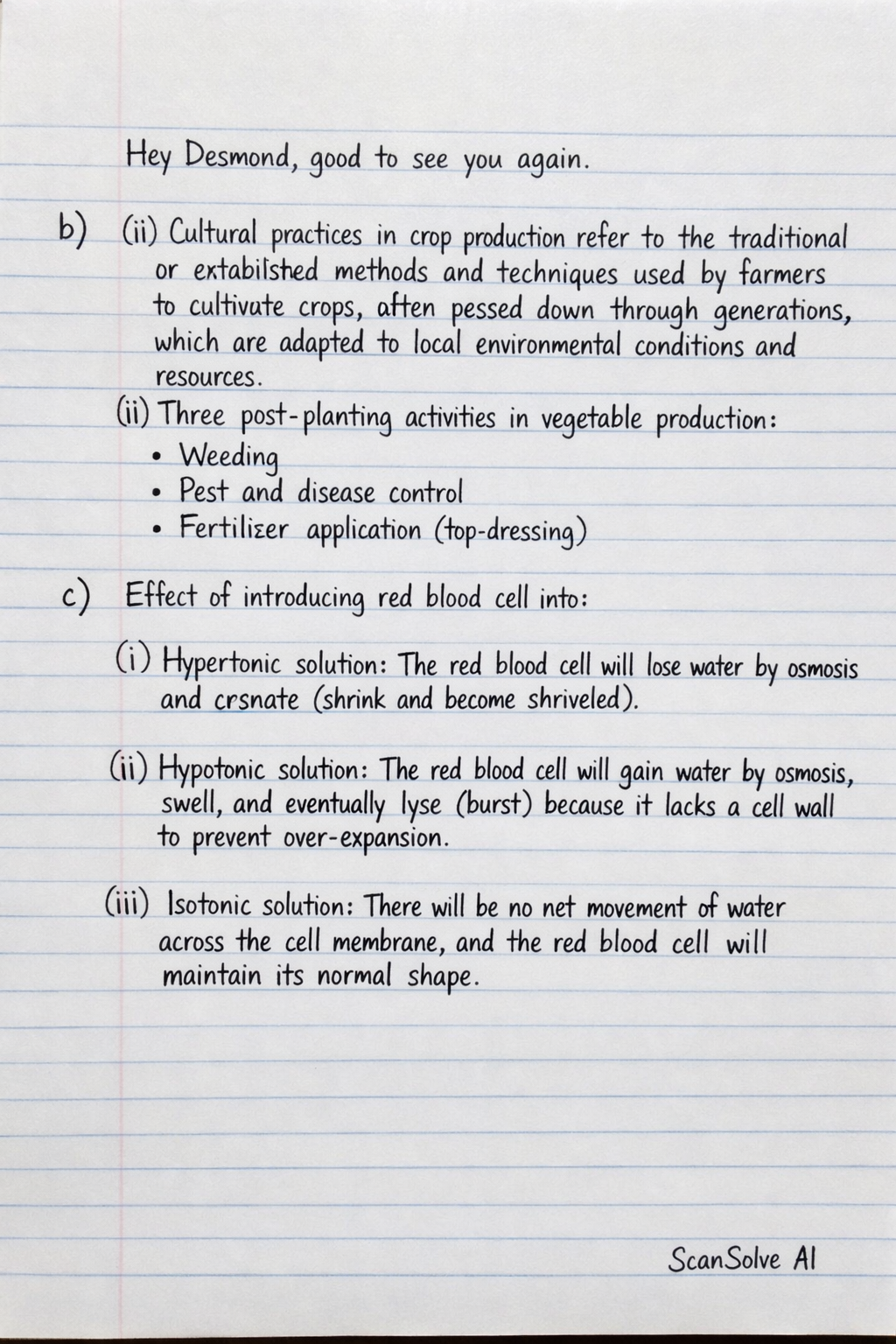
(i) Cultural practices in crop production refer to the traditional or established methods and techniques used by farmers to cultivate crops, often passed down through generations, which are adapted to local environmental conditions and resources.
(ii) Three post-planting activities in vegetable production:
- Weeding
- Pest and disease control
- Fertilizer application (top-dressing)
c)
Effect of introducing red blood cell into:
(i) Hypertonic solution: The red blood cell will lose water by osmosis and crenate (shrink and become shriveled).
(ii) Hypotonic solution: The red blood cell will gain water by osmosis, swell, and eventually lyse (burst) because it lacks a cell wall to prevent over-expansion.
(iii) Isotonic solution: There will be no net movement of water across the cell membrane, and the red blood cell will maintain its normal shape.
d)
Protection of buildings and installations from lightning strikes using lightning arrestors:
Lightning arrestors (or lightning rods) are tall, pointed metal conductors installed at the highest point of a building. They are connected by a thick copper cable to a metal plate buried deep in the ground. When lightning strikes, the arrestor provides a low-resistance path for the massive electrical current to flow directly into the earth, safely dissipating the charge and preventing damage to the building's structure, electrical systems, and occupants.
6.
a)
(i) Three differences between the foreign breed of fowl and the local breed of fowl:
| Feature | Foreign Breed of Fowl | Local Breed of Fowl |
|---|---|---|
| Growth Rate | Faster growth rate, reaches market weight quickly. | Slower growth rate, takes longer to mature. |
| Egg Production | High egg production, lays more eggs per year. | Lower egg production, lays fewer eggs per year. |
| Disease Resist. | Generally lower resistance to local diseases. | Higher resistance to local diseases and parasites. |
| Feed Conv. | Efficient feed conversion ratio. | Less efficient feed conversion ratio. |
| Adaptability | Less adaptable to harsh local environmental conditions. | Highly adaptable to local environmental conditions. |
(ii) Two breeds of rabbit:
- New Zealand White
- Californian (or Flemish Giant, Angora)
b)
Five effects of climate change on biodiversity resources:
- Habitat loss and fragmentation: Rising temperatures, sea levels, and extreme weather events destroy natural habitats, forcing species to migrate or face extinction.
- Species extinction: Many species cannot adapt quickly enough to rapid climate shifts, leading to increased extinction rates.
- Changes in species distribution: Animals and plants may shift their geographical ranges towards poles or higher altitudes in search of suitable climates.
- Disruption of ecosystems: Altered rainfall patterns, temperature changes, and ocean acidification can disrupt food webs and ecological interactions.
- Increased vulnerability to diseases: Stressed populations due to climate change may become more susceptible to diseases and parasites.
c)
(α) Draw the structural formula for the following organic compounds:
(i) Propane (C₃H₈):
(ii) Pentane (C₅H₁₂):
(iii) Heptane (C₇H₁₆):
(iv) Nonane (C₉H₂₀):
(β) A hydrocarbon is an organic compound consisting entirely of hydrogen and carbon atoms.
d)
An electric appliance is rated 240V, 750W.
(i) Calculate the current.
Use the formula relating power (), voltage (), and current ().
Rearrange the formula to solve for current.
Substitute the given values.
The current is (to 3 significant figures).
(ii) Calculate the resistance.
Use Ohm's law, which relates voltage (), current (), and resistance ().
Rearrange the formula to solve for resistance.
Substitute the values for voltage and the calculated current.
Alternatively, using :
The resistance is .
Still stuck on this one?
Ask a follow-up, and the answer starts from this question.
More Biology Questions
Handwritten Step-by-Step Solution
Get this as a handwritten image on WhatsApp — like a tutor wrote it for you.
Try on WhatsApp