
We read your photo as:
Which of the following practices is not a cultural practice in crop production?
ScanSolve AI Answer
Answer
Pest control
Here are the solutions to the multiple-choice questions:
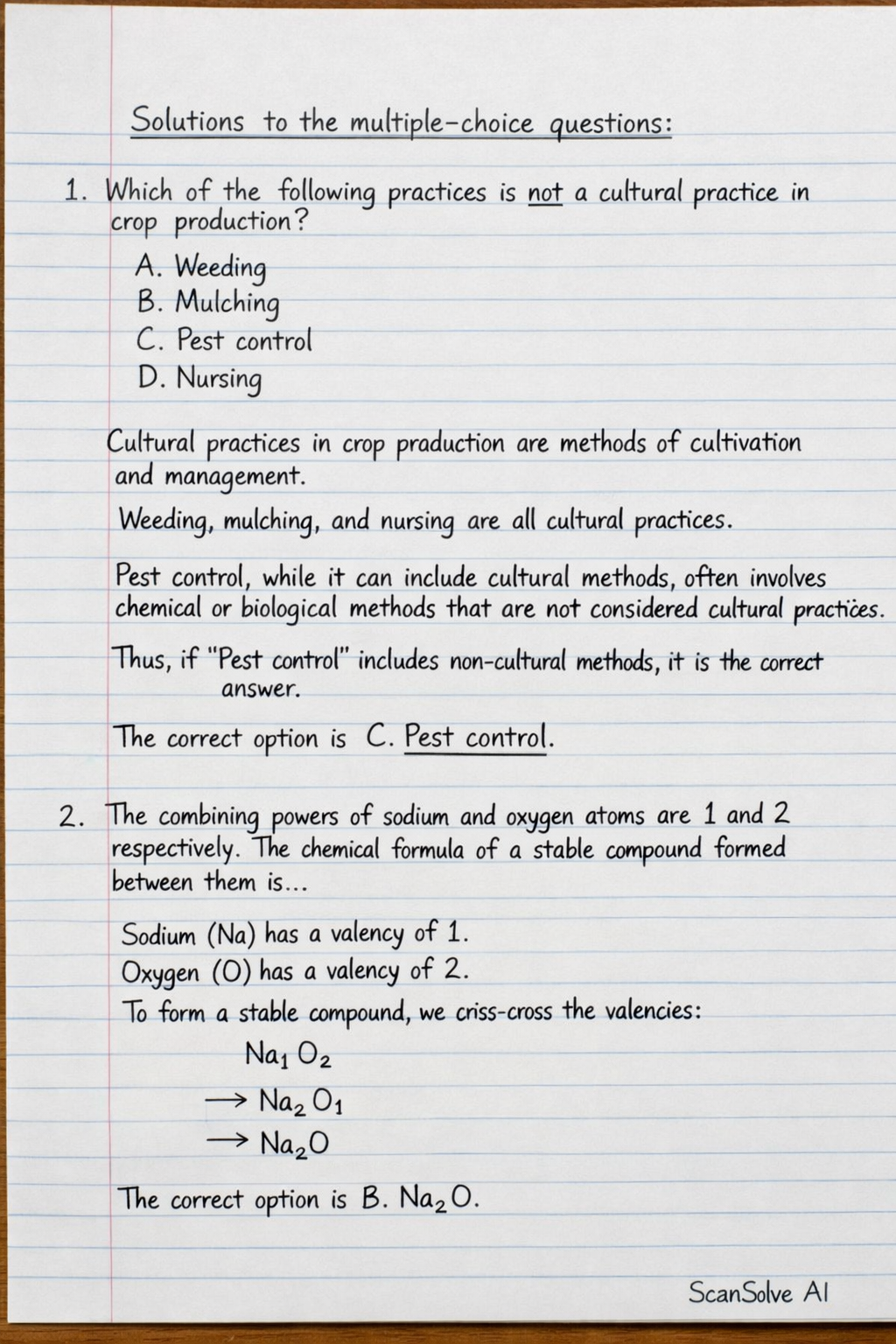
1. Which of the following practices is not a cultural practice in crop production?
A. Weeding
B. Mulching
C. Pest control
D. Nursing
Cultural practices in crop production are methods of cultivation and management. Weeding, mulching, and nursing (nursery management) are all cultural practices. Pest control, while it can include cultural methods (like crop rotation), often involves chemical or biological methods that are not considered cultural practices in the strict sense. Therefore, if "Pest control" includes non-cultural methods, it is the correct answer.
The correct option is C. Pest control.
2. The combining powers of sodium and oxygen atoms are 1 and 2 respectively. The chemical formula of a stable compound formed between them is...
Sodium (Na) has a valency of 1. Oxygen (O) has a valency of 2. To form a stable compound, we criss-cross the valencies:
The correct option is B. .
3. Which of the following methods could conserve soil water on a farm?
I. Adequate spacing
II. Disease control
III. Cover cropping
A. I, II and III
B. I and II only
C. I and III only
D. I and III only
Adequate spacing helps optimize water use by plants and can reduce evaporation from bare soil if plants are not too sparse. Cover cropping directly conserves soil water by reducing evaporation, suppressing weeds, and improving soil structure. Disease control primarily focuses on plant health and yield, not direct soil water conservation.
The correct option is C. I and III only.
4. Which of the following substances contains natural acid?
A. Saliva
B. Bile
C. Wood ash
D. Vinegar
Vinegar is a dilute solution of acetic acid, which is produced naturally through fermentation. Saliva is generally neutral to slightly alkaline, bile is alkaline, and wood ash is strongly alkaline.
The correct option is D. Vinegar.
5. Use the information on the simple food chain below to answer question 5.
Cassava Rat Snake Hawk
The primary consumer is the
A. hawk.
B. snake.
C. rat.
D. cassava.
In a food chain, the primary consumer is the organism that feeds on the producer. Here, cassava is the producer. The rat feeds on the cassava, making it the primary consumer.
The correct option is C. rat.
Try one yourself
A new problem that tests the same skill.
Still stuck on this one?
Ask a follow-up, and the answer starts from this question.
More Economics Questions
Handwritten Step-by-Step Solution
Get this as a handwritten image on WhatsApp — like a tutor wrote it for you.
Try on WhatsApp