
We read your photo as:
Cultural practices in crop production are methods used to manage crops and soil for optimal growth. Weeding, mulching, and pest control are all recognized cultural practices. "Nursing" in this co
ScanSolve AI Answer
Answer
Step-by-step solution
6 stepsHere are the answers to the questions:
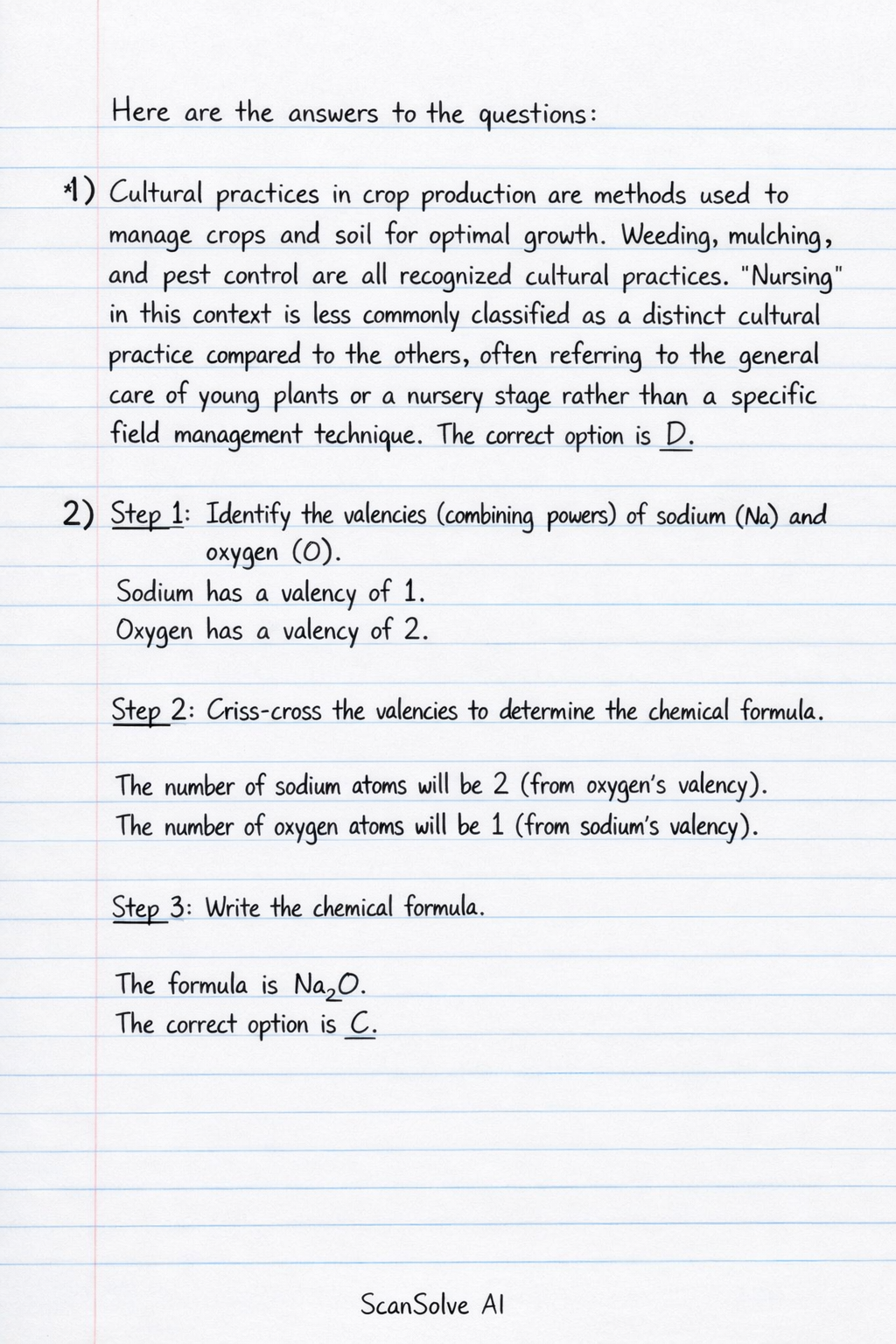
1) Cultural practices in crop production are methods used to manage crops and soil for optimal growth. Weeding, mulching, and pest control are all recognized cultural practices. "Nursing" in this context is less commonly classified as a distinct cultural practice compared to the others, often referring to the general care of young plants or a nursery stage rather than a specific field management technique.
The correct option is D.
2) Step 1: Identify the valencies (combining powers) of sodium () and oxygen ().
Sodium has a valency of 1.
Oxygen has a valency of 2.
Criss-cross the valencies to determine the chemical formula.
The number of sodium atoms will be 2 (from oxygen's valency).
The number of oxygen atoms will be 1 (from sodium's valency).Write the chemical formula.
The formula is .
The correct option is C.3) Step 1: Evaluate each method for its ability to conserve soil water.
I. Adequate spacing: Proper plant spacing can reduce competition for water and optimize water use efficiency, and can also influence soil exposure to evaporation. Thus, it could contribute to soil water conservation.
II. Disease control: This practice focuses on plant health and does not directly conserve soil water.
III. Cover cropping: Planting cover crops between main crops significantly reduces evaporation from the soil surface, improves soil structure, and enhances water infiltration, directly conserving soil water.Identify the methods that conserve soil water.
Methods I and III are effective in conserving soil water.
The correct option is B.4) Step 1: Examine each substance to determine if it contains a natural acid.
A. Saliva: Primarily contains water, enzymes, and electrolytes. Its pH is generally neutral to slightly alkaline, not acidic.
B. Bile: An alkaline fluid produced by the liver that aids in digestion.
C. Wood ash: Highly alkaline due to the presence of potassium carbonate.
D. Vinegar: A solution of acetic acid, which is produced naturally through the fermentation of ethanol.Conclude which substance contains natural acid.
Vinegar contains acetic acid, a natural acid.
The correct option is D.5) Step 1: Understand the roles in a food chain.
- Producers are organisms that produce their own food (e.g., plants).
- Primary consumers are herbivores that feed on producers.
- Secondary consumers are carnivores or omnivores that feed on primary consumers.
- Tertiary consumers are carnivores or omnivores that feed on secondary consumers.
Apply this understanding to the given food chain
Cassava Rat Snake Hawk.
- Cassava is the producer.
- The Rat eats the Cassava, making the Rat the primary consumer.
- The Snake eats the Rat, making the Snake the secondary consumer.
- The Hawk eats the Snake, making the Hawk the tertiary consumer.
Identify the primary consumer.
The primary consumer is the rat.
The correct option is C.
Try one yourself
A new problem that tests the same skill.
Still stuck on this one?
Ask a follow-up, and the answer starts from this question.
More Economics Questions
Handwritten Step-by-Step Solution
Get this as a handwritten image on WhatsApp — like a tutor wrote it for you.
Try on WhatsApp