
We read your photo as:
Describe the development of the heart from precursor cells to the formation of the four-chambered structure, including key anatomical terms and processes like cardiac looping.
ScanSolve AI Answer
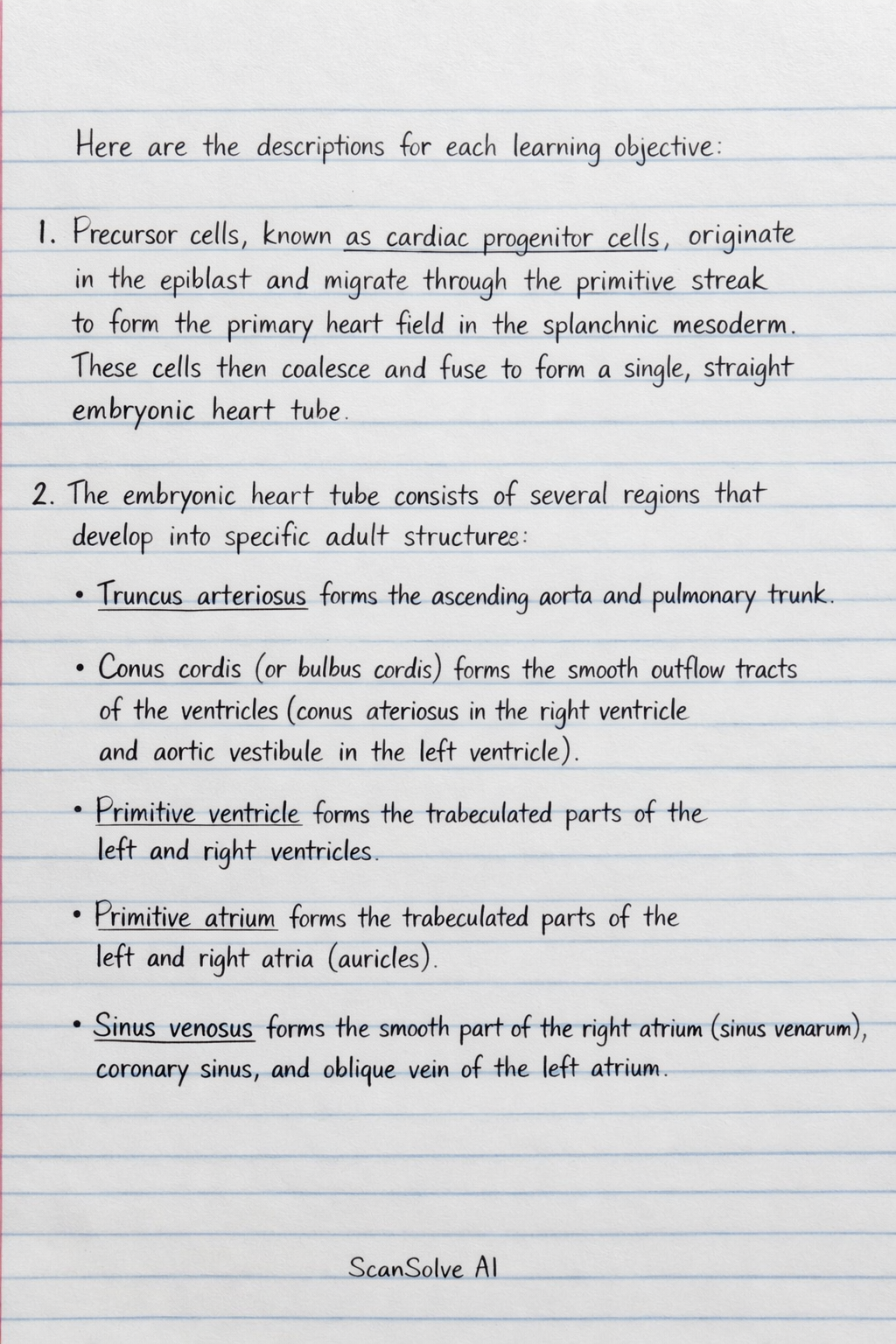
Here are the descriptions for each learning objective:
-
Precursor cells, known as cardiac progenitor cells, originate in the epiblast and migrate through the primitive streak to form the primary heart field in the splanchnic mesoderm. These cells then coalesce and fuse to form a single, straight embryonic heart tube.
-
The embryonic heart tube consists of several regions that develop into specific adult structures:
- Truncus arteriosus forms the ascending aorta and pulmonary trunk.
- Conus cordis (or bulbus cordis) forms the smooth outflow tracts of the ventricles (conus arteriosus in the right ventricle and aortic vestibule in the left ventricle).
- Primitive ventricle forms the trabeculated parts of the left and right ventricles.
- Primitive atrium forms the trabeculated parts of the left and right atria (auricles).
- Sinus venosus forms the smooth part of the right atrium (sinus venarum), coronary sinus, and oblique vein of the left atrium.
-
Cardiac looping is the process where the straight heart tube bends and folds, repositioning its chambers to their adult anatomical locations. The primitive atrium and sinus venosus move superiorly and posteriorly, while the primitive ventricle and bulbus cordis move inferiorly and anteriorly. This S-shaped bending establishes the basic arrangement of the heart chambers.
-
The primitive atrium divides through the formation of two septa: the septum primum and the septum secundum. The septum primum grows downwards, leaving an opening called the foramen primum. As the septum primum fuses, a new opening, the foramen secundum, forms. The septum secundum then grows downwards to the right of the septum primum, partially covering the foramen secundum and forming the foramen ovale. This allows oxygenated blood from the right atrium to shunt directly to the left atrium, bypassing the fetal lungs.
-
Septation involves the formation of several septa to divide the heart into four chambers. The atrial septum (septum primum and secundum) divides the atria. The ventricular septum (muscular and membranous parts) divides the ventricles. The atrioventricular septa (endocardial cushions) divide the atrioventricular canal into right and left orifices and contribute to the atrial and ventricular septa.
-
The aorticopulmonary septum forms from neural crest cells that migrate into the truncus arteriosus and conus cordis. These cells form two ridges that spiral around each other and fuse, dividing the outflow tract into the aorta and the pulmonary trunk. This spiraling ensures that the aorta arises from the left ventricle and the pulmonary trunk from the right ventricle.
-
The sinus venosus initially has right and left horns. The left horn largely regresses to form the coronary sinus and the oblique vein of the left atrium. The right horn significantly enlarges and is incorporated into the posterior wall of the right atrium, forming its smooth-walled part, the sinus venarum. The right sinus horn also gives rise to the sinoatrial (SA) node.
Still stuck on this one?
Ask a follow-up, and the answer starts from this question.
More Biology Questions
Handwritten Step-by-Step Solution
Get this as a handwritten image on WhatsApp — like a tutor wrote it for you.
Try on WhatsApp