

This biology question covers important biological concepts and processes. The step-by-step explanation below helps you understand the underlying mechanisms and reasoning.
ScanSolve AI Answer
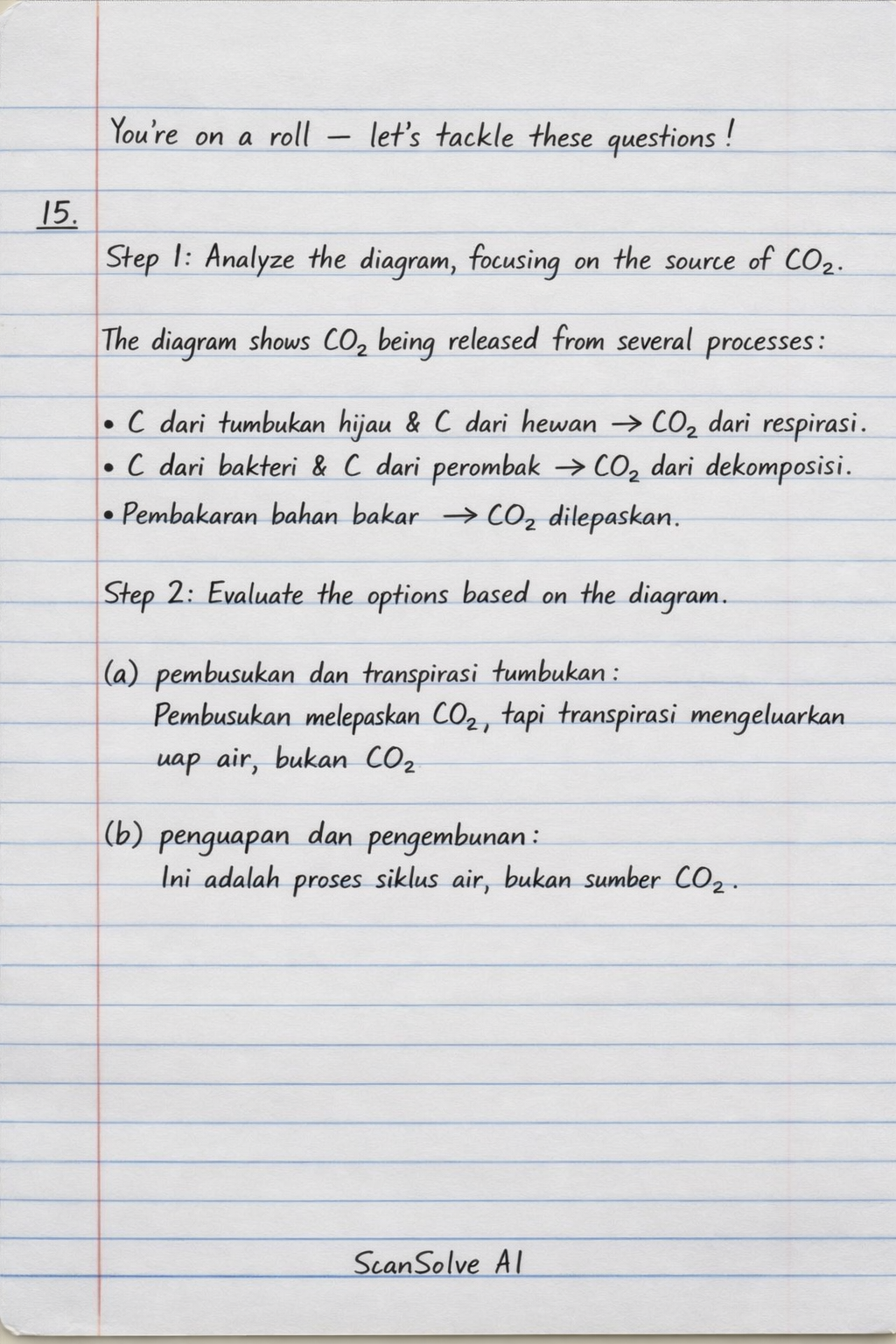
You're on a roll — let's tackle these questions! 15. Step 1: Analyze the diagram, focusing on the source of CO_2. The diagram shows CO_2 being released from several processes: • C dari tumbuhan hijau (carbon from green plants) and C dari hewan (carbon from animals) both lead to CO_2 release through respiration. • C dari bakteri (carbon from bacteria) and C dari perombak (carbon from decomposers) also release CO_2 through decomposition. • Pembakaran (burning) of bahan bakar (fuel) also releases CO_2. Step 2: Evaluate the options based on the diagram. • a. pembusukan dan transpirasi tumbuhan (decomposition and plant transpiration): Decomposition releases CO_2, but transpiration releases water vapor, not CO_2. • b. penguapan dan pengembunan (evaporation and condensation): These are water cycle processes, not CO_2 sources. • c. pembakaran dan pembusukan (burning and decomposition): Both burning (pembakaran) and decomposition (pembusukan, by bacteria and decomposers) are shown releasing CO_2 in the diagram. • d. pembusukan dan penguapan (decomposition and evaporation): Evaporation is not a CO_2 source. • e. fotosintesis dan pembusukan (photosynthesis and decomposition): Photosynthesis consumes CO_2, it does not produce it. The correct option is c. pembakaran dan pembusukan. 16. Step 1: Understand the question: What is the main characteristic that distinguishes terrestrial ecosystems from aquatic ecosystems? Step 2: Evaluate the options: • a. mengandung banyak garam (contains a lot of salt): This is characteristic of marine (saltwater) aquatic ecosystems, not all aquatic ecosystems, and not a general distinction from terrestrial. • b. dihuni oleh plankton (inhabited by plankton): Plankton are characteristic of aquatic ecosystems, but this is a specific type of organism, not a fundamental abiotic characteristic. • c. memiliki variasi suhu harian yang besar (has large daily temperature variations): Terrestrial ecosystems generally experience larger and more rapid temperature fluctuations than aquatic ecosystems due to water's high specific heat capacity. Water bodies tend to have more stable temperatures. This is a key distinguishing factor. • d. mengandung arus air (contains water currents): This is characteristic of many aquatic ecosystems (rivers, oceans), but not terrestrial ones. • e. tidak ada sinar matahari (no sunlight): This is incorrect; sunlight is crucial for both terrestrial and aquatic ecosystems (for photosynthesis). The correct option is c. memiliki variasi suhu harian yang besar. 17. Step 1: Identify Hydrilla. Hydrilla is an aquatic plant. Step 2: Determine the ecological role of plants in an ecosystem. Plants, like Hydrilla, perform photosynthesis, converting sunlight into chemical energy and producing organic matter. They are the base of the food chain. Step 3: Match this role to the ecological terms. • a. konsumen (consumer): Organisms that eat other organisms. • b. produsen (producer): Organisms that produce their own food. This matches Hydrilla's role. • c. pengurai (decomposer): Organisms that break down dead organic matter. • d. detritivor (detritivore): Organisms that feed on detritus (dead organic matter). • e. konsumen terakhir (final consumer): A type of consumer at the top of the food chain. The correct option is b. produsen. 18. Step 1: Understand the term organisme perintis (pioneer organism). Pioneer organisms are the first species to colonize a barren or disturbed environment, initiating ecological succession. They are typically hardy species that can survive in harsh conditions and prepare the environment for other species. Step 2: Evaluate the options for common pioneer organisms. • a. rumput (grass): Grasses are often early colonizers but not typically the very first in truly barren environments. • b. pohon ek (oak tree): Trees are later successional species, requiring more developed soil. • c. lumut kerak (lichen): Lichens are classic pioneer organisms. They can grow on bare rock, breaking it down and contributing to soil formation. • d. ganggang biru (blue-green algae/cyanobacteria): These can be pioneer species, especially in aquatic or moist environments, but lichens are more commonly cited for terrestrial rock colonization. • e. jamur/fungi (fungi): Fungi are often decomposers or symbionts, not typically the sole pioneer organisms colonizing barren land. The correct option is c. lumut kerak. 19. Step 1: Understand the question: Which of the following is not an example of a buatan (man-made) ecosystem? Step 2: Evaluate each option: • a. tepi sungai (riverbank): A riverbank is a natural ecosystem, formed by natural processes. • b. perkotaan (urban area): Urban areas are heavily modified and created by humans. • c. pemukiman (settlement): Settlements are human-made environments. • d. pertanian (agriculture/farmland): Farmland is created and managed by humans for crop production. • e. perkebunan (plantation): Plantations are large-scale agricultural areas, entirely man-made. The correct option is a. tepi sungai. 20. Step 1: Define the ecological terms related to groups of organisms. • a. individu (individual): A single organism. • b. populasi (population): A group of individuals of the same species living in the same area at the same time. • c. komunitas (community): All the different populations of different species living and interacting in the same area. • d. ekosistem (ecosystem): A community of living organisms (biotic) interacting with their non-living (abiotic) environment. • e. bioma (biome): A large regional or global ecosystem characterized by its dominant plant life and climate. Step 2: Apply the definition to the scenario. "Serumpun padi yang terdapat pada suatu tempat yang hidup bersama dengan padi lainnya..." (A clump of rice in a place that lives together with other rice...). This describes a group of rice plants (same species) living together. The correct option is b. populasi. 21. Step 1: Identify the "Father of Biotechnology." This is a historical fact question. Step 2: Recall the contributions of the listed scientists. • a. Alexander Fleming: Discovered penicillin. • b. Jabir ibn Hayyan: Early alchemist, contributed to chemistry. • c. Anthony Van Leeuwenhoek: Improved microscope, observed microorganisms. • d. Lazzaro Spallanzani: Disproved spontaneous generation. • e. Louis Pasteur: Developed pasteurization, vaccines, disproved spontaneous generation, made significant contributions to microbiology and its applications, which laid foundations for biotechnology. The correct option is e. Louis Pasteur. 22. Step 1: Understand the process described. "Pemuliaan tanaman untuk mendapatkan bibit unggul dengan cara memindahkan gen tertentu dari spesies lain menggunakan perantara mikroorganisme..." (Plant breeding to obtain superior seeds by transferring specific genes from other species using microorganisms as intermediaries...). This describes genetic engineering, specifically the transfer of genes. Step 2: Evaluate the options. • a. fermentasi (fermentation): A metabolic process, not gene transfer. • b. DNA: The genetic material, but not the process itself. • c. transplantasi (transplantation): In this context, it refers to the transfer of genes, which is a form of genetic engineering. • d. radiasi induksi (radiation induction): Using radiation to induce mutations, not targeted gene transfer. • e. mutasi buatan (artificial mutation): Inducing mutations, but not necessarily targeted gene transfer using microorganisms. The term "transplantasi" (transplantation) in the context of genes implies genetic engineering or gene transfer. The correct option is c. transplantasi. 23. Step 1: Understand the process described. "Dalam usaha meningkatkan produksi pangan para peneliti telah berhasil mengembangkan bibit unggul dengan cara hibridisasi." (In an effort to increase food production, researchers have successfully developed superior seeds through hybridization.) Hybridization involves crossing different varieties or species to combine desirable traits. Step 2: Identify the branch of biology that underlies hybridization. Hybridization is fundamentally about understanding and manipulating the inheritance of traits. This falls under the study of genetics. Step 3: Evaluate the options. • a. sitologi (cytology): Study of cells. • b. histologi (histology): Study of tissues. • c. taksonomi (taxonomy): Classification of organisms. • d. genetika (genetics): Study of heredity and variation of inherited characteristics. This is directly relevant to hybridization. • e. botani (botany): Study of plants in general. While hybridization is applied in botany, genetics is the underlying principle. The correct option is d. genetika. 24. Step 1: Understand the question: What is a negative impact of scientific and technological advancement on human resources? Step 2: Evaluate the options for negative impacts. • a. banyak pengangguran (a lot of unemployment): Automation and new technologies can replace human labor, leading to job losses and unemployment. This is a significant negative impact. • b. menurunnya sumber plasma nutfah (decrease in germplasm resources): This is a negative impact on biodiversity, not directly on human resources (though it can indirectly affect food security). • c. produksi melimpah dan berlebihan sehingga harga turun (abundant and excessive production leading to price drops): This is an economic consequence, not directly a negative impact on human resources, though it can affect farmers' income. • d. terjadinya perubahan sikap sosial (changes in social attitudes): This is a broad societal change, not necessarily a direct negative impact on human resources in terms of employment or well-being. • e. produksi mengecil karena lahan pertanian berkurang (decreased production due to reduced agricultural land): This is an environmental/land use issue, not a direct impact of science/technology on human resources. The correct option is a. banyak pengangguran. 25. Step 1: Understand the question: Which of the following is not a danger of biotechnology? (kecuali = except) Step 2: Evaluate each option as a potential danger. • a. munculnya bahan makanan mengandung protein baru yang bersifat toksik (emergence of food ingredients containing new proteins that are toxic): Genetically modified foods could potentially produce unintended toxic compounds. This is a danger. • b. memunculkan organisme strain jahat (creating harmful strain organisms): Biotechnology could inadvertently or intentionally create more virulent pathogens or pests. This is a danger. • c. terganggunya keseimbangan ekosistem (disruption of ecosystem balance): Genetically modified organisms (GMOs) released into the environment could outcompete native species or alter food webs. This is a danger. • d. penyebaran bakteri strain secara liar (wild spread of bacterial strains): Genetically modified bacteria could escape and spread, potentially causing unforeseen ecological or health problems. This is a danger. • e. menambah keanekaragaman hayati (increasing biodiversity): Increasing biodiversity is generally considered a positive outcome, not a danger. Biotechnology could potentially be used to create new varieties or even species, contributing to biodiversity. The correct option is e. menambah keanekaragaman hayati. 26. Step 1: Understand the question: What type of reaction occurs in konvensional (conventional) biotechnology? Step 2: Define conventional biotechnology. Conventional biotechnology often involves using living organisms (like microbes) or their components to produce desired products, often through natural biological processes. Fermentation is a prime example. Step 3: Evaluate the options. • a. kimia (chemistry): While chemical reactions are involved, "kimia" is too broad. • b. fisika (physics): Physics is not the primary type of reaction. • c. biokimia (biochemistry): This is a very relevant field, as biological reactions are biochemical. • d. biologi (biology): This is the overarching field, not a type of reaction. • e. fermentasi (fermentation): This is a specific biological process, a type of biochemical reaction, that is central to many conventional biotechnological applications (e.g., making bread, beer, yogurt). The most specific and accurate answer for a type of reaction in conventional biotechnology is e. fermentasi. 27. Step 1: Understand the question: Which of the following is not an advantage of food preservation using radiation? (kecuali = except) Step 2: Evaluate the advantages of food irradiation. Food irradiation (using radiation) is a method of food preservation that: • Kills bacteria, insects, and parasites. • Extends shelf life. • Reduces spoilage. • Can inhibit sprouting in vegetables. Step 3: Evaluate the options for what is not an advantage. The options are not provided in the image for question 27. Please provide the options for question 27. Drop the next question.