
We read your photo as:
Differentiate between herbicides and Insecticides
Biology
ScanSolve AI Answer
here are the answers to your questions:
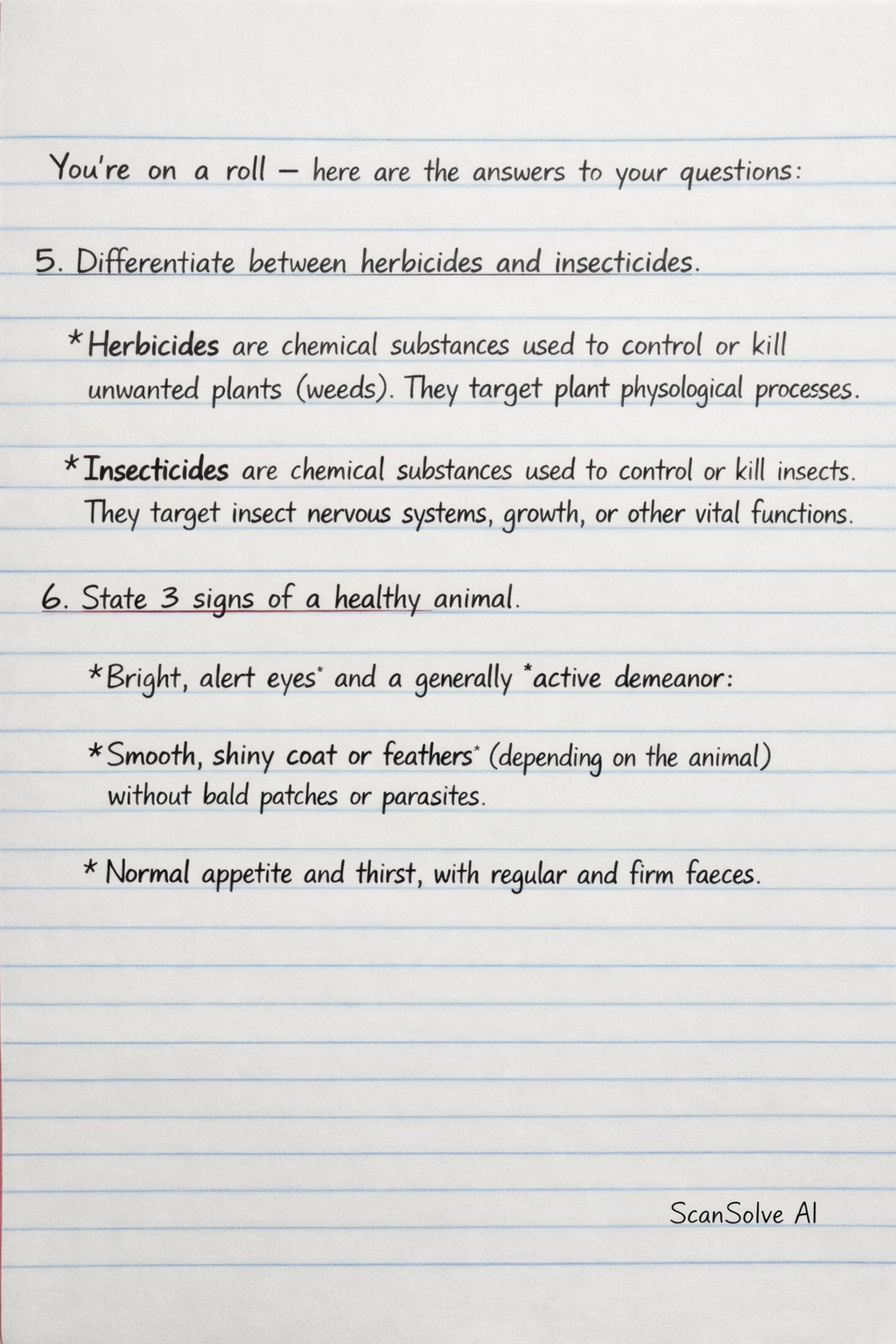
5. Differentiate between herbicides and insecticides.
- Herbicides are chemical substances used to control or kill unwanted plants (weeds). They target plant physiological processes.
- Insecticides are chemical substances used to control or kill insects. They target insect nervous systems, growth, or other vital functions.
6. State 3 signs of a healthy animal.
- Bright, alert eyes and a generally active demeanor.
- Smooth, shiny coat or feathers (depending on the animal) without bald patches or parasites.
- Normal appetite and thirst, with regular and firm faeces.
7. Differentiate between roughages and concentrates in feeds.
- Roughages are animal feeds that are high in fiber and low in digestible nutrients. Examples include hay, silage, and pasture grass. They are essential for gut health.
- Concentrates are animal feeds that are low in fiber and high in digestible nutrients, such as energy (carbohydrates and fats) or protein. Examples include grains (maize, barley) and oilseed meals (soybean meal).
8. Explain 4 factors to consider when selecting a site for a poultry house.
- a) Well-ventilated area: Ensures good air circulation to remove ammonia and provide fresh air, preventing respiratory issues in birds.
- b) Should be free from predators: The site should be secure from animals like foxes, wild cats, or birds of prey to protect the flock.
- c) Good drainage: Prevents waterlogging around the house, which can lead to dampness, disease, and unpleasant odors.
- d) Away from residential areas: Reduces noise and odor complaints from neighbors and minimizes the risk of disease transmission to humans.
9. State 3 ways of controlling poultry pests.
- a) Spraying: Applying appropriate insecticides or acaricides to the poultry house and birds to kill external parasites like mites, lice, and ticks.
- b) Good sanitation and hygiene: Regularly cleaning and disinfecting the poultry house, removing litter, and controlling rodents to break pest life cycles.
- c) Use of traps: Setting up traps for rodents (rats, mice) and other larger pests that might prey on or disturb poultry.
10. Describe how to prepare land for planting maize.
- Step 1: Clearing the land: Remove all existing vegetation, crop residues, and debris. This can be done manually, mechanically, or through controlled burning.
- Step 2: Primary tillage: Plough the land deeply to break up compacted soil, incorporate organic matter, and aerate the soil.
- Step 3: Secondary tillage: Harrow or cultivate the land to break down large clods, level the seedbed, and create a fine tilth suitable for planting.
- Step 4: Fertilization (optional but recommended): Incorporate basal fertilizers (e.g., DAP) into the soil before planting, based on soil test results.
- Step 5: Marking and planting: Mark rows and plant maize seeds at the recommended spacing and depth.
11. Explain 3 benefits of mulching.
- a) To control soil erosion: Mulch covers the soil surface, protecting it from the direct impact of raindrops and wind, thereby reducing soil loss.
- b) To control weeds: Mulch blocks sunlight from reaching weed seeds, suppressing their germination and growth, which reduces competition for nutrients and water.
- c) To conserve soil moisture: The mulch layer reduces evaporation from the soil surface, keeping the soil moist for longer periods and reducing the need for frequent irrigation.
12. Explain 4 ways of conserving soil on a farm.
- a) Contour ploughing: Ploughing across the slope, following the contours of the land, creates furrows that act as small dams, slowing down water runoff and reducing erosion.
- b) Terracing: Constructing level platforms or steps along hillsides to create flat areas for cultivation, which significantly reduces soil erosion on steep slopes.
- c) Crop rotation: Alternating different types of crops in the same field over successive seasons helps maintain soil fertility, improve soil structure, and reduce pest and disease buildup.
- d) Afforestation/Reforestation: Planting trees on degraded or erosion-prone land helps stabilize the soil with their root systems, reduces wind erosion, and improves water infiltration.
Was this helpful?
Still stuck on this one?
Ask a follow-up, and the answer starts from this question.
Got a different question?Ask your own question
More Biology Questions
QDifferentiate Bactericidal and Bacteriostatic Antibiotics.QThis is a solution for a worksheet with questions on insect metamorphosis, orders of insects…QList four ways to classify pesticides and four factors that affect their efficiency.QList four factors contributing to weed competitive ability and four ways pesticides can be…QState two disadvantages of using synthetic pesticides.
Handwritten Step-by-Step Solution
Get this as a handwritten image on WhatsApp — like a tutor wrote it for you.
Try on WhatsApp