

This biology question covers important biological concepts and processes. The step-by-step explanation below helps you understand the underlying mechanisms and reasoning.
ScanSolve AI Answer
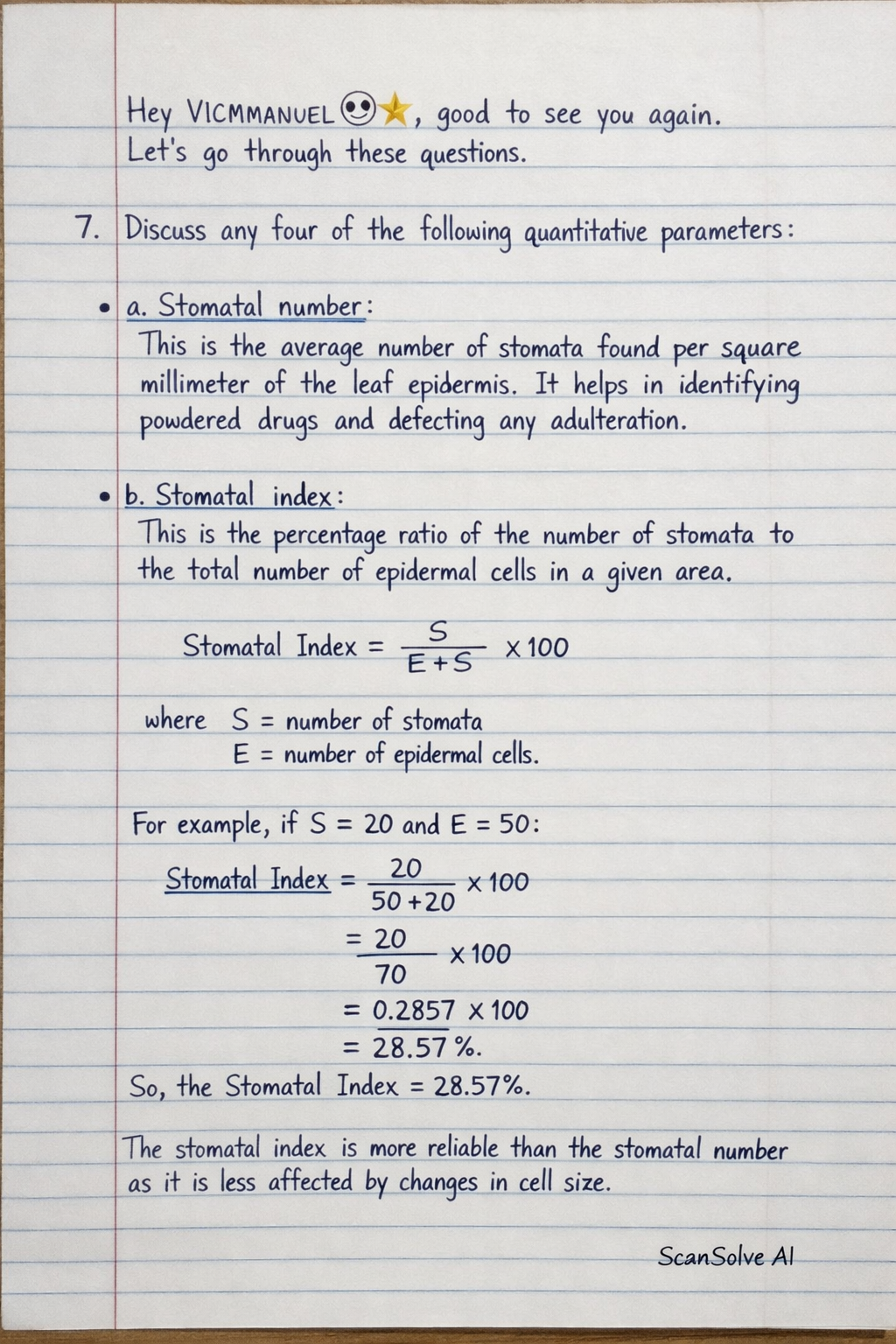
Hey VICMMANUEL👻⭐, good to see you again. Let's go through these questions. 7. Discuss any four of the following quantitative parameters: a. Stomatal number: This is the average number of stomata found per square millimeter of the leaf epidermis. It is a characteristic feature for a specific plant species and is used to identify powdered drugs and detect any adulteration. b. Stomatal index: This is the percentage ratio of the number of stomata to the total number of epidermal cells (including stomata) in a given area of the leaf epidermis. It is calculated using the formula: Stomatal Index = (S)/(E+S) × 100 where S is the number of stomata and E is the number of epidermal cells in the same area. The stomatal index is considered more reliable than the stomatal number because it is less affected by environmental changes that alter cell size. c. Palisade ratio: This refers to the average number of palisade cells beneath one epidermal cell, as observed in a surface view of the leaf. It is a relatively constant value for a particular species and is very useful for the identification and authentication of powdered leaf drugs. e. Vein-islet number: This is the number of vein-islets (small areas of photosynthetic tissue enclosed by the ultimate veinlets) per square millimeter of leaf surface. It is a fairly constant characteristic for a given plant species and is used for identification and to detect adulteration in crude drugs. 8. Define the following: a. Pharmacognosy: This is the scientific study of medicinal drugs derived from natural sources, primarily plants, but also animals and microorganisms. It covers the history, distribution, cultivation, collection, preparation, identification, evaluation, and uses of these natural products. b. Crude drugs: These are natural products that have undergone only collection and drying, with minimal or no processing. They are unrefined natural substances used as medicines or as raw materials for the preparation of medicines. Examples include whole leaves, barks, roots, or seeds. c. Monograph: In the context of pharmacopoeias, a monograph is a detailed written account or description of a single drug or substance. It typically includes information such as its source, description, identification tests, purity standards, assay methods, storage conditions, and therapeutic uses. Send me the next one 📸