
We read your photo as:
Distinguish between diploid and haploid, and gamete and zygote. Explain the genetics of incomplete dominance in fowl feather color crosses.
ScanSolve AI Answer
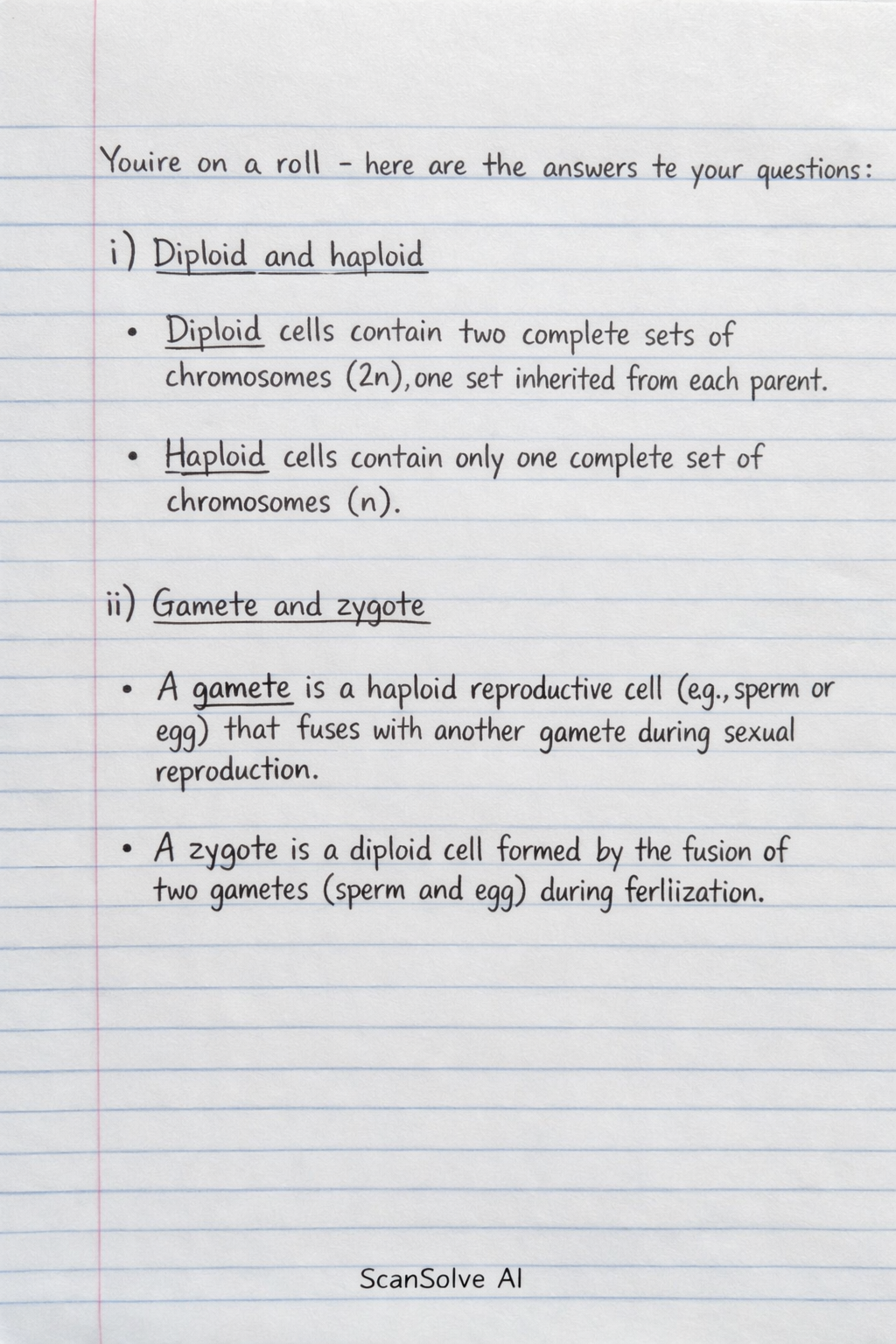
here are the answers to your questions:
10. a) Distinguish between the following pairs of terms:
- i) Diploid and haploid
- Diploid cells contain two complete sets of chromosomes (), one set inherited from each parent.
- Haploid cells contain only one complete set of chromosomes ().
- ii) Gamete and zygote
- A gamete is a haploid reproductive cell (e.g., sperm or egg) that fuses with another gamete during sexual reproduction.
- A zygote is a diploid cell formed by the fusion of two gametes (sperm and egg) during fertilization.
10. b) A poultry farmer crossed pure breed white fowls with pure breed black fowls and all offspring were blue. When two of these blue fowls were crossed, it was observed that out of the 492 F2 fowls produced, 121 were black, 125 were white and 246 were blue.
-
i) Using appropriate genetic symbols and diagrams, explain the genetics of the crosses. This scenario demonstrates incomplete dominance, where neither allele is completely dominant over the other, resulting in a blended phenotype in the heterozygote.
Let's use the following symbols:
- : Allele for white feather color
- : Allele for black feather color
Parental Cross (P Generation):
Pure breed white fowl () Pure breed black fowl ()F1 Generation:
- Genotype: All
- Phenotype: All Blue fowls
F2 Cross:
Two blue fowls from F1 generation are crossed: Blue () Blue ()F2 Generation:
- Genotypic Ratio:
- Phenotypic Ratio: 1 White : 2 Blue : 1 Black
Observed F2 Ratio:
Total F2 fowls = 492- Black: 121
- White: 125
- Blue: 246
Let's calculate the approximate ratios:
- Black:
- White:
- Blue:
The observed ratio of approximately 1 Black : 1 White : 2 Blue matches the expected phenotypic ratio for incomplete dominance.
-
ii) What is the expected result of a cross between a blue and a black fowl? Cross: Blue fowl () Black fowl ()
Expected Results:
- Genotypic Ratio:
- Phenotypic Ratio: 1 Blue : 1 Black The expected result is a chance of blue fowls and a chance of black fowls.
11. a) What is:
- i) Genetics Genetics is the scientific study of heredity and variation in living organisms, focusing on how traits are inherited from parents to offspring.
- ii) Variation Variation refers to the differences in characteristics or traits among individuals within a population or species. These differences can be genetic or environmental.
- iii) Mutation A mutation is a permanent, heritable change in the DNA sequence of an organism's genome. Mutations can lead to new alleles and are a source of genetic variation.
11. b) When a red-flowered plant was crossed with a white flowered plant of the same species, all the resulting offspring of the F1 generation were red flowered plants. When one of the F1 offspring was self-pollinated, 176 red-flowered and 64 white-flowered plants of the F2 were obtained.
-
i) Explain the genetics of these crosses by using appropriate diagrams and symbols. This scenario demonstrates complete dominance, where one allele (red) completely masks the expression of the other allele (white).
Let's use the following symbols:
- : Allele for red flowers (dominant)
- : Allele for white flowers (recessive)
Parental Cross (P Generation):
Pure red-flowered plant () Pure white-flowered plant ()F1 Generation:
- Genotype: All
- Phenotype: All Red-flowered plants
F2 Cross (Self-pollination of F1):
Red-flowered plant () Red-flowered plant ()F2 Generation:
- Genotypic Ratio:
- Phenotypic Ratio: 3 Red : 1 White
Observed F2 Ratio:
Total F2 plants =- Red: 176
- White: 64
Let's calculate the approximate ratios:
- Red:
- White:
The observed ratio of approximately 3 Red : 1 White matches the expected phenotypic ratio for complete dominance.
-
ii) What is the importance of a test cross? A test cross is used to determine the unknown genotype of an individual that exhibits a dominant phenotype. It involves crossing the individual in question with a homozygous recessive individual. If any offspring display the recessive phenotype, the dominant parent must be heterozygous. If all offspring display the dominant phenotype, the dominant parent is homozygous dominant.
12. a) Define the following terms as used in genetics:
- i) Homozygous An individual is homozygous for a gene if they possess two identical alleles for that particular gene (e.g., or ).
- ii) Heterozygous An individual is heterozygous for a gene if they possess two different alleles for that particular gene (e.g., ).
- iii) Recessive A recessive allele is one whose phenotypic effect is only expressed when two copies of the allele are present (i.e., in a homozygous recessive individual). Its expression is masked by a dominant allele in a heterozygous individual.
- iv) Dominance Dominance is a genetic phenomenon where one allele (the dominant allele) completely masks the expression of another allele (the recessive allele) in a heterozygous individual, determining the phenotype.
12. b) A farmer grows plants with rose flowers that are either red or white in colour. He realized that there is a request for pink coloured roses. In an attempt to get the pink coloured roses, he crossed the pure breed red ross flowered plant the pure breed white flowered plants. Using genetic symbols and diagrams, explain the results of this cross.
This scenario describes incomplete dominance, as the cross between pure red and pure white flowers results in an intermediate pink phenotype.
Let's use the following symbols:
- : Allele for red flowers
- : Allele for white flowers
Parental Cross (P Generation):
Pure breed red-flowered plant () Pure breed white-flowered plant ()
F1 Generation:
- Genotype: All
- Phenotype: All Pink-flowered plants
The result of this cross is that all the F1 offspring will have pink flowers, satisfying the farmer's request.
12. c) What would be the out of a cross between the pink flowers and the red parent?
Cross: Pink flowers ()
Still stuck on this one?
Ask a follow-up, and the answer starts from this question.
More Biology Questions
Handwritten Step-by-Step Solution
Get this as a handwritten image on WhatsApp — like a tutor wrote it for you.
Try on WhatsApp