
We read your photo as:
Draw and label a bird's head and digestive system, and describe the function of the gizzard.
Biology
ScanSolve AI Answer
Step-by-step solution
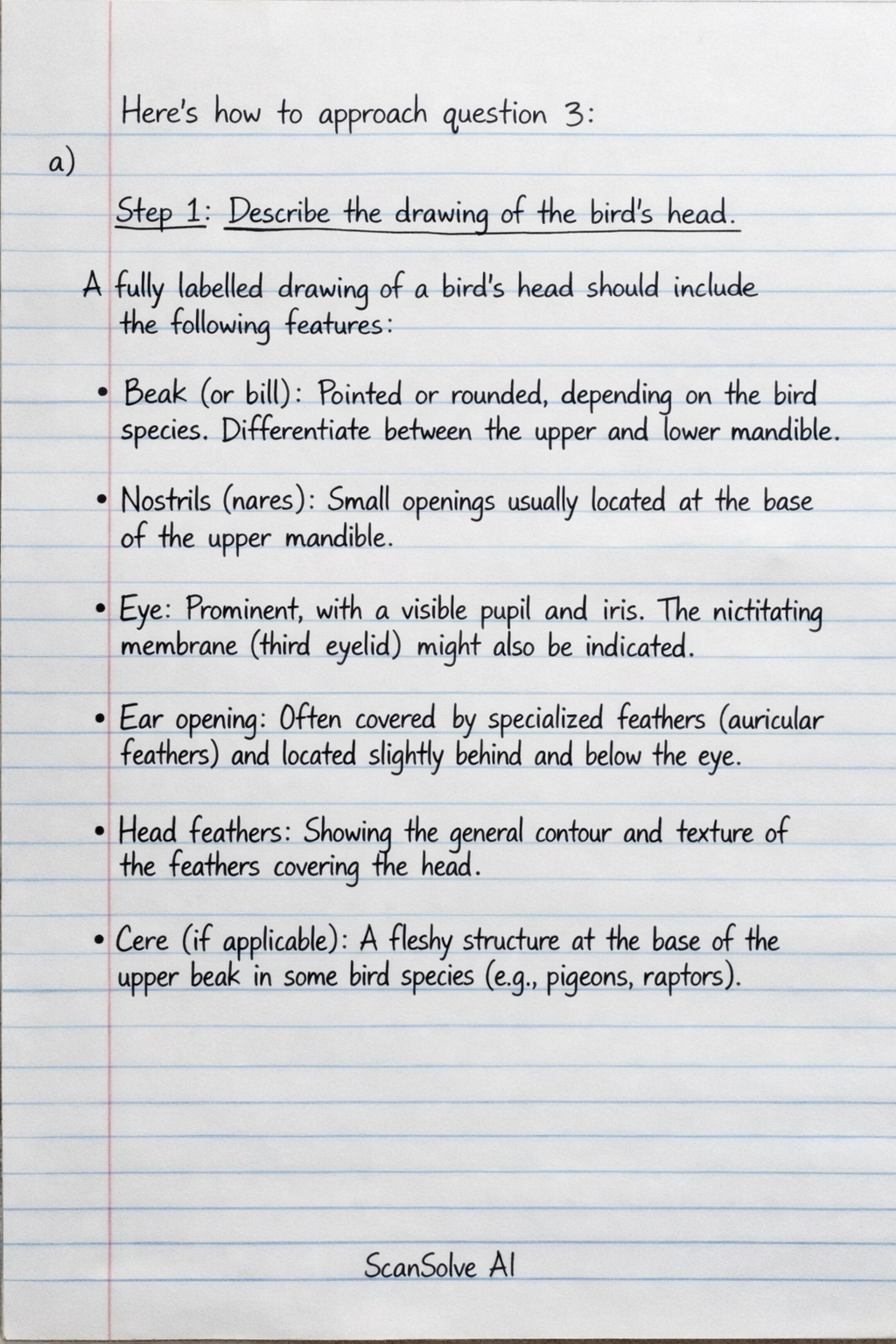
4 stepsHere's how to approach question 3:
Part a· 1 step
Describe the drawing of the bird's head.
A fully labelled drawing of a bird's head should include the following features:
- Beak (or bill): Pointed or rounded, depending on the bird species. Differentiate between the upper and lower mandible.
- Nostrils (nares): Small openings usually located at the base of the upper mandible.
- Eye: Prominent, with a visible pupil and iris. The nictitating membrane (third eyelid) might also be indicated.
- Ear opening: Often covered by specialized feathers (auricular feathers) and located slightly behind and below the eye.
- Head feathers: Showing the general contour and texture of the feathers covering the head.
- Cere (if applicable): A fleshy structure at the base of the upper beak in some bird species (e.g., pigeons, raptors).
Part b(i)· 1 step
Describe the drawing of the bird's digestive system.
A fully labelled drawing of the bird's digestive system and associated organs, as seen in a dissection, should include:
- Esophagus: A muscular tube extending from the pharynx to the crop.
- Crop: A pouch-like enlargement of the esophagus, typically located at the base of the neck, used for temporary food storage.
- Proventriculus (glandular stomach): The first part of the stomach, where digestive enzymes are secreted.
- Gizzard (ventriculus, muscular stomach): A thick-walled, muscular organ posterior to the proventriculus, responsible for grinding food.
- Small intestine: A long, coiled tube where most digestion and absorption occur. It consists of the duodenum (forming a loop enclosing the pancreas), jejunum, and ileum.
- Pancreas: Located within the duodenal loop, it secretes digestive enzymes and hormones.
- Liver: A large, usually bilobed organ, often dark red or brown, located anterior to the stomach. It produces bile.
- Gallbladder: A small sac, often green, associated with the liver (though absent in some bird species like pigeons), storing bile.
- Ceca (singular: cecum): Paired blind-ended sacs located at the junction of the small and large intestines, involved in fermentation of plant material in some birds.
- Large intestine (rectum): A short, straight tube connecting the small intestine to the cloaca.
- Cloaca: A common posterior opening for the digestive, urinary, and reproductive tracts.
Part b(ii)· 2 steps
Annotate a structure for food storage.
- Crop: This is a muscular pouch, an enlargement of the esophagus, primarily used for the temporary storage of ingested food. It allows birds to quickly consume a large amount of food and digest it later, often while in a safe location. In some species, it also moistens and softens food.
Annotate a structure for mastication.
- Gizzard (ventriculus): This is a highly muscular, thick-walled organ that serves as the bird's mechanical stomach. It contains grit (small stones or sand) ingested by the bird, which, along with strong muscular contractions, grinds and breaks down tough food items like seeds and insects into smaller, more digestible particles.
Part b(iii)
This part is an instruction for a practical examination and does not require a written answer.
Was this helpful?
Still stuck on this one?
Ask a follow-up, and the answer starts from this question.
Got a different question?Ask your own question
More Biology Questions
QThe gizzard in birds is a muscular organ that plays a crucial role in mechanical digestion. Since…QCompare and contrast the digestive systems of a fish and a bird. Identify bird sex from dissection.QCan you identify and explain the labeled parts of a dissected bird's digestive, respiratory, and…QPlease provide labelled diagrams for fish and bird dissections, including their digestive…QDraw a well-labelled diagram of the digestive system. What happens to the food in the stomach? What…
Browse by topic:Anatomy
Handwritten Step-by-Step Solution
Get this as a handwritten image on WhatsApp — like a tutor wrote it for you.
Try on WhatsApp