
We read your photo as:
Extraembryonic membranes are found during the development of humans but not during the development of chicks.
ScanSolve AI Answer
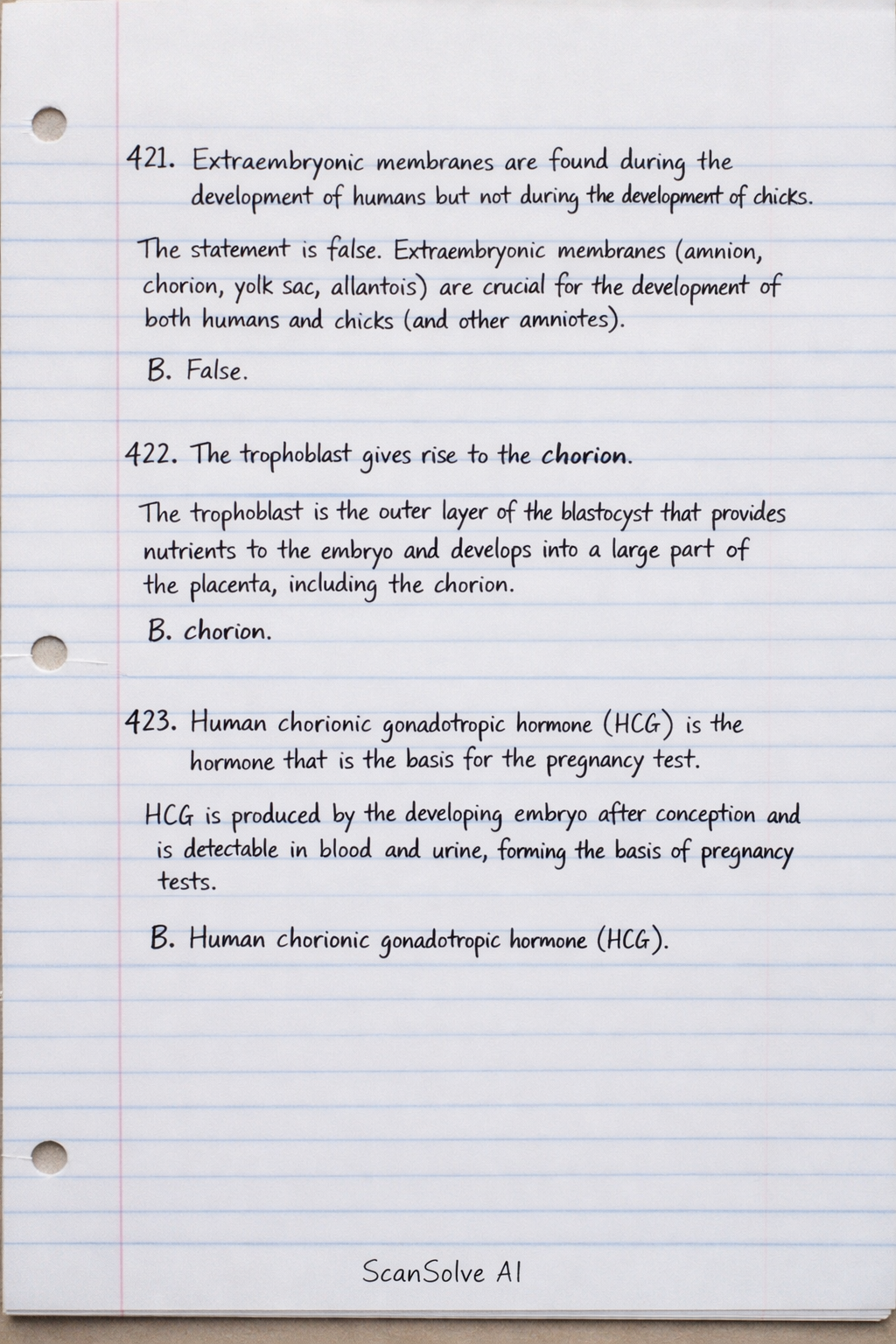
421. Extraembryonic membranes are found during the development of humans but not during the development of chicks.
The statement is false. Extraembryonic membranes (amnion, chorion, yolk sac, allantois) are crucial for the development of both humans and chicks (and other amniotes).
- B. False
422. The trophoblast gives rise to the chorion.
The trophoblast is the outer layer of the blastocyst that provides nutrients to the embryo and develops into a large part of the placenta, including the chorion.
- B. chorion
423. Human chorionic gonadotropic hormone (HCG) is the hormone that is the basis for the pregnancy test.
HCG is produced by the developing embryo after conception and is detectable in blood and urine, forming the basis of pregnancy tests.
- B. Human chorionic gonadotropic hormone (HCG)
424. In the third week, the embryo begins implanting in the wall of the uterus.
The statement is false. Implantation typically begins around 6-12 days after fertilization, which is during the second week, not the third.
- B. False
425. Gastrulation occurs during the second week and the inner cell mass flattens into the embryonic disk composed of ectoderm and endoderm.
Gastrulation is the process where the inner cell mass (embryoblast) differentiates into the three primary germ layers (ectoderm, mesoderm, and endoderm) and forms the embryonic disk. This process begins around the third week, but the initial flattening into a bilaminar disk occurs earlier. The question states "second week and the inner cell mass flattens into the ____ composed of ectoderm and endoderm," which refers to the formation of the bilaminar embryonic disk.
- D. embryonic disk
426. In humans, the fourth pair of pharyngeal pouches become parathyroid glands.
The pharyngeal pouches are structures in the embryonic pharynx. The third pharyngeal pouch gives rise to the inferior parathyroid glands and the thymus, while the fourth pharyngeal pouch gives rise to the superior parathyroid glands.
- C. parathyroid glands
427. During the fourth and fifth months, human features—arms and legs, ears, eyes and nose—begin to appear.
The statement is false. Basic human features like arms, legs, eyes, and ears begin to form much earlier, primarily during the embryonic period (weeks 3-8). By the fourth and fifth months (fetal period), these structures are already well-formed and are undergoing further development and growth.
- B. False
428. Three months after the embryo is fully implanted, the placenta begins to form.
The statement is false. The placenta begins to form much earlier, shortly after implantation (around the second week), and is fully functional by the end of the first trimester (around 10-12 weeks).
- B. False
429. The placenta produces prolactin.
The placenta produces several hormones essential for maintaining pregnancy, including estrogen, progesterone, and human chorionic gonadotropin (HCG). While prolactin is important for lactation, it is primarily produced by the anterior pituitary gland, not the placenta. Oxytocin is produced by the hypothalamus and released by the posterior pituitary.
- A. Prolactin
Still stuck on this one?
Ask a follow-up, and the answer starts from this question.
More Biology Questions
Handwritten Step-by-Step Solution
Get this as a handwritten image on WhatsApp — like a tutor wrote it for you.
Try on WhatsApp