
We read your photo as:
Describe the process of early human development, including fertilization, cell division, and the functions of the amniotic fluid and umbilical cord.
ScanSolve AI Answer
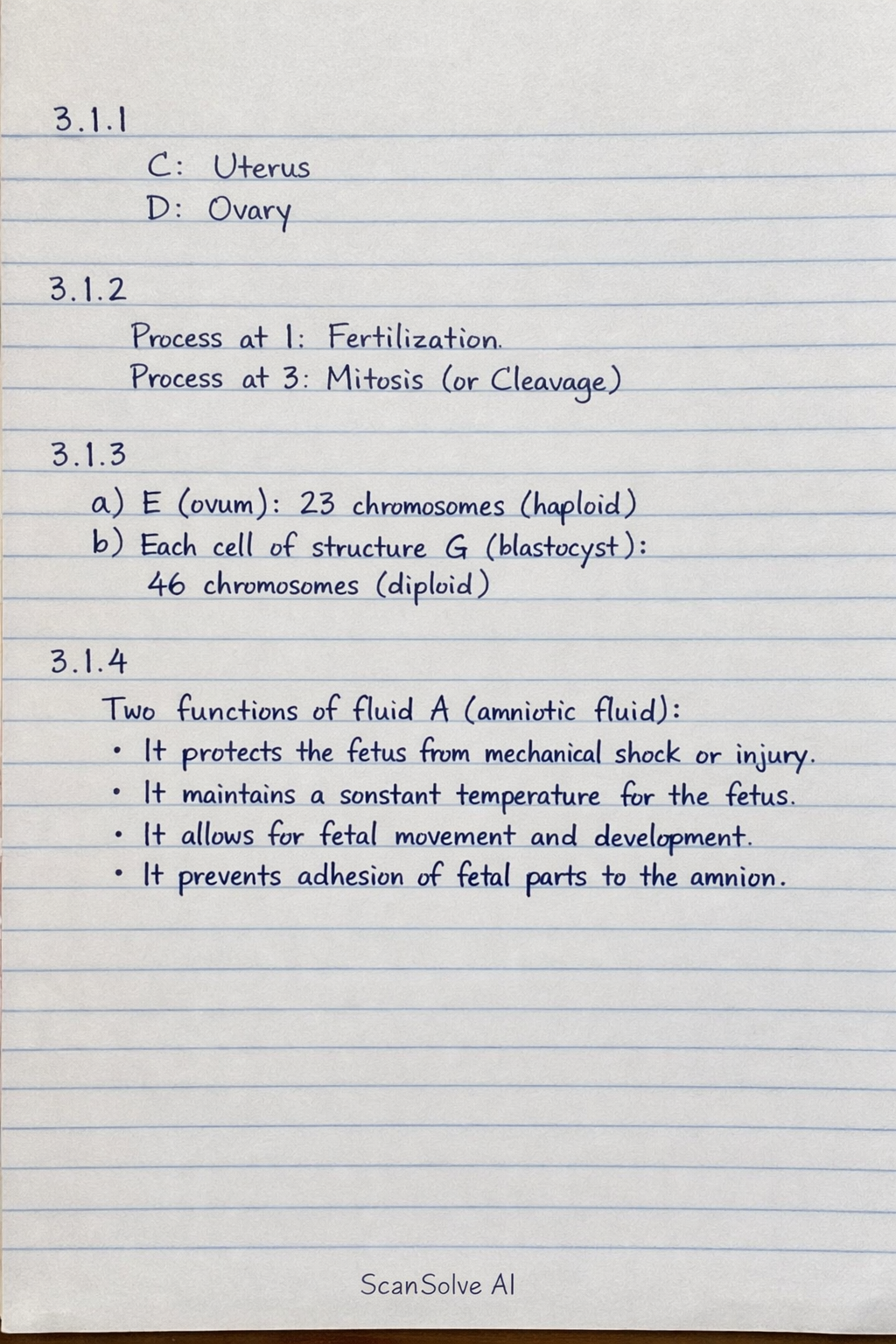
3.1.1
C: Uterus
D: Ovary
3.1.2
Process at 1: Fertilization
Process at 3: Mitosis (or Cleavage)
3.1.3
a) E (ovum): 23 chromosomes (haploid)
b) Each cell of structure G (blastocyst): 46 chromosomes (diploid)
3.1.4 Two functions of fluid A (amniotic fluid):
- It protects the fetus from mechanical shock or injury.
- It maintains a constant temperature for the fetus.
- It allows for fetal movement and development.
- It prevents adhesion of fetal parts to the amnion.
3.1.5
| Feature | Blood flowing to the fetus (via umbilical vein) | Blood flowing from the fetus (via umbilical artery) |
|---|---|---|
| Oxygen content | High | Low |
| Nutrient content | High | Low |
| Waste content | Low | High |
3.1.6
The zygote undergoes rapid mitotic cell divisions called cleavage to form a solid ball of cells known as a morula. The morula then develops into a hollow ball of cells called a blastocyst, which implants into the uterine wall. The inner cell mass of the blastocyst differentiates into three primary germ layers, which then develop into the various tissues and organs, forming an embryo. After approximately eight weeks, the embryo is referred to as a fetus.
3.1.7 Two functions of the placenta:
- It facilitates the exchange of nutrients (e.g., glucose, amino acids) and oxygen from the mother's blood to the fetus.
- It facilitates the removal of waste products (e.g., carbon dioxide, urea) from the fetal blood to the mother's blood.
- It produces hormones (e.g., progesterone, estrogen) essential for maintaining pregnancy.
- It provides immunity to the fetus by transferring antibodies from the mother.
Still stuck on this one?
Ask a follow-up, and the answer starts from this question.
More Biology Questions
Handwritten Step-by-Step Solution
Get this as a handwritten image on WhatsApp — like a tutor wrote it for you.
Try on WhatsApp