
We read your photo as:
Q1. State two functions each of the following structures during pregnancy in humans: (i) Placenta (ii) Amniotic fluid. Explain each of the following terms: (i) Nursery bed (ii) Cultural practices (iii
ScanSolve AI Answer
Step-by-step solution
10 stepsQ1a. State two functions each of the following structures during pregnancy in humans:
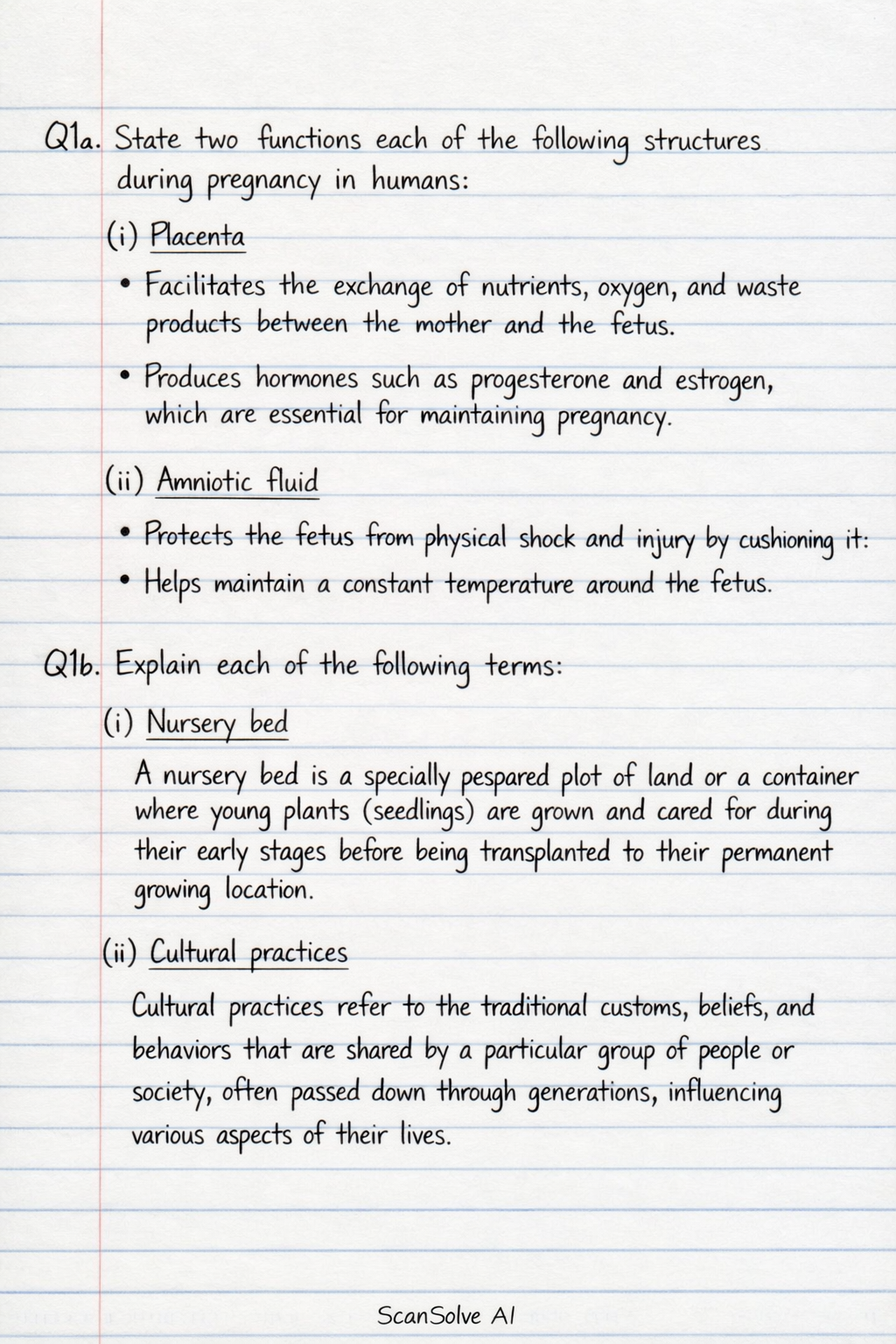
(i) Placenta
- Facilitates the exchange of nutrients, oxygen, and waste products between the mother and the fetus.
- Produces hormones such as progesterone and estrogen, which are essential for maintaining pregnancy.
(ii) Amniotic fluid
- Protects the fetus from physical shock and injury by cushioning it.
- Helps maintain a constant temperature around the fetus.
Q1b. Explain each of the following terms:
(i) Nursery bed
A nursery bed is a specially prepared plot of land or a container where young plants (seedlings) are grown and cared for during their early stages before being transplanted to their permanent growing location.
(ii) Cultural practices
Cultural practices refer to the traditional customs, beliefs, and behaviors that are shared by a particular group of people or society, often passed down through generations, influencing various aspects of their lives.
(iii) Transplanting
Transplanting is the process of moving a plant from one location to another, typically from a nursery bed or a smaller pot to a larger pot or its final growing site in a field or garden.
Q1c. Balance the following nuclear equations:
(i)
Balance the mass numbers (superscripts).
Balance the atomic numbers (subscripts).
The balanced equation is:
(ii)
Balance the mass numbers (superscripts).
Balance the atomic numbers (subscripts).
The balanced equation is:
(Note: The element with atomic number 97 is Berkelium (Bk), not Thorium (Th). The symbol 'Th' in the question is inconsistent with the atomic number 97.)
(iii)
Balance the mass numbers (superscripts).
Balance the atomic numbers (subscripts).
The balanced equation is:
(Note: The element with atomic number 28 is Nickel (Ni). 'NL' is not a standard element symbol.)
Q1d. State the type of radiation emitted in each reaction in question c:
(i) The emitted particle is , which is an alpha particle. Therefore, the type of radiation is alpha decay.
(ii) The emitted particle is , which is a beta particle. Therefore, the type of radiation is beta decay.
(iii) The emitted particle is , which is a beta particle. Therefore, the type of radiation is beta decay.
Q1e.
(i) Define light energy.
Light energy is a form of electromagnetic radiation that is visible to the human eye. It travels in waves and consists of photons, carrying energy that can be perceived as brightness and color.(ii) An electrical appliance is rated 1500W, 240V and left running for 2 hours. Calculate the:
(a) Current drawn
Identify the given values.
Power () =
Voltage () =Use the formula for power, , to find the current ().
The current drawn is .
(b) Electrical energy consumed
Identify the given values.
Power () =
Time () =Calculate energy consumed using the formula .
To express energy in Joules (J), convert time to seconds:
Alternatively, to express energy in kilowatt-hours (kWh), convert power to kilowatts:
The electrical energy consumed is or .
Still stuck on this one?
Ask a follow-up, and the answer starts from this question.
More Biology Questions
Handwritten Step-by-Step Solution
Get this as a handwritten image on WhatsApp — like a tutor wrote it for you.
Try on WhatsApp