
We read your photo as:
Describe the placenta, umbilical cord, and fetal development stages.
ScanSolve AI Answer
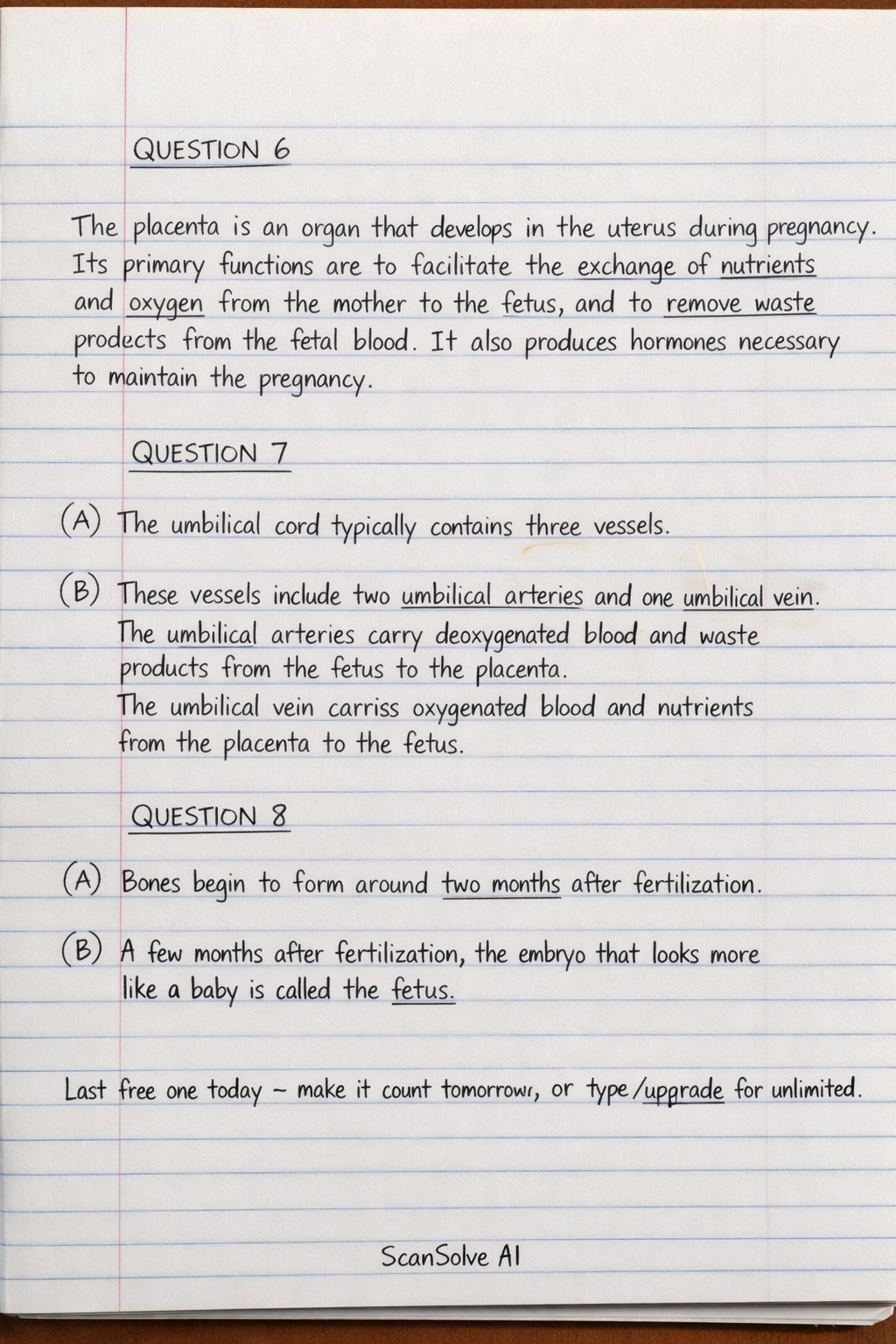
QUESTION 6
The placenta is an organ that develops in the uterus during pregnancy. Its primary functions are to facilitate the exchange of nutrients and oxygen from the mother to the fetus, and to remove waste products from the fetal blood. It also produces hormones necessary to maintain the pregnancy.
QUESTION 7
A) The umbilical cord typically contains three vessels.
B) These vessels include two umbilical arteries and one umbilical vein. The umbilical arteries carry deoxygenated blood and waste products from the fetus to the placenta. The umbilical vein carries oxygenated blood and nutrients from the placenta to the fetus.
QUESTION 8
A) Bones begin to form around two months after fertilization.
B) A few months after fertilization, the embryo that looks more like a baby is called the fetus.
Still stuck on this one?
Ask a follow-up, and the answer starts from this question.
More Biology Questions
Handwritten Step-by-Step Solution
Get this as a handwritten image on WhatsApp — like a tutor wrote it for you.
Try on WhatsApp