
We read your photo as:
Please define the following biological terms: Excretion, Osmoregulation, Homeostasis, Fertilization, Enzymes, Ecosystem, Photosynthesis.
ScanSolve AI Answer
here are the definitions for the terms you've listed:
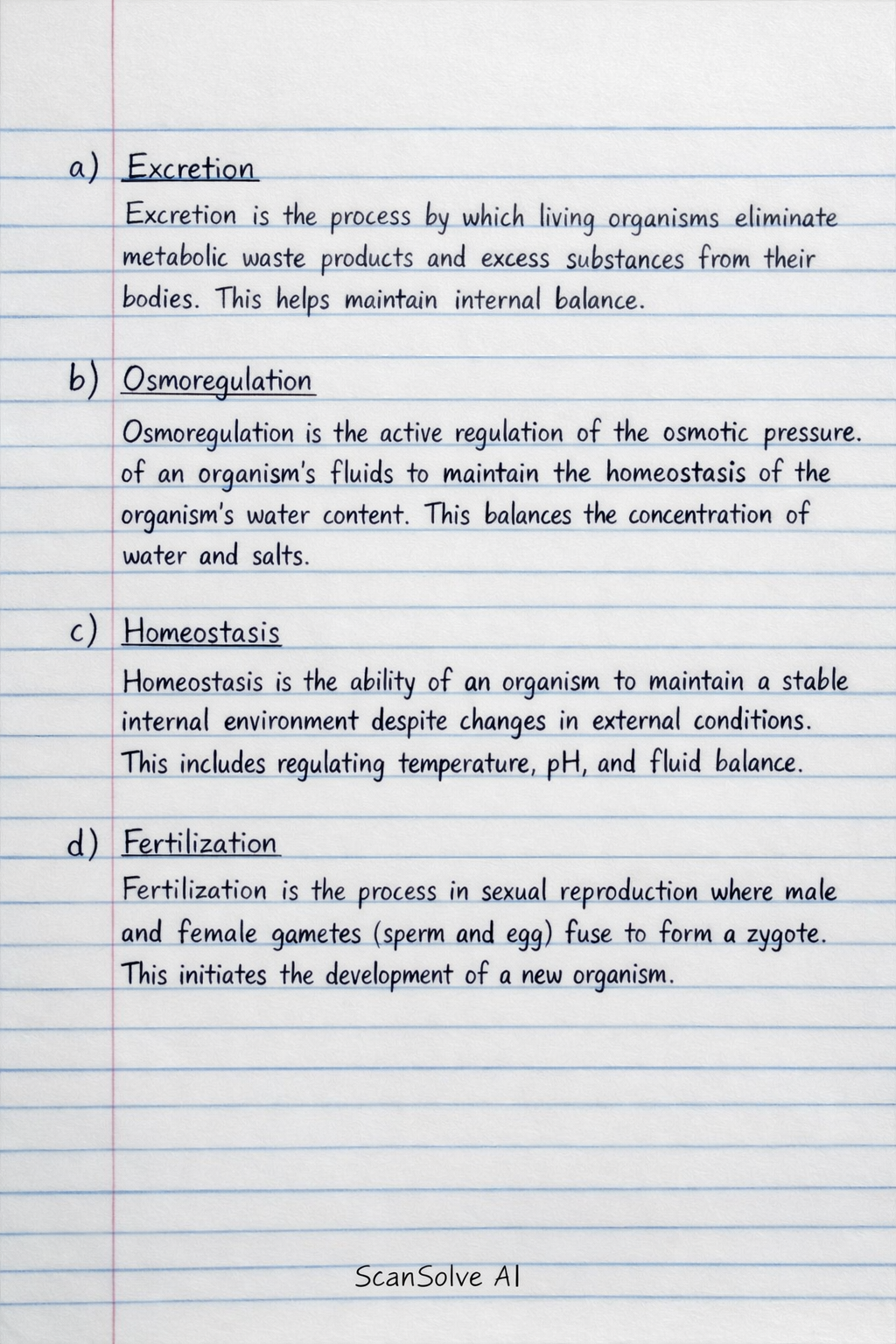
a) Excretion
Excretion is the process by which living organisms eliminate metabolic waste products and excess substances from their bodies. This helps maintain internal balance.
b) Osmoregulation
Osmoregulation is the active regulation of the osmotic pressure of an organism's fluids to maintain the homeostasis of the organism's water content. This balances the concentration of water and salts.
c) Homeostasis
Homeostasis is the ability of an organism to maintain a stable internal environment despite changes in external conditions. This includes regulating temperature, pH, and fluid balance.
d) Fertilization
Fertilization is the process in sexual reproduction where male and female gametes (sperm and egg) fuse to form a zygote. This initiates the development of a new organism.
e) Enzymes
Enzymes are biological catalysts, typically proteins, that speed up the rate of biochemical reactions without being consumed in the process. They are highly specific to their substrates.
f) Ecosystem
An ecosystem is a community of living organisms (biotic components) interacting with their non-living environment (abiotic components) in a specific area. It involves the flow of energy and cycling of nutrients.
g) Photosynthesis
Photosynthesis is the process used by plants, algae, and some bacteria to convert light energy into chemical energy. This involves synthesizing sugars from carbon dioxide and water, releasing oxygen as a byproduct.
h) Active transport
Active transport is the movement of molecules across a cell membrane against their concentration gradient, from a region of lower concentration to a region of higher concentration. This process requires energy, typically from ATP.
i) Respiration
Respiration is the biochemical process by which living organisms release energy from organic molecules (like glucose). This can be aerobic (with oxygen) or anaerobic (without oxygen), producing ATP for cellular activities.
j) Reproduction
Reproduction is the biological process by which new individual organisms, or "offspring," are produced from their parents. It is a fundamental feature of all known life, ensuring the continuation of a species.
k) Copulation
Copulation is the act of sexual intercourse between two individuals, typically involving the insertion of the male's penis into the female's vagina, for the purpose of reproduction.
l) Diffusion
Diffusion is the net movement of particles from an area of higher concentration to an area of lower concentration. This passive process occurs down a concentration gradient and does not require energy.
Still stuck on this one?
Ask a follow-up, and the answer starts from this question.
More Biology Questions
Handwritten Step-by-Step Solution
Get this as a handwritten image on WhatsApp — like a tutor wrote it for you.
Try on WhatsApp