
We read your photo as:
Define the following terms: i) Pathogen, ii) Vector, iii) Immunity. Using malaria as an example, describe: i) The causative organism and how it is transmitted. ii) The main symptoms of the disease in humans. State FIVE measures that can be taken to control the spread of malaria in a community.
ScanSolve AI Answer
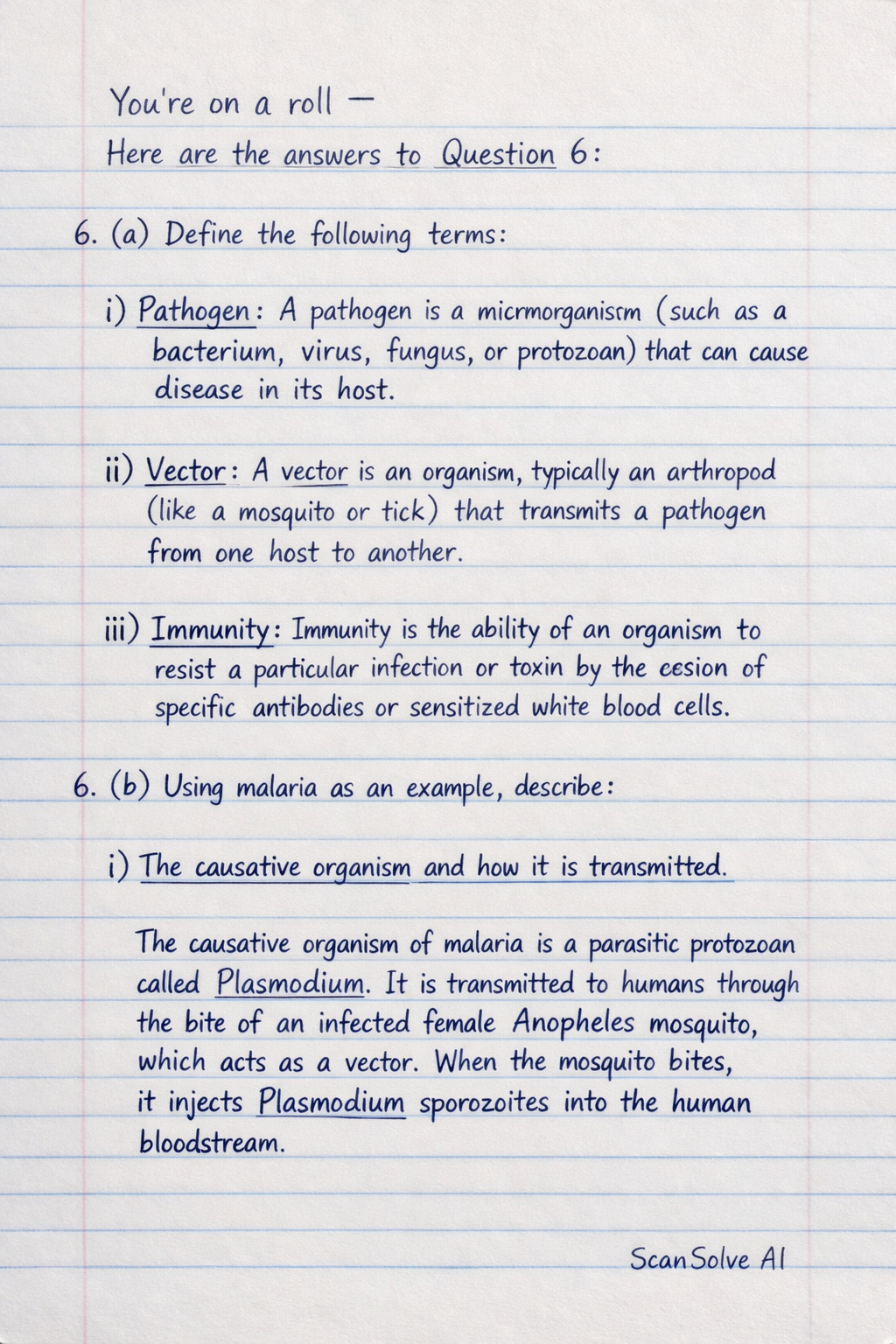
Here are the answers to Question 6:
6. (a) Define the following terms:
i) Pathogen: A pathogen is a microorganism (such as a bacterium, virus, fungus, or protozoan) that can cause disease in its host.
ii) Vector: A vector is an organism, typically an arthropod (like a mosquito or tick), that transmits a pathogen from one host to another.
iii) Immunity: Immunity is the ability of an organism to resist a particular infection or toxin by the action of specific antibodies or sensitized white blood cells.
6. (b) Using malaria as an example, describe:
i) The causative organism and how it is transmitted.
The causative organism of malaria is a parasitic protozoan called Plasmodium. It is transmitted to humans through the bite of an infected female Anopheles mosquito, which acts as a vector. When the mosquito bites, it injects Plasmodium sporozoites into the human bloodstream.
ii) The main symptoms of the disease in humans.
The main symptoms of malaria in humans include recurrent cycles of fever, chills, sweating, headache, muscle aches, fatigue, nausea, and vomiting. In severe cases, it can lead to anemia, jaundice, enlarged spleen, kidney failure, seizures, coma, and even death.
6. (c) State FIVE measures that can be taken to control the spread of malaria in a community.
Here are five measures to control the spread of malaria:
- Use of insecticide-treated mosquito nets (ITNs): Sleeping under ITNs prevents mosquito bites, especially at night when Anopheles mosquitoes are most active.
- Indoor residual spraying (IRS): Spraying the inside walls of homes with long-lasting insecticides kills mosquitoes that land on the surfaces.
- Larval source management: This involves eliminating mosquito breeding sites by draining stagnant water, filling in puddles, or applying larvicides to water bodies where mosquitoes lay eggs.
- Antimalarial drugs: Prophylactic (preventive) antimalarial drugs can be used by travelers to endemic areas, and prompt treatment of infected individuals reduces the parasite reservoir.
- Community education and awareness: Educating the community about malaria transmission, symptoms, and prevention methods encourages participation in control efforts and promotes early diagnosis and treatment.
Still stuck on this one?
Ask a follow-up, and the answer starts from this question.
More Biology Questions
Handwritten Step-by-Step Solution
Get this as a handwritten image on WhatsApp — like a tutor wrote it for you.
Try on WhatsApp