
We read your photo as:
Write briefly on malaria disease and describe its life cycle.
ScanSolve AI Answer
here's the answer to question 13:
-
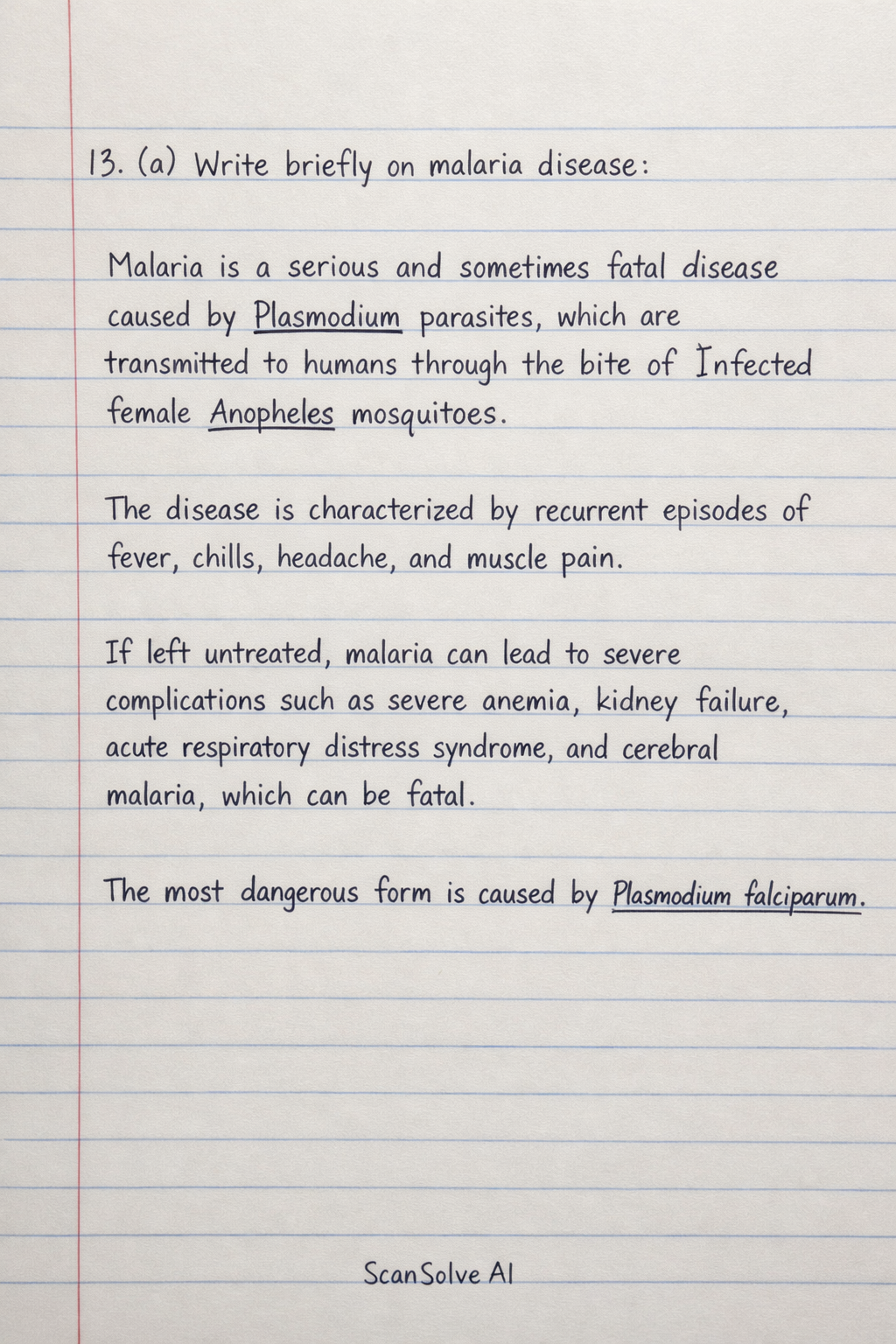
13. (a) Write briefly on malaria disease Malaria is a serious and sometimes fatal disease caused by Plasmodium parasites, which are transmitted to humans through the bite of infected female Anopheles mosquitoes. The disease is characterized by recurrent episodes of fever, chills, headache, and muscle pain. If left untreated, malaria can lead to severe complications such as severe anemia, kidney failure, acute respiratory distress syndrome, and cerebral malaria, which can be fatal. The most dangerous form is caused by Plasmodium falciparum.
-
13. (b) Describe the life cycle of malarial parasite The life cycle of the malarial parasite involves two hosts: humans and Anopheles mosquitoes.
- Human Infection: An infected female Anopheles mosquito bites a human and injects sporozoites into the bloodstream.
- Liver Stage (Exoerythrocytic Cycle): Sporozoites travel to the liver, infect liver cells, and multiply asexually into thousands of merozoites. This stage is asymptomatic.
- Blood Stage (Erythrocytic Cycle): Merozoites are released from the liver cells and invade red blood cells (RBCs). Inside RBCs, they develop into trophozoites and then schizonts, which multiply and rupture the RBCs, releasing more merozoites. This cyclical rupture of RBCs causes the characteristic symptoms of malaria. Some merozoites develop into male and female gametocytes.
- Mosquito Infection: When an uninfected female Anopheles mosquito bites an infected human, it ingests these gametocytes along with the blood meal.
- Mosquito Stage (Sexual Cycle): In the mosquito's gut, gametocytes mature into male and female gametes, which fuse to form a zygote. The zygote develops into an ookinete, which penetrates the gut wall and forms an oocyst.
- Sporozoite Formation: The oocyst grows and ruptures, releasing thousands of sporozoites that migrate to the mosquito's salivary glands, making the mosquito infectious to another human.
Still stuck on this one?
Ask a follow-up, and the answer starts from this question.
More Biology Questions
Handwritten Step-by-Step Solution
Get this as a handwritten image on WhatsApp — like a tutor wrote it for you.
Try on WhatsApp