
We read your photo as:
Describe the transmission and prevention of malaria. Also, explain the role of reducing sugars in germinating seeds and the economic uses of bacteria.
ScanSolve AI Answer
Step-by-step solution
3 stepsa)
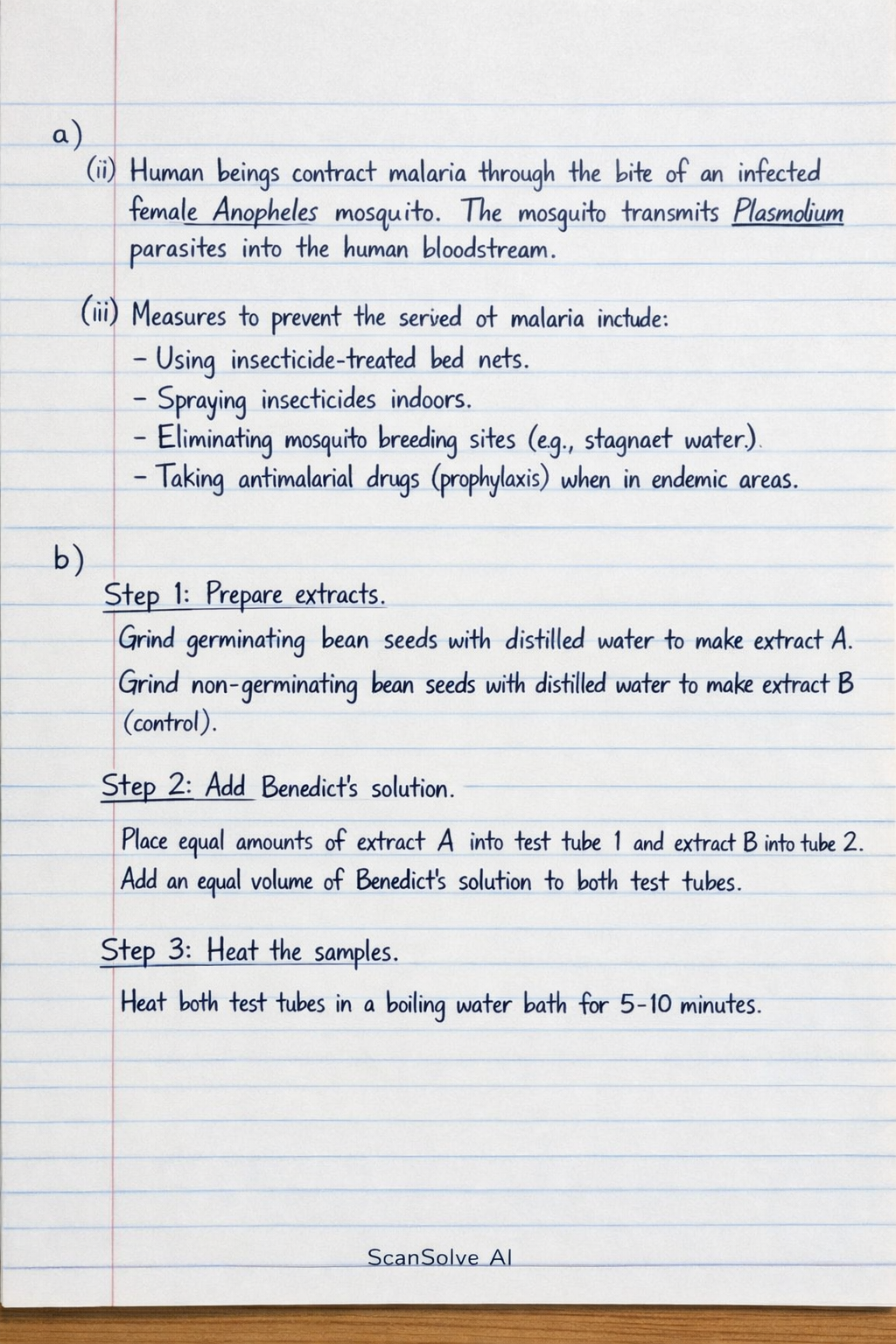
- (i) Human beings contract malaria through the bite of an infected female Anopheles mosquito. The mosquito transmits Plasmodium parasites into the human bloodstream.
- (ii) Measures to prevent the spread of malaria include:
- Using insecticide-treated bed nets.
- Spraying insecticides indoors.
- Eliminating mosquito breeding sites (e.g., stagnant water).
- Taking antimalarial drugs (prophylaxis) when in endemic areas.
b) Step 1: Prepare extracts.
Grind germinating bean seeds with distilled water to make extract A. Grind non-germinating bean seeds with distilled water to make extract B (control).
Add Benedict's solution.
Place equal amounts of extract A into test tube 1 and extract B into test tube 2. Add an equal volume of Benedict's solution to both test tubes.
Heat the samples.
Heat both test tubes in a boiling water bath for 5-10 minutes.
Observe and conclude.
Observation: Test tube 1 (germinating seeds) will show a color change from blue to green, yellow, orange, or brick-red precipitate, indicating the presence of reducing sugars. Test tube 2 (non-germinating seeds) will remain blue, indicating the absence of reducing sugars.
Conclusion: Reducing sugars are formed in germinating bean seeds, demonstrating the breakdown of stored food reserves.c) Bacteria are economically useful in several ways:
- Food Production: Used in the fermentation of foods like yogurt, cheese, and vinegar.
- Medicine: Used to produce antibiotics, vaccines, and insulin through genetic engineering.
- Agriculture: Nitrogen-fixing bacteria (e.g., Rhizobium) enhance soil fertility by converting atmospheric nitrogen into usable forms for plants.
- Bioremediation: Used to clean up environmental pollutants such as oil spills.
- Industrial Applications: Produce various chemicals, enzymes, and vitamins.
a)
- (i) Stimulus: An external or internal change in the environment that is detected by a receptor and causes a response in an organism.
- (ii) Reflex action: An involuntary, rapid, and automatic response to a stimulus that does not involve conscious thought, mediated by a reflex arc.
- (iii) Phototropism: The growth movement of a plant in response to light, typically growing towards a light source.
b) When the skin touches a hot object:
- Thermoreceptors (heat receptors) in the skin are stimulated, generating nerve impulses.
- These impulses travel along sensory neurons to the spinal cord.
- In the spinal cord, the sensory neuron synapses with a relay neuron, which then synapses with a motor neuron.
Still stuck on this one?
Ask a follow-up, and the answer starts from this question.
More Biology Questions
Handwritten Step-by-Step Solution
Get this as a handwritten image on WhatsApp — like a tutor wrote it for you.
Try on WhatsApp